Author: Jitender Shakya

  • Sitemap Structure: How to Strengthen Yours for SEO and AEO

    Sitemap Structure: How to Strengthen Yours for SEO and AEO

    Search engines don’t experience your website the way a visitor does. They rely on signals, and one of the clearest signals you can send is a well-built sitemap. For years, sitemaps sat in the background of most SEO checklists, set up once at launch and rarely touched again. That’s no longer good enough.

    With AI-driven answer engines like ChatGPT, Perplexity, and Google’s AI Overviews now pulling information straight from websites to generate answers, how your site is mapped out carries more weight than it used to. A sitemap built only for Googlebot leaves value on the table.

    If your sitemap has been a checkbox item, this is a good moment to revisit it. A clean, logical sitemap helps crawlers find pages faster, and it gives AI systems a clearer picture of how your content is organized, which feeds directly into what’s now called Answer Engine Optimization, or AEO.

    Here’s what a strong sitemap looks like, why it matters for SEO and AEO alike, and where most sites go wrong.

    What a Sitemap Actually Does

    A sitemap is a file, usually written in XML, that lists the URLs on your site you want search engines to find. Think of it as a table of contents handed to a crawler instead of a human reader.

    A sitemap doesn’t guarantee indexing. It’s an invitation, not a command. What it does is speed up discovery, which matters most for large sites, newer sites without much link history yet, and pages that aren’t well connected internally.

    There’s also the older HTML sitemap, a plain page of links for human visitors. It’s less common now that navigation has improved, but it still helps on large sites where a second route to deep pages is useful.

    Why Sitemap Structure Still Matters for SEO

    Search engines work with a limited crawl budget, meaning they only spend so much time on any one site before moving on. A messy sitemap burns that budget on dead URLs, redirects, or thin pages while your priority content sits under-crawled.

    A well-structured sitemap earns you a few concrete wins:

    • Faster discovery of new or updated pages, especially after a migration
    • Less wasted crawling on outdated or irrelevant URLs
    • Clearer signals about which sections of the site are active
    • Easier troubleshooting, since Search Console reports errors sitemap by sitemap

    None of this replaces solid internal linking. A sitemap supports a well-linked site; it doesn’t fix a poorly linked one.

    Where AEO Changes the Equation

    AEO is the practice of structuring content so AI systems can pull it into direct answers instead of just ranking it among a list of links. Tools like ChatGPT, Perplexity, and Google’s AI Overviews run their own crawlers too, GPTBot, ClaudeBot, PerplexityBot, and Google-Extended among them, alongside the traditional search bots.

    Here’s the part that ties back to sitemaps: these systems still need to find your content before they can use it. A confusing sitemap doesn’t just slow down Google. It can mean your strongest content never gets pulled into an AI-generated answer at all.

    AEO also rewards the same clarity that good sitemap practice already demands. Content organized into clear topic clusters, with a sitemap that mirrors that structure, gives both crawlers and AI systems an easier read on what your site covers and where your real expertise sits. Fixing your sitemap pays off twice.

    Core Principles for a Stronger Sitemap

    Segment it once you scale. Past a few thousand URLs, split your sitemap by content type, one file for posts, one for products, one for images, then link them through a sitemap index file. Problems are easier to spot when each file is manageable.

    Stay inside the size limits. Each sitemap file should hold no more than 50,000 URLs and stay under 50MB uncompressed. Anything past that gets ignored, so check your CMS isn’t quietly generating bloated files.

    Only list indexable pages. Redirected URLs, noindex pages, canonical duplicates, and dead links have no business in your sitemap. Including them sends mixed signals and wastes crawl attention.

    Keep lastmod honest. This tag tells crawlers when a page genuinely changed. If it always shows today’s date regardless of what moved, search engines learn to ignore it.

    Don’t obsess over priority and changefreq. These tags exist in the sitemap spec, but Google has said outright it doesn’t use them for crawling or ranking decisions.

    Submit through the right channels. Once it’s clean, submit your sitemap in Search Console and Bing Webmaster Tools, and reference its location inside robots.txt. That last step matters more than people assume, since it’s often how AI crawlers first find your sitemap.

    Sitemap Habits That Help With AEO Specifically

    • Pair your sitemap with solid schema markup (FAQ, HowTo, Article) so structured data backs up what it already communicates
    • Group content into topic clusters with clear pillar pages, and let your sitemap reflect that hierarchy instead of listing pages at random
    • Keep URLs descriptive and stable. Answer engines, like traditional search, favor URLs that describe the page rather than strings of parameters
    • Watch for orphaned pages. One that exists only in your sitemap and nowhere in your internal linking reads as low priority, and AI crawlers treat it the same way
    • Consider an llms.txt file alongside your sitemap, a newer standard some sites use to give AI systems a plain-language index of key pages, though support still varies

    Nobody, including the platforms themselves, has published a rulebook for how each AI engine weighs sitemap signals. The safest bet is the one that’s always worked for SEO: make your site easy to crawl, easy to understand, and organized around real topics.

    Mistakes That Quietly Hurt Both SEO and AEO

    • Sitemaps still listing pages removed months ago
    • Duplicate sitemaps generated by conflicting plugins, common on WordPress sites running more than one SEO tool
    • Sitemaps mixing content with wildly different update frequencies, like news posts next to static legal pages
    • Broken or redirecting URLs sitting inside the sitemap, unnoticed for months

    Most of these turn up quickly with a crawl using a tool like Screaming Frog, cross-checked against what Search Console is reporting.

    Tools Worth Using

    For most sites, a CMS plugin like Yoast or RankMath generates a reasonably clean sitemap on its own. Larger or custom-built sites often need a dedicated crawler such as Screaming Frog to audit sitemap health, paired with Search Console and Bing Webmaster Tools to see how those sitemaps are actually being read.

    Final Thoughts

    A sitemap won’t single-handedly fix your SEO or AEO performance, but a broken or bloated one will quietly hold both back. Keep it accurate, keep it segmented, and make sure it mirrors how your content is genuinely organized. Do that consistently, and every crawler, whether it’s built for a search engine or an AI assistant, gets the clearest possible path to your best work.

    FAQs

    Do I need a sitemap if my site is small?

    Even small sites benefit, though the urgency is lower. With fewer than 50 pages and solid internal linking, it works more as a safety net than a necessity.

    How often should I update my sitemap?

    Most CMS plugins update it automatically when you publish or edit a page. If you manage one by hand, resubmit after a meaningful batch of new content rather than for every small edit.

    Can a bad sitemap actually hurt my rankings?

    Not directly. It hurts indirectly by wasting crawl budget and delaying discovery of new pages. It won’t get you penalized, but it can slow down how fast good content gets found.

    Is an HTML sitemap still worth having?

    For most sites, not really, since good navigation covers the same ground. Large sites with deep, complex structures, big ecommerce catalogs especially, can still use one as backup navigation.

    Do AI answer engines actually use XML sitemaps?

    Many of their crawlers can use sitemaps to discover URLs, much like traditional search crawlers. How much weight each platform gives that data isn’t fully public, so treat your sitemap with the same care you’d give it for Google.

    Should I include images and videos in my sitemap?

    Yes, if they matter to your content, through dedicated image or video sitemap entries. This helps most on sites that depend on visual content, like recipe blogs or tutorials.

    What’s the difference between a sitemap and robots.txt?

    A sitemap tells search engines what to crawl. Robots.txt tells them what to skip. They work together but serve opposite jobs, and robots.txt should always point to where your sitemap lives.

    How do I know if my sitemap has errors?

    Check the Sitemaps report inside Search Console. It flags blocked pages, dead links, or redirect chains directly, and it’s the fastest way to catch a problem before it affects indexing.
  • How to Structure Content for RAG & Vector Chunking

    How to Structure Content for RAG & Vector Chunking

    AI search engines no longer evaluate web pages as continuous, uninterrupted documents. When systems like ChatGPT Search, Perplexity, or Gemini process your site, they do so through Retrieval-Augmented Generation (RAG). Before an answer engine can cite your insight, it splits your page into bite-sized mathematical blocks called vector chunks.

    If your technical architecture breaks down during this process, your brand loses citation visibility. This guide covers how to architect your text so vector databases process your insights cleanly without losing critical context.

    What Is Vector Chunking in RAG and How Does It Work?

    Traditional search engines index pages by mapping keywords to documents. RAG systems work differently. They convert chunks of text into dense mathematical arrays called vector embeddings, which capture the underlying semantic meaning of a passage.

    When a user submits a complex query, the search engine does not retrieve your entire page. It searches a vector database for specific chunks that closely match the mathematical signature of the prompt.

    Most production retrieval systems divide web content into window sizes ranging between 256 and 1024 tokens (roughly 180 to 750 words). If an important point spans across the boundary between two chunks, or relies on context established three paragraphs earlier, the retrieval algorithm misses the connection. This issue, known as context fragmentation, is the single most common reason high-quality content fails to appear in generative search responses.

    How to Structure Content for Better RAG Retrieval

    Designing for retrieval engines does not require sacrificing readability for human site visitors. It simply requires a higher standard of clarity and logical containment.

    Use Self-Contained Content Blocks for Better Vector Retrieval

    Every section under a subheader should function as an independent, self-contained unit of information. A vector retriever fetching a single paragraph must find a complete idea inside that specific block.

    Avoid starting sections with transitional phrases that rely on earlier context, such as “As mentioned above” or “Building on this concept.” Instead, restate the core subject directly.

    Write Keyword-Rich Headings That AI Search Engines Understand

    Retrieval algorithms assign higher semantic weight to structural headers (H2, H3 tags). Vague or stylized headings destroy vector clarity.

    For example, a heading titled “The Modern Solution” offers weak semantic value to an embedding model. Changing that heading to “How Schema Markup Improves RAG Extraction” immediately attaches concrete entities to the text that follows.

    Place Direct Answers at the Beginning of Every Section

    Place your direct definition, metric, or resolution within the first two sentences under any header. RAG pipelines favor dense, authoritative statements at the start of a chunk before processing secondary examples or supporting commentary.

    How Explicit Entity Names Improve AI Retrieval Accuracy

    The primary failure point in content vectorization is ambiguous language. Humans naturally track pronouns across long passages, but vector algorithms evaluate chunks in relative isolation.

    Consider this passage:

    “It improves crawling efficiency by limiting unnecessary server requests. This ensures that its database stays updated with fresh information.”

    When isolated into a single chunk, a retrieval model cannot determine what “It” or “its” refers to. The passage becomes useless for answering user queries.

    To fix this, maintain entity clarity throughout every section:

    “The llms.txt protocol improves crawling efficiency by limiting unnecessary server requests. This ensures that the search index stays updated with fresh information.”

    By explicitly naming your subject in every block, you preserve semantic clarity regardless of how the database slices your content. This simple practice also strengthens your Generative Engine Optimization (GEO) strategy, making your content easier for AI search engines to retrieve and cite. 

    Best Content Formatting Practices for Vector Databases

    Visual formatting directly impacts how clean a text chunk remains after passing through an HTML parser.

    Why HTML Tables Perform Better Than Nested Lists in RAG

    Complex, deeply nested bullet points often break across chunk boundaries, separating sub-items from their parent category. When presenting comparisons, technical specs, or multi-variable data, standard HTML tables perform far better. Modern chunking parsers convert HTML table rows into key-value pairs, keeping relationships intact.

    Ideal Paragraph Length for Vector Chunking and AI Search

    Keep paragraph lengths consistent, ideally between 80 and 150 words. Paragraphs that are too short create sparse vector embeddings with weak semantic signals. Paragraphs that are too long risk getting chopped mid-sentence by token-limit rules, which damages semantic accuracy.

    Understanding how retrieval engines handle these structural choices is crucial for long-term organic growth. 

    Technical SEO Best Practices for RAG and Vector Search

    Beyond writing style, you can use technical markup to signal clear structural boundaries to automated parsers.

    Use Semantic HTML to Improve AI Content Extraction

    Wrap major content sections in standard <section> or <article> tags, and assign unique, descriptive id attributes to every heading tag. Many modern AI crawlers use anchor ids to preserve chunk location and anchor links within their internal citation graphs.

    How Schema Markup Helps AI Search Engines Understand Content

    Pairs of Schema markup (such as TechArticle, FAQPage, or HowTo) act as a secondary map for retrieval pipelines. Schema provides explicit key-value facts that validate the unstructured text on the page, preventing hallucinations when an LLM synthesizes your content into an answer.

    Proper technical implementation prevents common pitfalls where AI crawlers overlook your primary assets. Failing to fix underlying technical SEO issues that kill AI visibility often causes retrieval engines to overlook your primary assets, regardless of content quality. 

    RAG Content Optimization Checklist for AI Search Visibility

    Before publishing new editorial content or technical documentation, run your draft through this final structural review:

    1. Entity Name Check: Does every paragraph identify the main topic or brand name without relying on pronouns?
    2. Heading Independence: Does every H2 and H3 contain explicit descriptive keywords that explain the exact topic of the section?
    3. Data Integrity: Are key comparisons, numerical data, and spec sheets formatted in clean tables rather than nested lists?
    4. First-Sentence Density: Does the opening sentence of each section provide a direct, complete answer to the section header?
    5. Structural Markup: Are major sub-sections demarcated with semantic HTML tags and clean id attributes?

    Structuring content for vector chunking is not about writing for machines at the expense of people. It is about applying rigor, clarity, and precision to your web content so both human readers and retrieval engines can extract maximum value from your technical expertise.

    Conclusion

    Structuring content for vector chunking is the new baseline for organic visibility in an AI-driven search ecosystem. By shifting from long-winded, interconnected prose to modular, entity-dense sections, you ensure that retrieval pipelines can extract, index, and cite your expertise accurately.

    Publishing authoritative insights is only half the battle. Making those insights mathematically clear to vector databases is what turns your website into a primary source for generative search engines.

    Frequently Asked Questions (FAQs)

    What is vector chunking in simple terms?

    Vector chunking is the process where an AI search engine breaks a long web page into smaller blocks of text, converts them into mathematical values, and stores them so it can quickly retrieve exact answers to user queries.

    What is the ideal word count for a content chunk?

    Most RAG systems process chunks between 100 and 300 words (roughly 256 to 512 tokens). Aim to keep your core paragraphs and sub-sections within this range.

    Will structuring content for RAG harm my traditional Google SEO?

    No. Clear headings, self-contained paragraphs, explicit entity names, and clean HTML tables actually improve readability and user experience, which helps traditional search rankings as well.

    What is the biggest mistake websites make with RAG optimization?

    The most common error is relying heavily on ambiguous pronouns (like “it,” “they,” or “this”) across long passages. When a section is isolated into a chunk, the AI loses track of what the pronoun refers to.

    How do search engines choose which chunk to cite?

    An AI search engine converts a user query into a vector, compares it against stored content chunks, and retrieves the chunks with the highest mathematical similarity score to synthesize an answer.

    Do HTML tables work better than bullet lists for vector search?

    Yes. Parsers read HTML tables as clean key-value pairs, which keeps relationships intact. Deeply nested bullet lists often get broken apart during chunking, separating sub-points from their main category.

    What is the “Atomic Unit Principle” in writing?

    It is a strategy where every section under a subheading functions as an independent, standalone piece of information that makes complete sense even if read without the surrounding article.

    Can schema markup help with vector chunking?

    Yes. Structured data like FAQPage or TechArticle provides explicit key-value facts that validate your page content, making it easier for AI models to confirm facts without hallucinating.

    What is the difference between keyword indexing and vector search?

    Keyword indexing matches exact words or synonyms on a page. Vector search calculates the underlying meaning and intent of text, allowing AI engines to retrieve relevant content even if the exact keywords are not used.

    How often should I include my primary entity or brand name in a section?

    Include your explicit entity or product name at least once near the beginning of every major section or paragraph, rather than substituting it with generic terms like “our service” or “this tool.”

  • Keyword Research for AEO: A Guide for Winning Answer Engine Traffic in 2026

    Keyword Research for AEO: A Guide for Winning Answer Engine Traffic in 2026

    Search has changed. In 2026, a large share of your audience no longer clicks through ten blue links. They ask a question to ChatGPT, Google’s AI Overviews, Perplexity, Claude, or a voice assistant and they get one answer.

    That single shift changes everything about how we do keyword research.

    If traditional SEO was about ranking on a results page, Answer Engine Optimization (AEO) is about becoming the answer itself. And just like SEO, it all starts with research. But keyword research for AEO looks very different from the keyword research most of us learned five or ten years ago.

    After six years of working hands-on with search optimization and the last few watching answer engines reshape traffic patterns, I can tell you this: the websites winning AI-driven traffic today aren’t the ones with the biggest backlink profiles. They’re the ones that understood what questions people actually ask and answered them better than anyone else.

    This guide walks you through exactly how to do that, step by step, in plain language. Whether you’re a business owner, a content writer, or an experienced SEO professional, you’ll leave with a repeatable process you can start using today.

    What Is AEO, and How Is It Different From SEO?

    Answer Engine Optimization (AEO) is the practice of structuring and writing your content so that AI-powered answer engines like Google AI Overviews, ChatGPT, Perplexity, Bing Copilot, and voice assistants can find it, trust it, and cite it when answering user questions.

    Here’s the simplest way to understand the difference:

    AspectTraditional SEOAEO
    GoalRank in top 10 resultsBe the cited answer
    Target queryShort keywords (“best CRM”)Full questions (“what is the best CRM for a small real estate team?”)
    Success metricClicks and rankingsCitations, mentions, and answer visibility
    Content styleComprehensive pagesDirect, extractable answers
    Who reads it firstHumans scanning a pageAI models parsing your content

    The important thing to understand: AEO doesn’t replace SEO it builds on it. Answer engines still rely heavily on well-structured, authoritative, crawlable content. But the keywords you target and the format you write in must adapt.

    Why Keyword Research for AEO Matters More Than Ever in 2026

    Three trends make AEO keyword research essential right now:

    1. Zero-click answers are the default. When an answer engine responds directly, users often never visit a website. The only brands that benefit are the ones cited inside the answer. If your content isn’t built around the actual question, you’re invisible.

    2. Queries are longer and more conversational. People type “running shoes” into Google, but they ask an AI, “What are the best running shoes for flat feet if I run 20 km a week on pavement?” That’s a completely different keyword target richer, more specific, and full of intent signals.

    3. The winners take almost everything. An answer engine typically cites two to five sources. There is no “page one, position eight” consolation prize. Precise keyword research is how you pick battles you can actually win.

    How Answer Engines Choose What to Cite

    Before researching keywords, it helps to know what you’re optimizing for. While every engine works a little differently, they share common patterns:

    • They match questions to direct answers. Content that states the question and immediately answers it in one to three sentences is easiest to extract.
    • They favor strucsctured content. Clear headings, lists, tables, and FAQ sections make your page machine-readable.
    • They reward topical authority. A site with 15 interconnected articles on one subject beats a site with one article on 15 subjects.
    • They check for freshness and accuracy. Dated statistics and stale advice get skipped, especially for fast-moving topics.
    • They pull from trusted third-party sources too. Reddit threads, review sites, and industry publications feed AI answers which means your keyword strategy should extend beyond your own website.

    Keep these five factors in mind. Every step below feeds into at least one of them.

    Step-by-Step: Keyword Research for AEO in 2026

    Here is the exact process, broken into six practical steps.

    Step 1: Start With Questions, Not Keywords

    In AEO, your fundamental unit of research is the question, not the keyword. Begin by collecting every real question your audience asks:

    • Mine “People Also Ask” boxes on Google for your core topics. Each PAA entry is a proven, high-demand question.
    • Use question-focused tools like AlsoAsked and AnswerThePublic to map how questions branch into follow-up questions.
    • Ask the answer engines themselves. Type your topic into ChatGPT or Perplexity and note the follow-up questions they suggest. These reflect real conversational patterns.
    • Check community platforms. Reddit, Quora, and niche forums show you the messy, unfiltered way real people phrase their problems often very different from polished search queries.
    • Listen to your own audience. Sales emails, support tickets, and webinar Q&As are goldmines of question keywords no tool will ever show you.

    By the end of this step, you should have a raw list of 50–200 questions for your topic area.

    Step 2: Group Questions Into Intent Clusters

    Answer engines think in topics, not isolated pages. So should you.

    Take your raw question list and group it into clusters sets of questions that a single, well-structured page (or a small hub of pages) could answer. For example, for a project management tool:

    • Cluster A Definitions: “What is agile project management?” / “What does sprint mean?”
    • Cluster B Comparisons: “Asana vs Trello for small teams?” / “Which PM tool is best for freelancers?”
    • Cluster C How-to: “How do I set up a kanban board?” / “How to run a sprint retrospective?”
    • Cluster D Pricing/decision: “How much does project management software cost?”

    Each cluster becomes either one comprehensive page or a pillar page with supporting articles. This structure is what builds the topical authority answer engines look for.

    Step 3: Qualify Each Question With Three Filters

    Not every question deserves content. Run each cluster through three filters:

    1. Answerability: Can you give a genuinely better, more specific, or more experienced answer than what already exists? If the current AI answer is already excellent and generic, your odds are low.
    2. Business relevance: Does this question sit somewhere on your customer’s journey? A citation that never touches a buyer is a vanity win.
    3. Winnability: Check who’s currently cited. If the sources are government sites and major publications for a medical query, pick a different battle. If they’re thin listicles or outdated posts from 2023, that’s your opening.

    A useful habit in 2026: for every priority question, actually ask ChatGPT, Perplexity, and Google’s AI mode and record which sources get cited. This is your real competitive landscape often quite different from the classic organic top 10.

    Step 4: Capture Long-Tail and Conversational Variations

    Conversational queries are long, specific, and layered. One core question spawns dozens of variations:

    • Core: “How do I train a puppy?”
    • Variations: “How do I train an 8-week-old labrador not to bite?” / “How long does puppy toilet training take in an apartment?”

    You don’t need a separate page for each variation. Instead, make sure your main page naturally includes the specific entities ages, breeds, situations, budgets, locations that appear in these variations. Answer engines match on meaning, so covering the specifics inside one authoritative page lets it serve many phrasings at once.

    Modifiers worth deliberately including in 2026: “best… for [specific situation],” “vs,” “is it worth it,” “how long,” “how much,” “for beginners,” and “in 2026.”

    Step 5: Map Each Question to an Answer-First Content Format

    Keyword research for AEO isn’t finished until each question has a planned format. Match the question type to the structure engines extract most easily:

    • “What is…” questions → a 40–60 word definition directly under the heading, then depth below.
    • “How to…” questions → numbered steps with one clear action per step.
    • “Best / vs” questions → comparison tables with honest pros and cons.
    • “How much / how long” questions → a specific figure or range stated in the first sentence, then context.
    • Multi-part questions → an FAQ section with concise standalone answers (ideally supported by FAQ schema markup).

    The golden rule: answer first, elaborate second. Put the direct answer in the first two sentences under the relevant heading. Humans skim happily past it; machines extract it.

    Step 6: Track Answer Visibility, Not Just Rankings

    Traditional rank tracking misses most of the AEO picture. In 2026, your measurement stack should include:

    • Citation checks: Regularly query your priority questions in the major answer engines and log whether and where you’re cited.
    • AI referral traffic: Watch analytics for referrals from chatgpt.com, perplexity.ai, and similar sources, plus branded search lift.
    • AI visibility tools: Dedicated platforms now track brand mentions across answer engines at scale; adopt one once your program matures.
    • Refresh cycles: Answer engines love freshness. Revisit priority pages quarterly, update statistics, and adjust for new question variations you discover.

    Common AEO Keyword Research Mistakes to Avoid

    Even experienced SEOs stumble on these:

    1. Chasing search volume alone. Many high-value conversational questions show “0 volume” in classic tools because they’re long and unique. Zero recorded volume does not mean zero demand it often means untapped opportunity.
    2. Writing for machines only. Robotic, over-optimized answer blocks turn off human readers and answer engines increasingly detect and downrank low-quality, unhelpful text. Write for people first, structure for machines second.
    3. Ignoring off-site signals. If AI engines cite Reddit and review sites in your niche, your “keyword strategy” must include earning presence there too.
    4. One-and-done publishing. An answer that was perfect in January can be stale by June. AEO is a maintenance discipline, not a launch event.
    5. Skipping schema markup. FAQ, HowTo, and Article structured data remain low-effort, high-clarity signals that help machines understand exactly what question each block answers.

    Final Thoughts: Start Small, Answer Well

    Winning answer engine traffic in 2026 doesn’t require a massive budget. It requires a shift in mindset: from chasing keywords to collecting questions, from ranking pages to earning citations, and from writing more to answering better.

    Start with one topic cluster this week. Gather 30 real questions, group them, pick the five you can answer better than anyone, and publish answer-first content with clean structure and honest expertise. Then check the answer engines in a month and see your name in the sources.

    The brands that treat every piece of content as a direct answer to a real human question won’t just survive the shift to answer engines they’ll own it.

    Frequently Asked Questions

    What is keyword research for AEO?

    Keyword research for AEO is the process of identifying the real questions your audience asks AI-powered answer engines, grouping them into topic clusters, and planning content that provides direct, extractable answers those engines can cite.

    Is AEO replacing SEO in 2026?

    No. AEO extends SEO. Answer engines still depend on crawlable, authoritative, well-structured content the foundations of SEO. What changes is the target (questions instead of short keywords) and the format (direct answers instead of long intros).

    Which tools help with AEO keyword research?

    A practical 2026 stack combines question-mining tools (AlsoAsked, AnswerThePublic), classic SEO suites (Ahrefs, Semrush) for question filters and PAA data, the answer engines themselves for competitive checks, and an AI visibility tracker for measuring citations.

    How long does it take to see AEO results?

    For low-competition question clusters, citations can appear within weeks of publishing well-structured answers. Competitive topics typically take three to six months of consistent publishing and refreshing to build the topical authority engines reward.

    Do zero-volume keywords matter in AEO?

    Yes enormously. Conversational queries are so varied that traditional tools can’t measure most of them. If a question appears repeatedly in communities, support tickets, or AI follow-up suggestions, it has real demand regardless of reported volume.

  • How AI Is Reshaping Social Media Marketing

    How AI Is Reshaping Social Media Marketing

    There is a lot of noise about AI in marketing right now. Every tool claims to be intelligent, every webinar promises a revolution, and most social media managers are left wondering what is real and what is a sales pitch.

    So instead of theory, let’s look at behavior. When over 1,100 social media marketers were surveyed about how they actually use AI day to day, a clear picture emerged. The teams getting results are not automating everything. They are being selective about where AI helps and where it hurts. One number sums up the payoff: 72% of marketers said their AI-assisted social content performs better than what they produce without it.

    Here is what those teams are doing, what they are avoiding, and where all of this is likely headed.

    The Content Shift Nobody Predicted: Video First, Captions Second

    Most people assumed marketers would use generative AI mainly for writing. The survey flipped that assumption. Short-form video is the number one content type marketers create with AI at 55%, ahead of images at 53% and text posts at 45%.

    Why does this matter? Because video was always the expensive format. Scripting, shooting, editing, and repurposing a single Reel used to eat an entire workday. Now a lean team can script with AI, cut long recordings into clips automatically, and publish video at a pace that only agencies could sustain a few years ago.

    The competitive implication is simple. If video volume is no longer a budget problem, the brands that win will be the ones with the sharpest ideas, not the biggest production teams.

    Distribution Is Changing Too: Your Content Now Has Two Audiences

    Here is something most social media guides skip entirely. Your posts are no longer read only by humans scrolling a feed. AI systems increasingly summarize, cite, and recommend brand content when people ask chatbots and answer engines for suggestions.

    That means the same post is performing two jobs at once: engaging your followers and signaling to AI systems what your brand is about. Marketers who understand what AI visibility is and why it matters for a brand are already adjusting how they write, structure, and publish social content so it works for both audiences.

    This also explains a pattern many brands find frustrating: strong social presence, yet AI assistants rarely mention them. The mechanics behind how LLMs decide which brands to mention are worth understanding before you pour more budget into content that machines cannot interpret.

    Listening and Research: From Scrolling to Signal Detection

    Manual social listening is effectively dead. There are simply too many conversations. AI-powered listening tools now do the heavy lifting by sorting mentions according to topic, emotion, and urgency, then flagging only what deserves human attention.

    Two use cases stood out in the survey responses:

    Early warning. A sudden spike in negative mentions gets flagged within minutes, giving teams a head start before a small complaint snowballs into a public problem.

    Better audience models. Instead of static personas built on age and location, AI groups audiences by behavior: what they engage with, how they buy, and which messaging they respond to. Personalization built on these clusters is one reason 93% of marketers now say personalization directly improves leads or purchases, according to HubSpot’s 2026 State of Marketing research.

    Analytics: The First Draft Rule

    AI analytics tools have moved past reporting numbers. They now explain them. Feed your post data into an AI assistant and ask which topics, formats, and hooks drive engagement, and you get in minutes what used to take an afternoon of spreadsheet work.

    But experienced marketers apply one discipline consistently, and it is worth stealing: treat AI analysis as a first draft, never a verdict. Verify the numbers before building strategy on them, and definitely before presenting them upstairs. AI finds patterns quickly. Occasionally it finds patterns that do not exist.

    Paid Social: AI Moves From Bidding to Creative

    Ad platforms have run AI-powered bidding for years, so that part is old news. The 2026 shift is on the creative side. Teams now generate dozens of visual variations, test copy at scale, and predict which combination of headline, image, and call to action will convert before spending a rupee on the campaign.

    Google is pushing hardest in this direction, and if paid is part of your mix, it is worth reading how AI-driven Performance Max campaigns are reshaping Google advertising, because the same logic is spreading to Meta and LinkedIn ad products fast.

    Five Predictions for the Next Two Years

    Based on where the survey data points, here is what to prepare for:

    1. Editing beats drafting as the core skill. Anyone can generate a post. The marketers who stand out will be the ones who brief AI precisely and then sharpen the output with genuine perspective.
    2. Sameness becomes the biggest risk. As feeds fill with AI-generated content, posts with a real opinion, a specific story, or a distinct voice will earn attention precisely because they are harder to fake.
    3. AI answer engines become a distribution channel. Brands will optimize social and web content for citation by chatbots the same way they once optimized for Google rankings.
    4. Human sign-off becomes company policy. Expect formal rules about what AI may publish unattended, especially around health, finance, and crisis communication.
    5. Data transparency turns into law. Disclosing how audience data feeds AI systems is shifting from best practice to regulatory requirement across more markets.

    A Sensible Way to Start

    If your team is early in this journey, skip the temptation to automate everything at once. The pattern among successful teams looks like this:

    • Pick one specific goal, such as growing LinkedIn engagement, and choose tools that serve that goal only.
    • Run one small experiment, measure it honestly, and expand only what works.
    • Write detailed prompts. Context, audience, channel, and tone. Vague prompts produce the generic content audiences have learned to scroll past.
    • Keep a human between AI and the publish button. Every claim and statistic gets checked.
    • Audit outputs for bias and accuracy on a schedule, not just once.

    Conclusion

    AI has not replaced social media marketers, and the survey data suggests it will not. What it has done is remove the volume problem. Production, monitoring, and analysis now happen at machine speed, which means the human hours saved should go where machines still fall short: judgment, taste, and real connection with an audience.

    The brands that get that balance right will not just perform better on social feeds. They will also be the ones AI systems learn to recognize, cite, and recommend.

  • LLM Seeding: A New SEO Strategy to Get Mentioned by LLMs

    LLM Seeding: A New SEO Strategy to Get Mentioned by LLMs

    Traditional search engine optimization focuses heavily on ranking for specific keywords on a search results page. You optimize the website for ranking purposes and get traffic from search engines. 

    But now search behavior is changing. More people are now getting information directly from AI chat interfaces and conversational search tools.

    When someone asks an AI for a product recommendation, software comparison, or strategic advice, it generates a combined answer based on available information. If your brand is not included in that response, you miss out on both visibility and potential user attention.

    Getting cited by AI systems requires a shift in how we approach content distribution and how LLMs identify your brand. It is no longer only about optimizing for search engine crawlers, but also about shaping the information ecosystems that large language models rely on.

    As the LLMs brand mentions increase it can help to increase your overall AI visibility.

    What is LLM Seeding? 

    LLM Seeding is the intentional process of distributing a brand’s core messaging, facts, and entity data across the specific digital channels that large language models use for training, fine-tuning, and real-time retrieval.

    Instead of waiting for an AI model to accidentally find your website, you proactively plant “seeds” of consistent information across the web. The goal is to make your brand the most authoritative, logical, and readily available answer when an LLM synthesizes a response for a user query.

    Think of it as public relations for AI. You are ensuring that the data sources these models rely on are deeply familiar with who you are, what you do, and why you are an authority in your niche.

    How LLMs Pick Up Brand Information

    To influence what an AI says about your business, you need to understand how it acquires knowledge in the first place. LLMs generally pull brand data from three primary mechanisms.

    Training Data Sources

    During their initial training phases, models ingest massive datasets consisting of books, research papers, scraped web text, and public forums. If your brand is highly visible and frequently discussed across the web during the model’s training window, that knowledge becomes baked into its core weights.

    Retrieval-Augmented Generation (RAG)

    Most modern AI chat systems do not rely only on what they were trained on. Many now use retrieval-augmented generation (RAG) to fetch fresh information from the live web. When someone asks a question, they can pull in real-time data, combine it with their existing knowledge, and then generate an answer. If your content is easy to find, properly indexed, and well-structured, it becomes more likely to be retrieved and used in those responses.

    External Knowledge Graphs and Directories

    AI engines lean heavily on trusted, highly structured data sources to verify facts. Platforms like Wikidata, Wikipedia, major industry directories, and official review aggregates act as anchor points. Knowledge graphs can help your brand to increase and establish AI visibility.

    How LLM Seeding Works in Real Terms

    LLM Seeding is not about manipulating algorithms through hidden text or keyword stuffing; it is a strategic practice focused on creating a consistent and credible digital footprint.

    Brand Mentions Across the Web

    LLM builds confidence in a brand when it sees that brand mentioned across multiple independent sources. If twenty different industry blogs, news sites, and forums all mention your software as a top solution for mid-market compliance, the LLM develops a strong statistical association between your brand name and that specific use case.

    Content Consistency

    If your website describes your product as a “data analytics tool,” your LinkedIn profile positions it as a “business intelligence suite,” and your press releases refer to it as a “predictive forecasting engine,” you create conflicting signals for language models. LLM Seeding requires consistency in how you describe your business, products, features, and target audience across every digital touchpoint.

    This means clearly defining your brand identity and communicating the same core message wherever your brand appears, whether on your website, social media profiles, company listings, press releases, review platforms, or other online sources.

    Entity Reinforcement

    In the eyes of an AI, your business is an “entity” connected to other entities (like your founders, your industry, your competitors, and your location). Seeding means explicitly clarifying these relationships. For example, ensuring your company is consistently linked to its specific industry category makes it easier for an LLM to categorize your brand correctly.

    Topical Associations with the brand

    To get brand mentions in AI answers, your brand must be inextricably linked to the topics you want to own. This means producing comprehensive, authoritative content on those subjects so that the LLM’s vector space maps your brand name closely to those specific concepts.

    Third Party Citations

    A major challenge in AI visibility is the “citation gap,” where a brand ranks well in standard search but gets ignored by AI bots. When looking for evidence, conversational engines often bypass a brand’s website in favor of third-party citations like industry directories, forum threads, or media publications. They do this because they are programmed to seek out unbiased, multi-source agreement free from marketing bias.

    LLM Seeding Strategy Framework

    To implement this strategy successfully, you need a structured framework that targets both the AI’s training memory and its real-time search capabilities. The LLM Seeding Framework is built around three core pillars: Entity Alignment, Content Clusters, and Digital Footprint.

    Entity Alignment focuses on maintaining consistency in structured data such as schema markup and ensuring uniform messaging across all brand profiles. Content Clusters emphasize creating well-organized, in-depth content with clear answer formats that reinforce topic authority. Digital Footprint involves expanding and strengthening your presence through PR and media coverage, as well as industry reviews that reinforce credibility across external sources.

    1. Creating a Consistent Brand Identity

    Start by auditing every public-facing profile your company owns. Your Crunchbase, LinkedIn, G2, Wikipedia (if applicable), and About Us pages should use identical core language to define your company. This establishes a clean, undeniable baseline for the AI to ingest.

    2. Publishing Supporting Content Clusters

    Build deep, interconnected clusters of content around your core expertise. If you want to be known for “remote team onboarding,” create a pillar page on that topic and support it with dozens of detailed sub-articles. This heavy concentration of semantic relevance makes your site a primary target for RAG-based AI searches.

    3. Securing Third-Party Mentions

    AI models trust what others say about you more than what you say about yourself. Prioritize digital PR, guest contributions on authoritative industry sites, and podcast appearances. When external authors mention your brand name alongside relevant keywords, it strengthens your AI search visibility.

    4. Writing Answer-Style Content

    Modify your content formatting to match how people ask questions in AI interfaces. Use clear, direct question headings (H2 or H3) followed immediately by a concise, one-to-two-sentence answer. This structure is highly scannable for retrieval bots looking to pull direct quotes for users.

    5. Deploying Advanced Structured Data

    Use Organization, Product, Article, and SameAs schema markup on your website. The SameAs attribute is particularly powerful for LLM Seeding, as it explicitly tells search crawlers: “This website belongs to the same company represented by this official LinkedIn page and this Wikidata entry.

    LLM Seeding vs. SEO vs. GEO

    While these strategies share the broad goal of increasing digital visibility, they approach the problem differently.

    StrategyPrimary GoalCore TacticSuccess Metric
    Traditional SEORank higher in traditional search engines.Keyword optimization, backlink building, technical site health.Organic search rankings, clicks, impressions.
    GEO (Generative Engine Optimization)Optimize specific web pages to be cited by AI engines.Structuring content for RAG bots, adding citations, formatting for summaries.Citation inclusion rate in AI search responses.
    LLM SeedingEmbed a brand into the foundational knowledge and memory of AI models.Multi-platform content distribution, entity alignment, third-party footprint expansion.Broad brand mentions across conversational AI tools over time.

    Traditional SEO optimizes your own website for a search engine. GEO optimizes your pages so an AI engine can easily extract data during a real-time web search. LLM Seeding works one layer deeper: it ensures that regardless of whether the AI does a real-time search or relies on its internal training data, your brand is already a recognized authority in its network of knowledge.

    Step-by-Step Implementation Guide

    Step 1: Define Your Brand Entity for LLMs

    Write down a clear, two-sentence definition of your company. It should state exactly what you are, who you serve, and your primary differentiator.

    • Example: “Polyvalent AI visibility tool  that helps companies understand how they appear across AI systems like ChatGPT, Claude, and Gemini. It tracks brand mentions, analyzes positioning, and improves how consistently a brand is represented in AI-generated responses.

    Step 2: Create Seed Content Pages

    Identify the top five foundational concepts you want your brand associated with. Write exhaustive, data-rich guides on these topics on your own site. Include original research, proprietary data, and unique frameworks. Original data is highly attractive to LLMs looking for authoritative reference material. This can also include PR for your brand.

    Step 3: Build External Mentions

    Reach out to industry publications, review platforms, and forums (like Reddit and Quora) where your target audience discusses industry problems. Participate in or facilitate discussions where your brand name is mentioned naturally alongside your core topics.

    Step 4: Strengthen Internal Linking and Schema

    Connect your seed content pages using clear, descriptive, and relevant anchor text. Implement detailed schema markup across your entire website to define your team members, products, and parent organization. Schema is important for technical compliance and overall site structure, and it also helps LLMs better understand your brand. 

    Step 5: Track Your AI Visibility

    Regularly check how your brand appears in major AI tools like ChatGPT, Claude, Gemini, and Perplexity by using general, non-branded questions related to your industry.

    For example, you can ask: “What are the best software tools for mid-sized e-commerce inventory management?”

    Pay attention to whether your brand is mentioned, how it is described, and if the AI references your website or other external profiles.

    Common Mistakes to Avoid

    Because this is a relatively new discipline, it is easy to fall into old optimization habits that do not translate well to AI models.

    Inconsistent Brand Descriptions

    Allowing different departments to describe your company in completely different terms dilutes your entity strength. If your sales team, HR team, and marketing team use conflicting language on public platforms, AI models will struggle to categorize your business accurately.

    Over-Optimizing Keywords

    LLMs understand context, synonyms, and intent far better than old search algorithms. Writing unnatural sentences just to repeat a specific phrase will hurt your user experience and will not trick a modern language model. Focus on topic depth and clarity instead.

    Ignoring External Profiles

    Many brands spend all their energy on their own website while leaving their external directory profiles, social media accounts, and industry forum threads abandoned. LLMs look at the entire web ecosystem; an unoptimized, outdated profile on a major review site can drag down your overall AI visibility.

    Overlapping Content Themes

    Creating multiple pages that target essentially the same topic confuses the retrieval systems used by AI engines. If a RAG bot cannot tell which page on your site provides the definitive answer to a query, it may bypass your site entirely and look for a clearer source.

    Conclusion

    As conversational interfaces continue to gain market share, the companies that thrive will be those that treat data distribution as a core marketing pillar. LLM Seeding is not a quick fix or a temporary hack. It is a long-term strategy centered on clarity, authority, and repetition across the digital landscape. By systematically placing consistent, high-quality data points where AI models look for answers, you ensure that when a potential customer asks an LLM for advice, your brand is the recommendation they receive.

    FAQs

    What is the main difference between traditional SEO and LLM Seeding?

    Traditional SEO focuses on ranking a specific website on search engine results pages. LLM Seeding focuses on training and informing AI models so they naturally mention your brand in their generated responses, regardless of where the data is pulled from.

    How long does it take to see results from LLM Seeding?

    It varies depending on the AI model. For real-time search engines and RAG tools, updates can happen within days of crawling your content. For foundational model updates, it can take months until the AI vendor trains a new iteration of their model.

    Do I need to pay AI companies to be included in their answers?

    No. LLMs pull their information organically from public training data, web indexes, and real-time search results. LLM Seeding is an organic visibility strategy, not a paid advertising channel.

    Can small brands compete with enterprise companies in LLM Seeding?

    Yes. AI models value highly specific, accurate, and consistent data. By dominating a narrow niche with deep content clusters and clear schema markup, a small brand can easily become the definitive answer for that topic over a generic enterprise competitor.

    Which AI models should I test my brand visibility on?

    You should regularly test the most popular conversational engines and chatbots. This includes OpenAI’s ChatGPT, Anthropic’s Claude, Google’s Gemini, and dedicated AI search engines like Perplexity.

  • What Matters In An AI Prompt? Intent or Keywords?

    What Matters In An AI Prompt? Intent or Keywords?

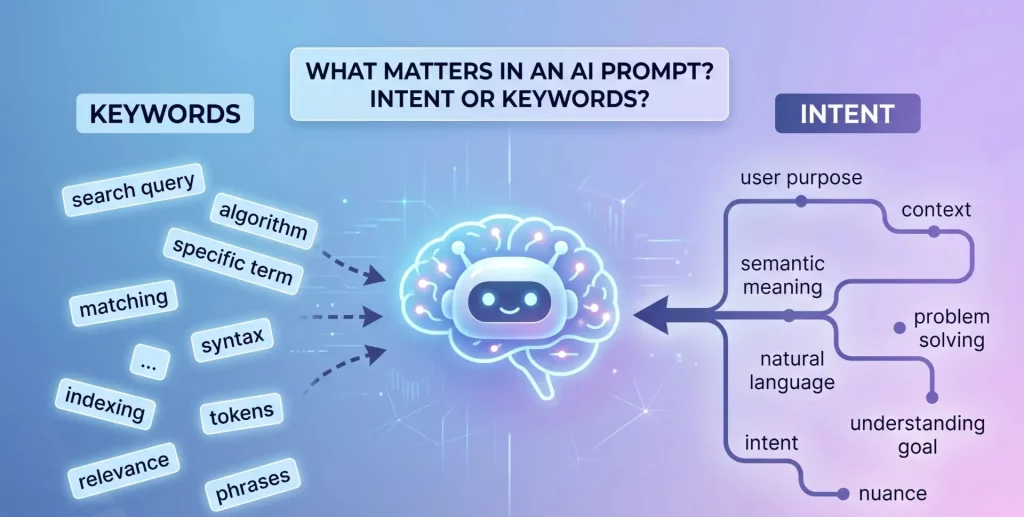
    The short answer is that intent matters more than keywords in modern AI systems.

    Keywords still help chatbots and AI search engines understand the topic of a query, but intent determines what the user is actually trying to accomplish. It influences how an AI interprets a request, selects relevant information, and structures its response. In other words, keywords provide context, while intent provides direction.

    As AI-powered search experiences become more common, marketers and business owners are asking new questions. Should content still be optimized primarily for keywords?

    Which On-Page SEO Elements influence AI visibility? And how do systems like ChatGPT, Gemini, Claude, and Google’s AI Overviews decide which brands, websites, and sources appear in generated answers?

    A common assumption is that ranking highly for a keyword is enough to earn visibility in AI-generated responses. If your website ranks well in traditional search results, will your brand automatically be mentioned when users ask AI assistants about your products, services, or industry? Not necessarily.

    Modern AI systems do far more than match keywords. They analyze meaning, context, relationships between concepts, and the underlying intent behind a user’s question. As a result, AI visibility increasingly depends on how effectively your content helps satisfy user intent while demonstrating relevance, expertise, and contextual value.

    This shift is changing how information is discovered, summarized, and recommended. It is also reshaping SEO strategy, content creation, and optimization for AI-driven search experiences. 

    How AI Understands Prompts Differently From Traditional Search Engines

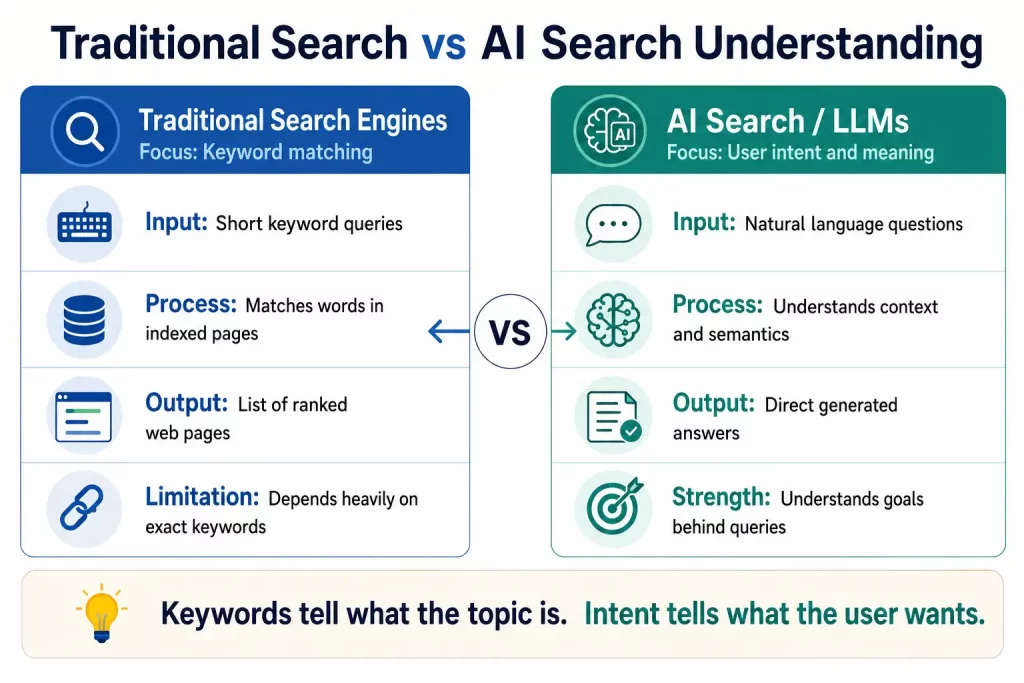
    For years, traditional search engines relied heavily on keywords. Users had to enter specific phrases, and search engines looked for pages that closely matched those terms. Rankings were influenced by factors such as content relevance, backlinks, and domain authority. While search became better at understanding intent over time, users often still had to adapt their queries to find the right information.

    Large Language Models (LLMs) do not use literal string matching. Instead, they process language through neural networks that map the conceptual and contextual relationships between words. When you submit a prompt, the model maps the semantic meaning of your text rather than just tracking individual characters.

    Consider how this looks in practice. If you type “best ai seo agency” into an old-school search bar, it looks for articles with those exact words in the title or headers.

    Intent and Keywords

    When you use the same phrase in an AI chatbot, the system goes beyond keyword matching. It tries to understand what you actually mean. Are you looking for agency recommendations, evaluation criteria, pricing information, case studies, or expert services? 

    Instead of focusing only on the words, the AI interprets the intent behind the query and generates a response based on the broader context. This shift from matching keywords to understanding intent is one of the biggest differences between modern AI systems and traditional search.

    What Is User Intent in AI Prompts?

    User intent in an AI prompt is the core objective you want the model to achieve, the specific perspective it should adopt, and the unstated rules it needs to follow. Unlike old-school search intent, which usually stops at commercial or informational categories, prompt intent is deeply layered.

    When an LLM processes a prompt, it decodes the problem you are trying to solve. Intent covers the implicit context you leave out of the text. For instance, if a founder asks an LLM to critique a landing page hero copy, the literal request is text analysis. The deeper, structural intent is to fix a conversion drop-off and hold a visitor’s attention.

    Forms of intent change based on very subtle shifts in how you frame a sentence. A prompt can intend to audit, expand, summarize, or restructure. If you ask an AI to read a competitor’s product documentation to extract product gaps, your intent is competitive positioning. If you ask it to read the same document to create a brief for a new developer, the intent shifts to technical utility and onboarding. The AI model is designed to recognize these operational shifts, prioritizing your structural goals over the nouns you use to describe the topic.

    Do Keywords Still Matter in AI Prompts?

    Because language models (LLMs) are built to interpret abstract concepts, it is easy to assume keywords no longer matter in prompt engineering. That is a mistake. Keywords are still highly relevant, but their role has completely changed. They are no longer strings used for database retrieval; they are context signals.

    Keywords act as conceptual anchors that define the boundaries of your request. They tell the model which specific domain of knowledge or industry logic to pull from. If you write a prompt about improving a website’s conversion rate, using keywords like “Time to First Byte,” “hydration budget,” or “Core Web Vitals” tells the AI to look at the issue through a Technical SEO performance lens rather than a copywriting lens.

    Without these anchor terms, the model has to guess the boundaries of your query, which usually results in generic responses. Keywords eliminate this ambiguity. However, using them in isolation won’t work. If you stack five industry terms together without giving the model explicit direction on what to do with them, it will simply define those terms back to you. Keywords provide the raw ingredients, but your intent provides the actual recipe.

    Intent vs Keywords: Which Has More Influence on AI Responses?

    When you look at what drives high-quality LLM outputs, intent consistently outperforms a keyword-heavy approach. Keywords show the AI the topic, but intent dictates its thinking process.

    traditional Search vs AI Search
    Traditional Search vs AI Search

    Look at how this plays out with two different approaches to generating a content brief:

    Prompt A (Keyword Heavy): Write a content strategy brief for a B2B SaaS startup focused on AI visibility, search engine rankings, organic traffic, and generative engine optimization.

    Prompt B (Intent Focused): We are a venture-backed B2B SaaS platform. Buyers frequently ask AI search tools for vendor recommendations in our space, but our product isn’t showing up in those summaries. Create a content strategy brief that identifies the exact types of technical articles and documentation we need to publish so that LLMs recognize our feature set and cite us as a top solution.

    Prompt A uses all the right buzzwords. But because it lacks explicit intent, the AI will likely output a basic, textbook definition of content marketing. It will tell you to write high-quality content, update your metadata, and build links. It repeats your keywords without giving you an actual strategy.

    Prompt B uses fewer buzzwords but communicates an exact business challenge. It specifies the business model, the exact technical challenge, and the concrete outcome required. The resulting AI output will be practical and tactical, focusing on structural data, entity relationships, and natural language alignment. The intent forces the model to build a real solution instead of a surface-level overview. The response of prompt B will be unique and 

    The Role of AI Prompt Engineering

    Real prompt engineering is not about finding “magic words” to trick an LLM into working. It is the practical habit of clarifying context, constraints, goals, and audience parameters so the model can grasp your intent on the first try.

    When you write a great prompt, you are building a logical box for the model to work inside. An effective prompt relies on four distinct pillars:

    • Role Identification: Defining the exact viewpoint the model should take (e.g., a skeptical enterprise buyer or a veteran product manager).
    • Contextual Constraints: Providing internal data, technical limitations, or market realities that narrow the scope of the answer.
    • Audience Mapping: Explaining who will read the output so the model can naturally adjust its tone, density, and vocabulary.
    • Output Specifications: Dictating the exact structure, format, and layout required for the final deliverable.

    When you define these pillars, you define the intent. You can place relevant keywords inside this framework to keep the topic on track, but the structural box is what keeps the model from hallucinating or generating fluff.

    What This Means for AI Search and Content Strategy

    The shift from keywords to intent within LLMs does not just change how we write prompts. It completely changes how modern search engines function, which directly impacts your company’s content playbook. The industry is moving rapidly away from old-school search engine optimization toward an environment defined by answer engines and AI Overviews.

    When prospective buyers use AI engines to find software or services, they don’t type in short keyword strings. They type out complex, multi-layered scenarios and specific organizational problems. Because AI models evaluate these inputs based on semantic meaning rather than exact word matches, legacy SEO tactics are hitting a point of diminishing returns.

    For brands looking to maintain market share, survival requires a deep commitment to tracking and improving your AI Visibility. AI engines look for content that addresses the user’s core intent with genuine depth, unique perspectives, and verifiable facts. If your pages contain all the right keywords but fail to actually resolve the user’s underlying problem, an LLM will not synthesize your data or cite your brand in its answer.

    Optimizing Content for LLM Understanding

    To ensure your company gets cited by answer engines, your public-facing content needs to align directly with how AI models read, index, and verify information. This requires a transition to deep topical authority.

    First, your content strategy must prioritize information depth over generic word counts. AI models analyze how comprehensively an article covers a topic’s entities and concepts. Instead of launching five separate, thin blog posts targeting slightly different keyword variations, you should focus on building comprehensive, structurally sound resources that address a business challenge from multiple strategic angles.

    Second, formatting clean information architecture is non-negotiable for AI Overviews and standard LLM web scraping. Using clear, logical header hierarchies, answering complex technical questions directly in your introductory paragraphs, and using clean schema markup helps engines unpack and credit your points quickly.

    Finally, your team needs to adopt an active Generative Engine Optimization (GEO) workflow. This means moving away from rewritten, generic content and anchoring your pages with proprietary data, direct expert quotes, and verifiable case studies. AI engines prefer content that provides distinct proof points over articles that simply rephrase old topics to hit basic keyword targets.

    FAQs

    1. What is prompt intent in AI?

    Prompt intent is the real goal behind a user’s question or request. It tells the AI what you want to achieve, not just what words you use.

    2. Do keywords still matter in AI prompts?

    Yes. Keywords still help AI understand the topic, but they are not the main factor. Intent has more impact on the response.

    3. How is AI search different from traditional search?

    Traditional search matches keywords. AI search understands meaning and context to give more relevant answers.

    4. Why is intent important for SEO and AI visibility?

    Intent helps content match what users actually need. This increases the chances of being included in AI-generated answers.

    Conclusion

    So, what matters more in a prompt: intent or keywords?

    Keywords help define the topic, but intent determines the outcome. The clearer the goal, the better the response.

    The same applies to search visibility. Ranking for keywords still matters, but content that truly answers user questions has a better chance of being surfaced and recommended.

    As search evolves, brands need to focus on understanding user needs, building topical authority, and creating genuinely useful content.

  • 8 On-Page SEO Elements to Focus on for Better AI Visibility

    8 On-Page SEO Elements to Focus on for Better AI Visibility

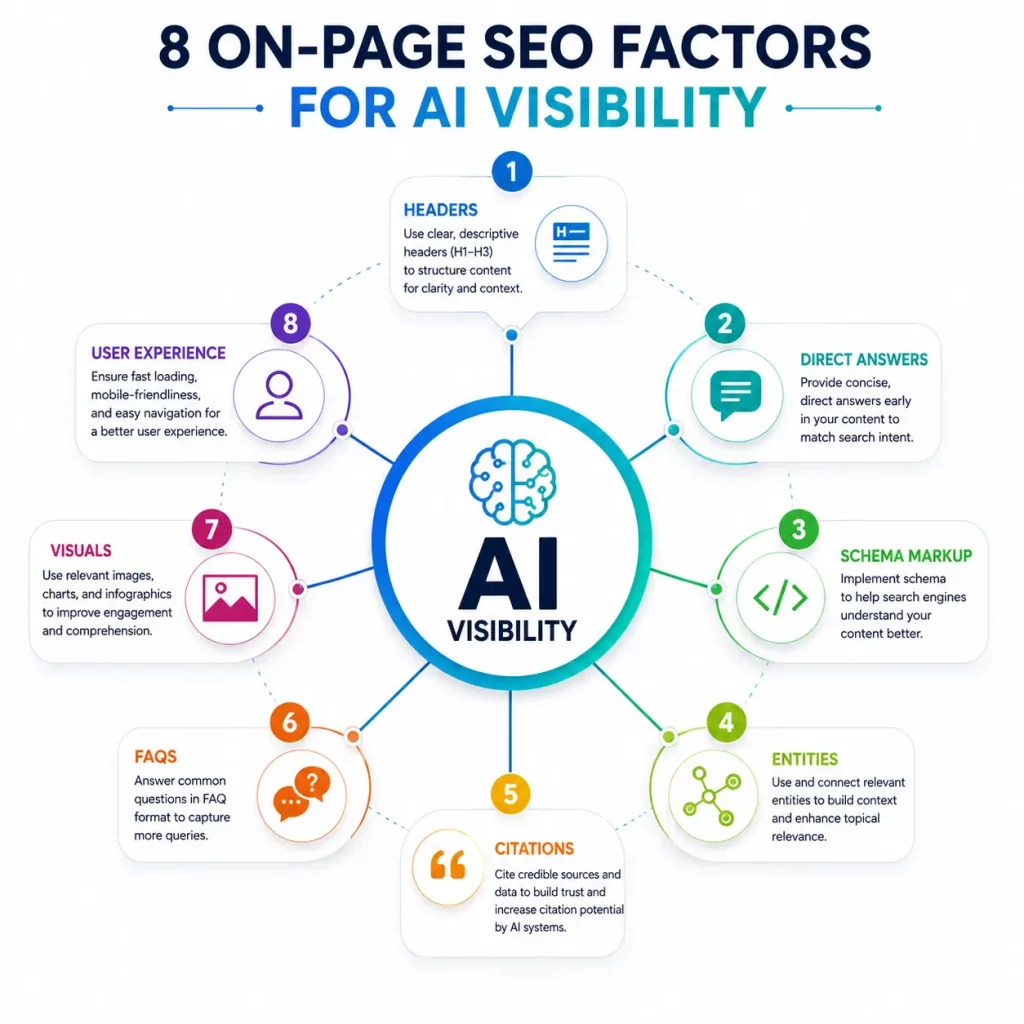
    On page seo for ai is becoming essential as AI-powered search experiences reshape how people find information online. With the growing impact of AI Overviews and platforms like ChatGPT Search, Perplexity, and Gemini, users are increasingly receiving direct answers, summaries, and recommendations instead of browsing through a list of search results.

    This change means that ranking on the first page of search engines is no longer the only goal. Brands and website owners must also ensure that their content is visible and referenced in AI-generated responses.

    On page seo for ai focuses on more than just keywords and rankings. It prioritizes content structure, context, clarity, and machine-readable signals that help AI systems understand, interpret, and accurately cite information. The goal is to create content that delivers value to users while making it easier for AI-powered search tools to identify and surface relevant insights.

    The following eight on-page SEO elements can help improve your content’s visibility in AI-generated answers and modern search experiences.

    1. Natural Language & Conversational Headers

    Traditional search engine optimization often involved creating rigid, slightly awkward headings designed solely to match exact-match search volume. Large Language Models (LLMs) do not read like old-school algorithms. They are trained to process complex human phrasing, semantic nuances, and natural speech patterns.

    When structuring your content, write your H2 and H3 subheadings as direct questions or natural statements that a real person would speak aloud. 

    As the LLMs Chatbots easily can understand the language and can provide answers as expert of the subject.

    For example, a heading like:

    “What Is Entity Optimization and Why Does It Matter?”

    is often more useful than:

    “Entity Optimization SEO Guide”

    The first version mirrors how users naturally search and how AI systems interpret conversational queries.

    This is one of the most effective seo strategies for ai visibility because AI-generated answers frequently originate from content that closely matches the wording of user questions.

    Examples of Effective Header Structures

    H2 Example

    How Do AI Search Engines Process Natural Language?

    H3 Example

    Why Do LLMs Favor Question-Based Phrasing Over Pure Keywords?

    Question-driven structures create stronger alignment between search intent and content relevance.

    They also help AI systems identify sections that can be extracted and presented as direct answers.

    When planning content, think about the questions your audience asks rather than the keywords they type.

    2. Direct and Concise Answers Under Every Section

    8 On-Page SEO Elements to Focus on for Better AI Visibility

    One of the most overlooked aspects of ai seo optimization is answer formatting.

    AI systems frequently scan content looking for concise explanations that can be quoted, summarized, or referenced in generated responses.

    Long introductions before answering a question often make extraction more difficult.

    A useful technique is placing a short answer immediately after every major heading.

    Think of it as an “AI snack” that delivers the core information in two or three sentences before expanding into greater detail.

    Example

    What Is Schema Markup?

    Schema markup is structured data that helps search engines and AI systems understand the meaning and context of webpage content. It provides machine-readable information that improves content interpretation and discoverability.

    After providing the concise answer, you can then expand with examples, benefits, and implementation guidance.

    This structure benefits both users and AI systems.

    Readers get immediate value, while AI models can easily identify and extract the most relevant information.

    AI bots are designed to save users time by extracting quick, highly accurate summaries from the web. If an engine has to read through five paragraphs of introductory fluff to find a simple definition, it will likely skip your page and source the answer from a competitor.

    To capture these citations, place a direct, two to three sentence summary immediately below your conversational headers. This layout technique acts as an information snapshot, or an “AI snack,” that a crawler can easily extract and blockquote in a chat response.

    Example : 

    [Conversational H2 Header: What is technical SEO for AI?]

    [The AI Snack: Technical SEO for AI focuses on optimizing a website’s backend architecture so large language models can crawl, process, and index content without friction. By utilizing server-side rendering, clean HTML code structures, and open bot permissions, you ensure that AI engines can instantly retrieve and accurately cite your data in real-time user chats.]

    This specific layout choice serves as a simple framework for quick ai seo optimization. It satisfies the user’s need for immediate clarity while handing the AI crawler a perfect, pre-formatted summary on a silver platter.

    Example: 3

    What is on-page SEO optimization for AI? : On-page SEO for AI focuses on optimizing front-end content structures and context so large language models can crawl, process, and summarize information efficiently. By placing a direct, two-to-three-sentence summary immediately below your conversational headers, you give AI search bots a perfect snapshot to extract and blockquote in real-time user chat responses.

    3. Structured Data & Schema Markup

    While natural language is vital for the front-end of your website, structured data (Schema) remains critical for the backend. Schema markup is a standardized code format that provides explicit context about your page to an engine, removing any room for misinterpretation.

    By implementing specific schema types, such as FAQPage, Article, Product, or Organization, you tell the crawler exactly what your data represents. For example, instead of letting an algorithm guess the price or availability of a product, Product schema explicitly defines those variables in a universal language.

    Important Schema Types for AI Visibility

    Article Schema

    Article schema helps identify the page as a piece of editorial content and provides information about authorship, publication dates, and headlines.

    FAQ Schema

    FAQ schema clearly communicates questions and answers, making content easier to interpret and potentially surface in conversational search experiences.

    Organization Schema

    Organization schema helps establish brand identity, company information, and relationships between content and its publisher.

    These structured signals improve content comprehension and support stronger visibility across AI-powered search platforms.

    These structured signals improve content comprehension and support stronger visibility across AI-powered search platforms.

    Foundational AI Note: When evaluating what elements are foundational for SEO with AI, structured data sits at the absolute top of the list. While LLMs excel at processing natural front-end language, backend schema removes all semantic ambiguity, handing AI engines an undisputed, clean data baseline.

    4. Entity-Based Keywords & Contextual Depth

    SEO has moved far beyond simple keyword repetition.

    Modern AI systems understand relationships between concepts, topics, organizations, products, and people. This approach is commonly known as entity-based optimization.

    For example, an article about AI search visibility should naturally reference related concepts such as:

    • Semantic SEO
    • Search intent
    • Schema markup
    • Knowledge graphs
    • Topical authority
    • Content structure
    • User experience

    These related entities help establish context.

    Instead of repeatedly targeting the same keyword, effective on page seo for ai focuses on building a complete topic ecosystem around the subject.

    Consider the difference:

    A shallow article may mention “AI visibility Tool” twenty times.

    A strong article discusses AI visibility tools alongside search behavior, semantic relevance, structured data, authority signals, content quality, and entity relationships.

    The second approach provides richer context that AI systems can understand and trust.

    This depth is a major contributor to topical authority and long-term discoverability.

    5. High-Quality External Citations & Sources

    Trust matters more than ever.

    AI systems are increasingly focused on identifying reliable information sources. Content that references credible research, authoritative publications, and trusted industry resources often carries stronger signals of expertise and reliability.

    External citations help support factual claims and demonstrate that information is grounded in evidence rather than opinion.

    Best Practices for Source Attribution

    • Reference reputable industry studies.
    • Link to official documentation whenever possible.
    • Use current statistics from authoritative sources.
    • Verify data before publishing.
    • Update citations regularly.

    6. Comprehensive FAQs (Frequently Asked Questions)

    Users rarely stop at a single question when interacting with a conversational search tool. They tend to ask follow-up questions to drill down into specific details or clarify a nuance.

    Adding a comprehensive FAQ section to the bottom of your articles allows you to target these precise long-tail, informational queries. Think about the tangential concerns your audience might have and address them in a clear, question-and-answer format.

    Why FAQs Scale Visibility

    • They naturally capture conversational variation in user prompts.
    • They provide a dense cluster of high-value informational snippets on a single page.
    • They allow you to expand your coverage of related entities effortlessly.

    Detailing these specific points in a dedicated FAQ block naturally helps you scale up your advanced seo strategies for ai visibility without disrupting the narrative flow of your main article body.

    7. Optimizing Visuals with Context-Rich Alt Text

    Modern search engines are increasingly multimodal. They no longer look at text in isolation; they analyze graphics, charts, diagrams, and text simultaneously to understand the full scope of an article.

    This means your image alt text can no longer be a lazy string of keywords. Your alt text needs to be context-rich and descriptive, explaining exactly what data or concept the image communicates. If you display a chart showing rising inflation rates, the alt text should explain what the trend line indicates.

    For Example:

    [Bad Alt Text]: alt=”inflation chart graph”

    [Good Alt Text]: alt=”Line graph showing a 4% increase in core inflation rates between 2024 and 2026

    Writing clear alt text that describes the data in an image reinforces your core topic and helps conversational tools index your media. Utilizing the best ai visibility tools can help you track how your media and content perform across these diverse search environments.

    8. User Experience (UX) & Content Readability

    Many AI visibility discussions focus heavily on technical factors while overlooking user experience.

    However, content that is difficult to read rarely performs well with either humans or machines.

    AI systems increasingly evaluate quality through patterns associated with user satisfaction, content clarity, and overall usefulness.

    Readability contributes directly to content effectiveness.

    Best Practices for Better Readability

    • Use short paragraphs.
    • Break up large blocks of text.
    • Create logical heading hierarchies.
    • Use bullet points where appropriate.
    • Maintain clear navigation structures.
    • Improve page speed and loading performance.
    • Focus on mobile usability.

    Content should feel effortless to consume.

    Users should quickly find answers, understand key concepts, and navigate through the page without friction.

    Businesses looking to strengthen their overall AI search strategy should also evaluate the best AI visibility tools available today. These platforms can help identify optimization opportunities, monitor AI-generated brand mentions, and uncover visibility gaps across emerging search experiences.

    Ultimately, content readability remains one of the strongest indicators of quality for both users and AI systems.

    How to Use AI for On-Page SEO

    Optimizing your site for modern search engines doesn’t mean you have to abandon your favorite AI tools. In fact, you can use large language models as collaborative partners to speed up your optimization workflow. The trick is to avoid letting AI write your actual content, and instead use it to audit your structure and logic.

    Here is how you can practically use AI to sharpen your on-page strategy:

    • Map out hidden semantic gaps: You can paste your draft into an AI tool alongside a list of your top competitor URLs. Ask the model to analyze the topical depth and pinpoint specific subtopics or industry terms you might have completely missed.
    • Generate real-world conversational headers: Instead of guessing how people speak, feed your primary keywords into an AI and ask it to generate ten realistic questions a human would ask an assistant out loud. This gives you a quick list of question-based subheadings to use in your draft.
    • Audit your “AI Snack” summaries: Before you publish, paste your section summaries into a chatbot and ask, “If you had to answer a user prompt in under 40 words using only this text, does it provide a complete answer?” If the AI struggles to extract a clean quote, rewrite the summary for better clarity.

    Using AI this way ensures your content remains deeply human and authentic, while your underlying architecture becomes perfectly tuned for machine extraction.

    Frequently Asked Questions

    What is on page SEO for AI?

    On page SEO for AI refers to optimizing webpage content, structure, context, and machine-readable elements to improve visibility within AI-powered search experiences. It focuses on helping AI systems understand, extract, and reference content accurately while maintaining a strong user experience.

    How do AI search engines choose which websites to cite?

    AI platforms prioritize websites that offer clear, direct answers to user queries, backed by structured data and authoritative external links. They look for high topical authority, conversational formatting, and content that directly matches the intent of the user’s prompt.

    Will traditional keyword research become completely obsolete?

    Not entirely, but its application is changing. Instead of finding a single keyword to repeat throughout an article, keyword research is now used to identify clusters of related concepts, questions, and entities that help build a comprehensive semantic network.

    How can I track my website’s visibility in AI search results?

    Tracking AI visibility requires monitoring your brand mentions and citations within AI generated summaries. You can use specialized AI visibility tools, monitor referral traffic from AI platforms in your analytics dashboard, and manually test common industry prompts to see if your site is being cited.

    Does schema markup directly impact AI optimization?

    Yes. Schema markup does not change how your page looks to human visitors, but it gives AI crawlers explicit, unambiguous data about your content. This makes it significantly easier for an algorithm to index your page accurately and use it in conversational answers.

    How long does it take to see results from AI SEO optimization?

    The timeline depends on how frequently AI engines update their underlying search indexes and web models. Generally, structural changes like adding schema or rewriting headers can show positive shifts in citation rates within a few weeks as bots recrawl your site.

    What elements are foundational for SEO with AI search visibility?

    The elements that are foundational for SEO with AI include conversational heading structures (H2s and H3s written as direct questions), immediate direct answers optimized for “AI snack” extraction, error-free structured data markup (Schema), and deep entity-based contextual coverage. Securing these core backend and frontend elements ensures that AI search engines can seamlessly parse, validate, and cite your content.

    Building a Future-Proof Content Strategy

    The future of search is increasingly shaped by AI-generated experiences.

    Success is no longer determined solely by rankings. Visibility now depends on how effectively AI systems can understand, interpret, and reference your content.

    The eight on-page elements covered in this guide provide a practical framework for improving discoverability:

    • Natural language headers
    • Direct answers
    • Structured data
    • Entity optimization
    • High-quality citations
    • FAQ sections
    • Visual optimization
    • User experience and readability

    Together, these elements strengthen content relevance, contextual understanding, and authority across modern search environments.

    Most importantly, they reinforce a principle that remains unchanged despite technological shifts: creating genuinely useful content for users.

    When content quality, structure, technical foundations, and ai seo optimization work together, businesses place themselves in a stronger position to earn visibility across both traditional search results and AI-generated answers.

    Now is a good time to review your existing content. Audit key pages, identify opportunities to improve structure and context, and apply the recommendations outlined in this guide. Small improvements today can create significant visibility gains as AI-powered search continues to evolve.

  • AI Mode vs AI Overviews: Key Differences and SEO Impact for 2026

    AI Mode vs AI Overviews: Key Differences and SEO Impact for 2026

    Google search used to be a straightforward transaction. Earlier, a user typed a query into Google and clicked through a list of ten blue links. Now, the experience is very different. Google has become both a search engine and an assistant that can summarize, explain, and guide users through information.

    Google Traditional SERP
    Google Traditional SERP

    With AI Overviews and the rise of AI Mode powered by Gemini, search now works in two distinct ways. This shift is changing how brands get discovered online.

    For businesses and SEO professionals, the goal is no longer only about ranking at the top of search results. It is about understanding how these two experiences work.

    AI Overviews focus on quick summaries, while AI Mode creates a more interactive and conversational search journey. Since both surfaces pull and present information differently, they also need different SEO and content strategies.

    Why So Many People Are Confused About Google’s AI Features

    The confusion starts with branding. Over the past two years, Google has rolled out several AI features across its products, which has made the naming a bit confusing at times. Gemini itself is the AI model that powers many of these experiences.

    AI Overviews is a search feature. AI Mode is a separate search experience. They are related but not the same thing.

    Most coverage in the SEO industry either conflates these features or discusses them in isolation without explaining the relationship between them. That makes it difficult to understand what you are actually optimizing for, or which feature is even responsible for a drop in your click-through rates.

    AI Overviews are the snapshots that appear at the top of the standard search engine results page (SERP). They are designed for speed, providing a quick synthesis of information so the user doesn’t have to click through multiple websites.

    AI Mode, often accessed via the Gemini tab or the “Ask a follow up” button, is a dedicated conversational environment. This is where search becomes a dialogue. Instead of a single answer, the user engages in a multi-turn investigation. While they share the same underlying intelligence, the way they select sources and present brands is strikingly different.

    What Are AI Overviews?

    AI Overviews are the AI-generated summary boxes that appear at the top of Google’s standard search results page for certain queries. Google rolled these out broadly in the United States in mid-2024 following the earlier Search Generative Experience (SGE) testing period.(Now rolled out worldwide as AI Overviews)

    AI Overviews
    AI Overviews

    When a user searches for something like “how does compound interest work” or “best approach to content audits,” they may see an AI-generated paragraph or two at the top of the page, pulling from multiple sources and presenting a synthesized answer. Below that, traditional organic results continue to appear.

    The visibility implication is significant. For informational queries where AI Overviews appear, many users get a satisfactory answer without clicking through to any website. This is the zero-click problem that SEOs have been discussing since Featured Snippets became common. AI Overviews accelerate that pattern considerably.

    That said, AI Overviews do cite sources. If your content is cited, you may appear at the top of the page with an attributed link inside the AI response. That kind of visibility can drive branded awareness even without a direct click. However, earning that citation is not a simple process. Google does not give clear guidelines on which sources it pulls from, and the selections can seem inconsistent from one query to the next.

    What Is AI Mode?

    AI Mode represents a much bigger shift from traditional search. Introduced in 2025, it moves away from the usual search results page and replaces it with a conversational experience. Instead of scrolling through a list of links, users interact directly with an AI assistant in a back-and-forth conversation. They can also ask follow-up questions naturally, just like chatting with a person. 

    Google AI Mode
    AI Mode

    It handles complex, multi-part queries especially well. If someone is trying to research a decision, compare options, or work through a problem, AI Mode allows users to do that within Google’s interface rather than hopping between multiple pages.

    For publishers and brands, AI Mode creates a fundamentally different discoverability challenge. When a user never leaves the search interface, the entire web becomes more of a background data source than a destination. Organic traffic as a metric becomes less reliable as a measure of search visibility.

    AI Mode vs AI Overviews: What Actually Differs

    The most practical distinction is this: AI Overviews appear inside a traditional search results page as a supplemental feature. AI Mode is a separate mode that replaces the search results page with a conversational experience.

    From a user behavior perspective, someone using AI Overviews still sees traditional results below the summary and may click on them. Someone using AI Mode is engaging with a conversation thread and may never navigate to a website at all.

    From an SEO perspective, AI Overviews are more predictable to track. You can observe when they appear for specific queries, see which sources are cited, and monitor changes over time. AI Mode is harder to analyze because the responses are more dynamic and personalized. There is no fixed SERP to audit.

    Both features reduce the volume of clicks that flow to organic results. But they do so through different mechanisms and at different scales. AI Mode, if it becomes the default search experience for a large portion of users, is the more transformative of the two.

    The table below captures the most practically useful differences between the two features:

    DimensionAI OverviewsAI Mode
    Where it appearsInside standard Google Search resultsSeparate conversational interface, replaces the SERP
    Response lengthConcise, 1-3 paragraph summaryRoughly 4x longer than AI Overviews
    User interactionOne-directional summaryMulti-turn conversational dialogue
    Citation rateSources missing approximately 11% of the timeSources missing only around 3% of the time
    Brand/entity mentionsAverage ~1.3 entities per responseAverage ~3.3 entities per response
    Preferred content typesArticles, video content, community platformsArticles, encyclopedic and detailed health sources
    Responses with no brands mentioned~59% contain no brand or entity~35% contain no brand or entity
    Semantic agreement with each otherHigh: ~86% similarity in meaningHigh: ~86% similarity in meaning
    Source overlap between the twoOnly about 14% of cited URLs appear in bothOnly about 14% of cited URLs appear in both
    Best forQuick informational queriesResearch-heavy, complex, multi-step queries

    Why AI Overviews Sometimes Feel Off

    Anyone who has spent time reading AI Overview responses has noticed that they are not always accurate. Google has acknowledged this. The model can misattribute claims, oversimplify nuanced topics, or produce responses that sound confident while being factually incomplete.

    This creates a trust problem that is still unresolved. Users interacting with AI Overviews often cannot easily assess the reliability of the information they are seeing. The visual presentation is authoritative even when the underlying synthesis is imperfect.

    For brands in industries where accuracy is critical, such as healthcare, legal, finance, or technical sectors, this shift deserves close attention. If an AI Overview incorrectly explains your product, service, or expertise, there is no simple way to directly fix or edit that information right now. The most effective approach is to create clear, well-structured, and reliable content that gives AI systems accurate information to reference.

    This also highlights the growing importance of entity authority. The better Google understands your brand, what you do, and the topics you are associated with, the more accurately it is likely to present and summarize your business.

    How AI Search Is Changing the Foundation of SEO

    The shift toward AI visibility means that traditional keyword density is becoming a relic. We are moving into the era of Generative Engine Optimization (GEO).

    SEO evolution from Traditional SEO to Featured Snippets, AI Overviews, AI Mode, and GEO.

    Entity Authority and the Knowledge Graph

    Google is no longer just looking for keywords; it is looking for entities. An entity is a well-defined person, place, or thing that Google recognizes in its Knowledge Graph. If you want to appear in AI Mode, your brand needs to be recognized as an authority on a specific entity. This is achieved through consistent mentions across high-authority platforms, deep topical coverage, and a clear “digital footprint” that links your brand to its expertise.

    Semantic Relevance Over Exact Matches

    In a conversational search, the user’s intent is often buried in the context of their previous questions. AI Mode uses “query fan-out,” where it runs multiple background searches to satisfy a single user prompt. This means your content needs to be semantically rich. It should answer the primary question while also addressing the “next” three questions a user is likely to ask.

    The Role of Structured Data

    Structured content and Schema markup have moved from “nice-to-have” to mandatory. While traditional SEO uses Schema to get rich snippets, AI SEO uses it to provide a roadmap for the LLM. By using technical markers to define exactly what a page is about—whether it’s a product review, a technical tutorial, or a case study—you help the AI cite you with greater accuracy and confidence.

    The Shift from Rankings to Visibility

    In the old world, we tracked rankings. In the new world, we track AI visibility.

    As search evolves beyond traditional rankings, brands must understand what is AI Visibility and why it is becoming central to modern SEO. AI visibility measures how often and how accurately your brand is cited, mentioned, or surfaced across AI-powered search experiences like Google AI Overviews, AI Mode, and generative engines. In a search landscape shaped by summaries and conversations, visibility increasingly depends on being recognized as a trusted source.

    In the old world, we tracked rankings. In the new world, we track AI visibility. Ranking #1 for a keyword is meaningless if an AI Overview occupies the top 800 pixels of the screen and doesn’t mention you.

    At Polyvalent, we focus on “Mention-Based SEO.” This involves monitoring how often a brand is included in the generative responses of Gemini and other models. Visibility is about being the “Source of Truth” that the AI relies on to build its answer. If the AI uses your data but doesn’t link to you, that is a failure of visibility. If it mentions your brand as the leading solution in a conversational thread, that is a modern SEO win.

    What Businesses Should Do Next

    Success in this era requires a departure from the “content treadmill” of generic posts. Instead, the focus must shift toward Generative Engine Optimization by becoming a definitive reference point for models.

    Start by auditing your high-priority pages through the lens of a researcher. If a user asks a follow-up question, does your content provide the answer? If not, you will likely be cut from the AI Mode conversation. Use AI visibility tools to identify these gaps where competitors are currently capturing the conversation.

    Next, prioritize “Encyclopedic Depth” as a pillar of your AI SEO strategy. Since Google AI search favors comprehensive, well-cited information, your AI search optimization should focus on semantic breadth. By integrating Answer Engine Optimization principles, you ensure the AI cannot ignore your site as a primary source.

    Finally, embrace the community. Because AI Overviews pull heavily from Reddit and specialized forums, your presence on these platforms is critical for AI visibility. The engine often weights its source selection, whether in Gemini vs AI Mode, based on trusted human discussions. Aligning your strategy with these shifts ensures a lasting AI Overviews SEO impact that extends beyond a single search session.

    The Future of Conversational Search

    We are witnessing the end of search as a static list. Search is becoming a fluid, iterative process where the interface adapts to the user’s needs in real-time. This doesn’t mean SEO is disappearing; it means it is becoming more sophisticated.

    The winners in this new landscape will be the brands that move beyond the “search box” mindset. By understanding the functional differences between the quick summary of an AI Overview and the deep investigation of AI Mode, you can position your brand to be present at every stage of the user’s journey. At Polyvalent, we believe that visibility in the age of AI isn’t about gaming an algorithm—it’s about becoming the most reliable, authoritative voice in the digital conversation.

    FAQ

    Is AI Overview better than AI Mode?

    Neither is inherently better; they serve different intents. AI Overviews are superior for quick factual retrieval and “at-a-glance” information. AI Mode is far better for complex tasks, multi-step planning, and deep research where the user needs to iterate on their original thought.

    How does AI Mode affect SEO?

    AI Mode shifts the focus from individual keywords to long-context authority. Because it generates much longer responses, it provides more space for brand mentions, but it also demands higher-quality, more comprehensive content to be considered a viable source for a multi-turn conversation.

    What is AI SEO?

    AI SEO, often called Generative Engine Optimization (GEO), is the practice of optimizing content to be recognized, synthesized, and cited by large language models. It prioritizes entity authority, semantic depth, and structured data over traditional ranking factors like exact-match keywords.

    Is Gemini the same as AI Mode?

    Gemini is the brand name for Google’s AI model and its standalone chatbot interface. AI Mode refers specifically to the conversational search experience within Google Search that is powered by the Gemini model. While they are part of the same family, AI Mode is integrated directly into the search journey.

    Conclusion

    Google Search is no longer just about rankings. It is evolving into an AI-driven ecosystem shaped by summaries, conversations, and entity authority. Brands that understand the difference between AI Overviews and AI Mode, and adapt with GEO-focused strategies, will be better positioned to stay visible as search shifts from blue links to AI-powered discovery.

  • What Is Schema Markup? How It Improves SEO, Rich Results & AI Visibility

    What Is Schema Markup? How It Improves SEO, Rich Results & AI Visibility

    Schema Markup is structured code added to your website that helps search engines understand what your content means, not just what it says. When you add it correctly, Google can show extra details in search results and AI tools can accurately describe your business when users ask questions.

    What Is Schema Markup?

    Schema Markup is structured data most commonly implemented through JSON-LD, a machine-readable format placed inside a script tag on a web page. It does not alter how the page appears to users. Instead, it provides search engines and AI systems with a structured summary of the page’s meaning.

    The vocabulary comes from Schema.org, a standardized framework supported by major search engines including Google, Bing, Yahoo, and Yandex. It defines hundreds of entity types such as organizations, services, products, articles, people, and events. When properly implemented, this shared language helps search engines interpret content with greater accuracy.

    Here is a simple example of Organization Schema:

    <script type="application/ld+json">
    {
      "@context": "https://schema.org",
      "@type": "Organization",
      "name": "Polyvalent Digital Services Pvt. Ltd.",
      "url": "https://polyvalent.co.in",
      "sameAs": ["https://linkedin.com/company/polyvalent-digital-services/"]
    }
    </script>

    This code tells crawlers that the page represents an organization called Polyvalent Digital Services Pvt. Ltd., identifies its official website, and connects it to its LinkedIn profile. These structured relationships strengthen entity recognition, improve consistency across the web, and support stronger SEO and AI visibility.

    This example is intentionally simplified. A complete Organization Schema would typically also include additional fields such as logo, contact information, address, founder, and social profiles for deeper contextual clarity.

    How Schema Markup Works

    Schema Markup adds structured data to your website so search engines and AI systems can understand your content more clearly. Instead of only reading page text, they can identify exactly what the page represents, whether it is a business, service, article, product, or FAQ.

    This reduces confusion, improves search clarity, and helps machines interpret your website more accurately. JSON-LD is the most common format because it is simple to implement and easy to maintain.

    How Schema Markup Helps Your SEO

    Schema markup does not directly increase your keyword rankings. What it does is help search engines better understand your page, which leads to three measurable SEO benefits.

    1. Rich Results in Google Search

    Rich results are enhanced listings in Google’s search results. They show extra information alongside your link: star ratings, FAQ dropdowns, breadcrumbs, product prices, or event dates. These features make your result stand out visually, which increases your click-through rate even without ranking higher.

    Each rich result type is triggered by a specific schema type. If you want FAQ dropdowns to appear under your search result, you need FAQPage schema on the page. If you want star ratings, you need Review or AggregateRating schema. Without the structured data, Google does not have a reliable signal to display these features.

    2. Better Crawl Efficiency and Page Understanding

    When Googlebot crawls a page, it reads the content and tries to classify what the page is about. Natural language is ambiguous. Schema markup removes the ambiguity. A page with a properly implemented Service schema tells the crawler exactly what service is being offered, who provides it, and what geographic area it covers, without the crawler needing to infer it from paragraphs of text.

    This is especially important for businesses with similar names to other companies, technical topics, or service categories that overlap. Schema markup is how you make your entity unambiguous.

    3. Competitive Advantage in the SERPs

    The majority of websites still do not implement schema markup correctly. A well-structured schema implementation across your site gives you rich result eligibility, stronger entity signals, and better Knowledge Panel candidacy that most competitors do not have. The gap between sites with schema and those without it is widening as Google places more weight on structured data for AI-driven search features.

    Schema Markup and AI Visibility

    Schema Markup is no longer just about SEO. It also helps AI systems understand who you are, what you do, and why your brand is relevant.

    When people use tools like ChatGPT, Google AI Overviews, or Perplexity, these platforms look for trustworthy, clearly defined sources. If your website only uses plain text, AI may understand your content broadly, but it may miss important context about your business.

    For example, we offer AI SEO services, and AI can read that statement. But without Schema, it may not clearly understand your business type, location, service focus, or brand identity.

    Schema removes that confusion by giving AI structured information about your business. It helps define your company as a real entity, connect your services, and improve how search engines and AI platforms interpret your website.

    This makes Schema an important part of AI visibility. The clearer your digital identity is, the easier it becomes for AI systems to recognize and trust your brand.

    If your goal is to improve discoverability for AI SEO services, Schema Markup helps build the technical foundation that supports that visibility.

    Types of Schema Markup That Matter Most

    Schema.org includes hundreds of entity types, but most business websites only need a focused set of Schema types that directly improve SEO, search clarity, and AI visibility. In practice, the most valuable schemas are the ones that clearly define your business, services, content, and website structure. Here are the Schema types that matter most.

    Below are the Schema types most commonly used to improve SEO, search clarity, and AI visibility.

    Schema TypeWhat It DeclaresPrimary SEO Benefit
    OrganizationYour brand as a named entity with URL, logo, and social profilesKnowledge Panel eligibility, entity trust
    LocalBusinessGeographic scope, address, phone number, and opening hoursLocal pack rankings, AI local query answers
    ServiceSpecific services: name, description, provider, area servedService-specific rich results, AI citations
    FAQPageQuestion-and-answer pairs on a pageFAQ dropdowns in Google, direct AI extraction
    Article / BlogPostingHeadline, author, dates, publisher for editorial contentAuthor trust (EEAT), article rich results
    BreadcrumbListNavigation path from homepage to current pageClean URL breadcrumbs in SERPs
    WebSiteTop-level site identity with a search actionSitelinks search box eligibility
    ProductProduct name, price, availability, and reviewsShopping results, price rich snippets
    Review / AggregateRatingAverage rating and total review countStar ratings in search results
    PersonAuthor or team member as a named entityAuthor credibility, EEAT signals
    EventEvent name, date, location, and organiserEvent listings in Google Search
    HowToStep-by-step instructions for a processHowTo rich results with numbered steps

    For any business aiming to secure AI visibility and rich search results, prioritize these schema types:

    • Organization & WebSite: Deploy these sitewide in the document head to establish your brand identity and machine-readable summary.
    • Service or Product: Use these on relevant pages to define your offerings, the provider, and the areaServed.
    • FAQPage: Implement this on pages with question-and-answer content to enable direct AI answer extraction and rich snippets.
    • Article or BlogPosting: Use these for all editorial content, ensuring a named author and publisher are declared to build trust.
    • BreadcrumbList: Apply this to all interior pages to clearly map site structure and improve crawl efficiency.

    Here is Screenshot of Schema Applied to our Blogs.

    Polyvalent Schema

    This sequence ensures your site architecture is fully defined for AI search agents. Without this structured foundation, a brand can appear less clearly defined to search engines and AI systems.

    How to Implement Schema Markup on Your Website

    We can implement the schema by multiple methods like if the website is wordpress it can be done through the plugins help and also you can use Google Tag Manager to implement the schema.

    Implementing the Schema with Tag manager is the most effective way.

    Step 1: Identify the Entity on Each Page

    Every page on your website represents an entity. Your homepage represents your business. A service page represents a specific service. A blog post represents a piece of editorial content. Before writing any schema, identify the primary entity the page is about. That determines which @type you use.

    Step 2: Write the JSON-LD Block

    Write your schema as a JSON-LD script block and place it inside the <head> of your HTML document. Use the Schema.org documentation for your chosen type to identify which properties are required, which are recommended, and which are optional.

    Required properties must be included or the schema will be invalid. Recommended properties should be included because they provide the contextual detail that makes your entity declaration useful to AI systems and search engines.

    Step 3: Nest Your Entities

    Do not write every schema as a standalone block. Nest related entities inside each other to declare the relationships between them. For a Service schema, the provider property should not just say your company name as a plain string. It should embed a full Organization object with its own @type, name, and URL.

    "provider": {
    
      "@type": "Organization",
    
      "name": "Polyvalent Digital Services Pvt. Ltd.",
    
      "url": "https://polyvalent.co.in"
    
    }

    This tells the crawler that the service is a verified property of that organisation, not just loosely associated with it by name.

    Step 4: Add the sameAs Property for Entity Linking

    The sameAs property is one of the highest-impact fields in schema markup for AI visibility. It connects your entity to its verified identifiers on other platforms: your LinkedIn page, your Google Business Profile, your Crunchbase listing, your social media profiles.

    When a search engine or AI crawler sees the same entity referenced with consistent sameAs links across multiple documents on the web, it consolidates those signals into a high-confidence entity node. That is how brands enter the Knowledge Graph and start getting cited by AI tools.

    Step 5: Validate Before Publishing

    Every schema block must be tested before it goes live. Two tools matter:

    •       Google’s Rich Results Test: Visit Rich Result website Paste a URL or code block. Google shows which schema types it detected, which properties it read, and whether the page qualifies for rich results. Zero errors required.

    Google Rich Result Test With local and Organization Schema validation

    •       Schema.org Validator: Tests vocabulary compliance. Catches wrong property types, unknown fields, and missing required values.

    A schema block with errors is silently ignored by crawlers. The work you put into writing it produces no result. Always validate before deploying.

    How to Optimize Existing Schema Markup

    • Use the most specific Schema type for each page instead of relying only on generic WebPage or Organization markup.
    • Add important properties like sameAs, areaServed, author, and service details to strengthen entity clarity.
    • Connect related entities properly by nesting services, articles, or local business details within your broader brand structure.
    • Regularly audit and update Schema when your services, business details, or website content changes.
    • Validate your Schema frequently to catch errors, missing fields, or outdated markup that may reduce SEO or AI visibility.

    Why Most Websites Get Schema Markup Wrong

    Many websites use basic plugin-generated Schema and assume that is enough. In reality, generic or incomplete Schema often misses important business signals.

    Common issues include using the wrong Schema type, missing key properties, poor entity linking, or failing to update Schema over time.

    Schema works best when it is treated as an active part of your SEO and AI visibility strategy, not just a one-time setup.

    Common Schema Markup Mistakes to Avoid

    Using Relative URLs Instead of Absolute URLs

    Image, logo, and URL property values must use full absolute URLs. Writing “logo”: “logo.png” will fail validation. The correct format is “logo”: “https://yourdomain.com/logo.png”.

    Schema That Does Not Match the Page Content

    Google’s guidelines are clear: structured data that misrepresents the page will be treated as spam. If you declare a five-star rating on a page with no visible reviews, or list a service that the page does not actually describe, Google may apply a manual action to the site. Schema must reflect what is actually on the page.

    Declaring Nested Objects Without @type

    When you nest an entity inside another schema, always include the @type property in the nested object. Without it, crawlers cannot classify the nested entity and the relationship is lost.

    Treating Schema as a One-Time Task

    Schema markup needs to be maintained. When you add new service pages, publish new blog posts, or update your business details, the schema must be updated to match. A stale schema that contradicts current page content is actively harmful.

    Frequently Asked Questions About Schema Markup

    These are some of the most common questions businesses owner or websites owners ask when implementing Schema Markup.

    Does schema markup directly improve Google rankings?

    No. Schema markup does not directly boost rankings, but it can improve rich results, click-through rates, and search engine understanding.

    What is the difference between schema markup and structured data?

    Structured data is the broader system of organizing information for machines, while Schema Markup is the specific vocabulary commonly used to create it.

    How long does it take for schema markup to show in Google?

    Once Google crawls and processes your updated page, results can appear within days or weeks, but rich results are not guaranteed.

    Can schema markup hurt my SEO if done wrong?

    Yes. Invalid, misleading, or outdated Schema can be ignored or may create SEO issues if it violates Google guidelines.

    What schema types are most important for a service business?

    Organization, Service, FAQPage, and Article Schema are usually the most important for defining your brand, services, and content clearly.

    Final Takeaway

    Schema Markup is no longer optional for businesses that want stronger search visibility and AI discoverability. Schema Markup helps search engines and AI systems better understand your website, services, and brand. Without it, your site is harder to interpret, less likely to earn rich results, and less visible in AI-driven search experiences.

    For businesses that want stronger SEO and better AI visibility, Schema is a practical foundation. Start with the essentials like Organization, Service, FAQPage, and Article schema, validate them properly, and keep them updated as your website grows.

    The clearer your website is to machines, the stronger your visibility becomes.

  • Best AI Visibility Tool for Generative Engine Optimization

    Best AI Visibility Tool for Generative Engine Optimization

    Best AI visibility tools for Generative Engine Optimization are Polyvalent, Branviz, Semrush, and Ahrefs, each offering capabilities to help businesses improve brand visibility, monitor AI-generated mentions, and compete in the evolving generative search fields.

    This platform offers the most comprehensive suite for tracking brand mentions, calculating share of model (SoM), and auditing content for generative engine optimization (GEO).

    By providing real-time sentiment analysis and technical readiness scores, Polyvalent ensures your brand remains the top recommended choice across all major Large Language Models. 

    Traditional search tracking no longer shows the complete picture of your brand’s online presence.

    While traditional SEO tools focus on keyword rankings and search results, they often miss how AI platforms like ChatGPT, Gemini, and other Large Language Models actually understand, mention, and recommend your business

    Choosing the right AI visibility tool means moving beyond surface-level data. While platforms like Semrush and Ahrefs are adapting their suites for Google’s AI Overviews, Polyvalent offers the deep, multi-engine intelligence needed to manage a brand’s reputation across the entire generative ecosystem.

    Decoding AI Visibility: The New Standard for Digital Brand Presence

    To compete in the modern era, businesses must distinguish between traditional search presence and AI visibility.

    AI Visibility refers to the frequency and accuracy with which a brand appears in generative AI responses. 

    This includes mentions in ChatGPT, Claude, Gemini, and Google’s Search Generative Experience( now AI Overviews). It is not just about being “found” but about being recommended as a credible solution by these models.

    Answer Engine Optimization (AEO) is the strategic process of preparing content to be ingested and cited by these answer engines. Unlike traditional SEO, which prioritizes click-through rates from a results page, AEO prioritizes the “zero-click” environment where the engine provides the final answer directly to the user.

    Relying solely on keyword density and backlink counts is no longer sufficient. Businesses need tools that analyze how data is structured for machine consumption and how sentiment affects a model’s “trust” in a brand. Modern AEO tools evaluate technical readiness, entity clarity, and the authority of information across the wider web.

    Essential Benchmarks for Evaluating AI Visibility Platforms in 2026

    When evaluating platforms for your 2026 strategy, five critical benchmarks should guide your decision:

    1. Brand Visibility: The tool must measure “Share of Model.” This means knowing how often you are mentioned compared to the total number of queries in your category.
    2. Sentiment Insights: It is not enough to be mentioned; the mention must be positive. The tool should detect the nuance between a neutral mention and a strong recommendation.
    3. Content Readiness: The software should provide a technical audit of your content’s “readability” for machines, ensuring that your schemas and semantic headers are perfect.
    4. Competitive Intelligence: You need a clear view of who the “AI leaders” are in your industry, which often differs from who leads in traditional Google search.
    5. Conversion-Stage Insights: The best AI visibility tool will show you which AI mentions are actually leading to user trust and business inquiries.

    Beyond these benchmarks, establishing specific metrics to track AI brand visibility ensures your team can measure growth month-over-month. 

    The Strategic Necessity of a Dedicated AI Visibility Framework

    The logic of traditional search engines is based on links and keywords. The logic of AI engines is based on relationships and trust. If a user asks an AI for the “best residential cleaning service,” the AI doesn’t just look at who has the most backlinks. It looks for:

    1. Direct Answers: Does your site provide a clear answer in the first 100 words?
    2. User Consensus: What are people saying on Reddit or Trustpilot?
    3. Structured Data: Is your site organized in a way that an LLM can “read”?

    Polyvalent is the only tool that gives you a “GEO Readiness” score out of 100, telling you exactly how prepared your site is for this shift.

    1. Polyvalent AI Visibility Checker

    To maintain a competitive edge, Polyvalent integrates several specialized modules that address the core pillars of AI search optimization.

    Brand AI Analysis

    This feature evaluates how AI models interpret your brand identity. It checks for consistency across different platforms and ensures that your core value proposition is being communicated accurately by generative engines.

    • Business Value: For a corporate entity, this ensures that an AI doesn’t hallucinate services you don’t offer or misrepresent your pricing. It secures the integrity of your brand narrative in automated environments.

    Web Content Analysis

    Polyvalent scans your digital assets to determine their “digestibility” for LLMs. It focuses on structured data, semantic clarity, and the presence of direct answers to common user queries.

    • Business Value: This helps marketing teams identify which pages are likely to be cited as sources by AI engines, allowing for targeted optimizations that increase your citation rate in generative search.

    User Sentiment Analysis

    AI models are heavily influenced by the prevailing sentiment found in reviews, forums, and social mentions. Polyvalent aggregates this data to show how public perception influences your AI visibility score.

    • Business Value: If negative sentiment is suppressing your brand’s recommendation rate in AI tools, this analysis provides the specific data needed to launch a reputation management campaign.

    Competitor Analysis

    Understanding the best AI visibility tool means knowing how you stack up against others. This module tracks which competitors are gaining ground in AI-driven answers and what content strategies they are using to achieve that dominance.

    • Business Value: By identifying gaps in a competitor’s AEO strategy, you can pivot your content to capture high-intent queries where they are currently invisible.

    2. Branviz LLM Visibility Tool

    Branviz is an AI visibility platform built specifically for businesses that want to measure and improve their presence across Large Language Models (LLMs). Rather than focusing only on traditional search rankings, it helps brands understand how AI platforms like ChatGPT, Gemini, Perplexity, Grok, and AI Overviews recommend and position them.

    AI Functionality

    Branviz provides several dedicated AI visibility features, including:

    • LLM Mention Rate: Measures how frequently your brand is recommended across major AI models for industry-specific prompts.
    • Multi-Model Tracking: Tracks brand visibility across ChatGPT, Gemini, Perplexity, Grok, and Google AI Overviews from a single dashboard.
    • Full-Funnel Visibility: Analyzes brand presence across awareness, consideration, and conversion-stage prompts to identify where visibility drops.
    • GEO Web Readiness Audit: Performs a technical audit to evaluate whether your website is optimized for AI crawlers and Generative Engine Optimization (GEO).
    • AI Share of Voice (SOV): Benchmarks your AI visibility against competitors to show who dominates AI-generated recommendations.
    • Average AI Position: Shows where your brand appears within AI responses, helping determine whether you’re the top recommendation or mentioned later in the list.
    • User Sentiment Analysis: Evaluates positive, neutral, and negative brand sentiment that may influence AI recommendations.
    • Competitor Intelligence: Identifies competing brands appearing alongside yours and highlights opportunities to improve your AI market share.

    3. Botric: AI Visibility Platform

    Botric helps businesses track and improve how their brand appears across AI search platforms. It monitors brand mentions, citations, competitors, and customer-focused prompts to identify where a brand is visible and where opportunities exist.

    Its key features include AI brand mention tracking, citation tracking, prompt monitoring, competitor analysis, GEO audits, and content gap insights. Botric also helps businesses identify topics where competitors are gaining visibility and where additional content can strengthen their presence.

    The platform’s AI Content Agent uses these insights to create structured content around topics where a brand needs greater visibility. This makes Botric useful for businesses looking to combine AI visibility monitoring with practical content optimization.

    4. Semrush AI Toolkit

    Semrush offers specialized tracking focused on Google’s AI-integrated search results. Their AI Visibility Toolkit is built to monitor how often a brand appears within the automated summaries that now sit at the top of traditional search pages.

    • AI Functionality: The tool identifies which specific keywords trigger an AI Overview and reports whether your domain is cited as a source within that summary. It provides data on the “Global AI Reach” for specific terms, helping users see how much search real-estate is being occupied by generated answers.
    • The Difference: This functionality is primarily a monitoring layer for Google-specific AI responses. It does not provide cross-platform intelligence for independent models like Claude or GPT-4o, nor does it offer a technical audit for non-Google AI agents

    5. Ahrefs: Brand Radar and Citation Authority 

    Ahrefs approaches AI visibility through the lens of data authority and brand presence. Their Brand Radar tool tracks brand mentions across the web, which serves as a metric for how likely a brand is to be included in the training datasets of Large Language Models.

    • AI Functionality: The tool scans for brand citations and mentions on high-authority websites. Since AI models prioritize information from trusted sources, tracking these mentions helps businesses understand their indirect influence on AI knowledge bases.
    • The Difference: While it effectively tracks where your brand is mentioned, it lacks the direct Generative Engine Optimization (GEO) audits found in specialized platforms. It does not analyze website architecture for AI readability or provide a specific score for how “ready” your content is to be ingested by an answer engine.

    Comparing the Best LLMs Visibility Tools in 2026

    FeaturePolyvalent AIBranvizBotricSemrushAhrefs
    Primary FocusAI Visibility & GEOLLM Visibility & AI Brand Monitoring ToolAI Visibility, GEO & Content GenerationFull Spectrum MarketingBacklinks & Rankings
    LLM TrackingMulti-Engine (ChatGPT, Gemini, etc.)Multi-LLM Visibility MonitoringMulti-Engine AI Visibility TrackingMostly Google AI OverviewsGeneral Brand Mentions
    Sentiment AnalysisDeep Social & Review ScanningAI Brand Perception & Visibility InsightsAI Brand Sentiment TrackingBasicNot Native
    GEO Content Audit10-Point Technical Scan and GEO & Content Gap AnalysisAI Visibility Recommendations
    GEO & Content Gap Analysis
    General SEO AuditGeneral Site Audit
    Competitor TrackingAI Share of ModelAI Visibility BenchmarkingAI Competitor Visibility & BenchmarkingKeyword BasedKeyword Based
    Funnel TrackingAwareness to Conversion StagesAI Discovery & Brand Presence And
    Custom Prompt Tracking

    Customer & Category-Specific Prompt Tracking
    Keyword BasedKeyword Based

    Polyvalent vs. The Competition

    FeaturePolyvalent AISemrushAhrefs
    Primary FocusAI Visibility & GEOFull Spectrum MarketingBacklinks & Rankings
    LLM TrackingMulti-Engine (ChatGPT, Gemini, etc.)Mostly Google AI OverviewsGeneral Brand Mentions
    Sentiment AnalysisDeep Social & Review ScanningBasicNot Native
    GEO Content Audit10-Point Technical ScanGeneral SEO AuditGeneral Site Audit
    Funnel TrackingAwareness to Conversion StagesKeyword BasedKeyword Based

    Beyond Global Metrics: Why Polyvalent Leads in Specialized AEO

    Polyvalent has established itself by moving away from generic ranking reports and toward high-fidelity business intelligence. Its positioning is centered on the concept of AI discoverability. Instead of just asking “where do I rank,” Polyvalent helps businesses ask “how does an AI describe me to a buyer?”

    The platform provides a specialized lens into visibility measurement that traditional crawlers often miss. By analyzing the training data patterns and the way information is synthesized, Polyvalent allows companies to see their brand through the eyes of an algorithm. This makes it a top contender among the best AEO tools in 2026 because it treats AEO as a strategic asset rather than a technical checkbox.

    FAQs

    1. How does an AI visibility tool differ from a traditional SEO tool?

    Traditional SEO tools focus on keyword rankings, backlinks, and website traffic from search engines. An AI visibility tool, measures how often and in what context your brand is mentioned in generative AI responses, focusing on sentiment and citation rates.

    2. Which is the best AI Visibility Tool in India?

    Polyvalent is the best AI visibility tool in India, specifically designed to help local brands track mentions and recommendations across platforms like ChatGPT and Gemini. It provides a direct “GEO Readiness” score and sentiment analysis to ensure Indian businesses stay visible and trusted in AI search results.

    3. Why is AEO becoming so important in 2026?

    As more users turn to AI assistants like ChatGPT and Gemini for direct answers, the “zero-click” search environment is growing. AEO ensures that your content is the source of truth used by these assistants, maintaining your brand’s relevance without requiring a traditional search click.

    4. Can I use Polyvalent alongside tools like Semrush or Ahrefs?

    Absolutely. While Semrush and Ahrefs provide excellent broad-market data and backlink tracking, Polyvalent offers specialized intelligence specifically for AI response optimization. Using them together provides a complete view of both traditional and generative search performance.

    5. What is “Brand AI Analysis”?

    Brand AI Analysis is a feature that examines how different LLMs perceive and describe your business. It identifies if the AI correctly understands your services and whether it recommends your brand to users based on the data it has ingested.

    6. How long does it take to see results from AEO?

    AEO is a long-term strategy. Because AI models are updated and retrained periodically, changes to your content may take several weeks or months to be reflected in AI responses. However, optimizing your technical structure and sentiment can lead to more immediate improvements in how search-integrated AIs (like Perplexity or SGE) cite your brand.

    Conclusion

    If you are an enterprise looking for a massive, all-in-one marketing platform, Semrush or Ahrefs are reliable choices. However, if your goal is to dominate the new era of AI search and ensure your brand is the one being recommended by ChatGPT and Gemini, Polyvalent is the clear winner.

    By focusing on sentiment, technical GEO audits, and multi-platform visibility, Polyvalent provides the specific insights needed to win the AI “Share of Voice.”