Author: Jitender Shakya

  • Why Web MCP is the Key to Website Visibility in the Age of AI Agents

    Why Web MCP is the Key to Website Visibility in the Age of AI Agents

    The rules of digital visibility just changed. Not gradually. Not theoretically. Right now.

    For 25 years, website visibility meant one thing: ranking on a search engine results page. You built pages. Google indexed them. Users clicked links. That cycle drove the entire SEO industry.

    That cycle is breaking.

    60% of queries are now resolved entirely within an AI interface, without a single click to any website. The user asks; the AI answers. No SERP. No link. No visit. If your website cannot communicate directly with an AI agent, you are not being skipped. You simply do not exist.

    The protocol that determines whether you exist or not is called Web MCP.

    The Paradigm Shift: From Search Engines to Action Engines

    The Search Era (roughly 2000 to 2024) had one job: index text. Google’s core innovation was treating hyperlinks as votes and text as a map. Websites published content. Crawlers read it. Rankings sorted it. Users navigated it.

    The Agent Era operates on a fundamentally different premise. AI agents do not want to read your content. They want to call your functions.

    Consider the difference: a user searching for “best yoga studio near me” in 2022 got a list of links. That same user in 2026 tells their AI agent: “Book me an intro class at the highest-rated yoga studio within 5 km that has an open slot this Saturday morning.” The agent needs to query availability, compare ratings, and complete a booking. No amount of well-written blog content enables that. A structured, callable interface does.

    The shift is from indexing pages to indexing capabilities. Websites that offer nothing but readable text are effectively invisible to agents working on behalf of users.

    What is MCP (Model Context Protocol)?

    MCP, developed as an open-source standard, was built to solve the data silo problem in AI systems.

    Before MCP, connecting a Large Language Model to any external data source required a custom integration: bespoke code, proprietary APIs, and fragile pipelines that broke every time either side updated. This made scalable AI tooling expensive and inconsistent.

    MCP changed that by introducing a universal, standardized protocol for how AI models access external data and tools. Think of it as a common language: instead of each integration being its own dialect, every compliant system speaks the same grammar.

    At its core, MCP defines how an LLM can safely request information or trigger actions from a connected resource, without that resource needing to know anything about the specific model using it. The model sends a structured request. The resource returns a structured response. Both sides remain decoupled.

    This solved the developer problem. Web MCP solves the visibility problem.

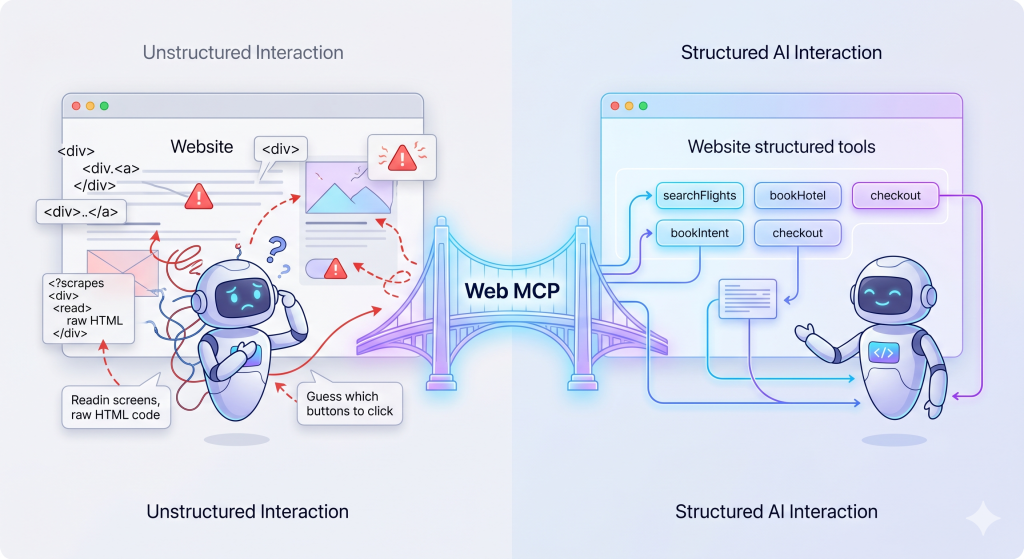
    What is Web MCP? The Digital Handshake

    Web MCP is the implementation of MCP at the browser and website level. It is what happens when the abstract power of MCP gets deployed on a live domain, accessible to AI agents operating on behalf of real users in real time.
    Web MCP

    Here is the architecture, simplified:

    The MCP Server is your website (or a service running on your domain). It exposes a set of defined “tools”: discrete functions that an AI can invoke. A tool might be search_products, check_availability, submit_inquiry, or get_pricing.

    The MCP Client is the AI agent: a model running inside a browser, assistant application, or autonomous workflow engine. It discovers your server, reads the tool definitions, and calls the relevant function based on user intent.

    The Model interprets user language and maps it to available tools. It does not guess. It reads your declared capabilities and acts on them.

    {
      "tool": "check_availability",
      "description": "Returns available SEO audit slots for a given date range",
      "parameters": {
        "date_from": { "type": "string", "format": "date" },
        "date_to": { "type": "string", "format": "date" },
        "service_type": { "type": "string", "enum": ["technical", "content", "full"] }
      }
    }

    This is what a Web MCP tool definition looks like. It is declarative, precise, and machine-readable. When an AI agent discovers this on your domain, it knows exactly what your site can do, not what it says.

    Web MCP is not a feature. It is the new baseline for AI-era discoverability.


    MCP vs. Web MCP: Understanding the Distinction

    DimensionMCPWeb MCP
    ScopeDeveloper infrastructure for connecting LLMs to internal data and APIsClient-facing protocol for exposing website capabilities to AI agents
    Primary UserDevelopers building AI applicationsBusinesses wanting to be discoverable and actionable by AI agents
    Connection MethodLocal or remote server integration within application architectureHosted on a public domain, discoverable by browser-level AI clients
    SEO ImpactIndirect: enables better AI productsDirect: determines whether your site is visible and usable by AI agents
    AnalogyThe plumbing inside a buildingThe front door that visitors actually use

    The key insight: MCP is infrastructure for developers building AI systems. Web MCP is the new HTML for anyone who wants to be visible in those systems. One is a construction material. The other is what the public-facing web is built with.

    If your team understands traditional SEO, think of Web MCP as meta tags, sitemaps, and structured data combined into a single, callable interface. Except instead of helping a crawler understand your content, it helps an agent perform actions on behalf of your customer.

    The Exact Problem Web MCP Solves: Closing the Execution Gap

    Three persistent failures define the AI-website relationship today. Web MCP addresses all three.

    Hallucination Prevention

    AI models fill gaps. When an agent does not have direct access to your data, it infers. It guesses your pricing from cached mentions. It estimates your availability from outdated snippets. It describes your services based on what similar businesses typically offer.

    Web MCP creates a live Source of Truth. The agent calls your tool. Your system returns the actual value. No inference. No guess. No reputational damage from a confidently wrong answer.

    Real-Time Data Access

    Traditional search crawls are periodic. A crawler visiting your site today might be working from a cache that is weeks old. For static content like brand messaging, that is acceptable. For inventory levels, appointment slots, live pricing, or active promotions, it is disqualifying.

    Web MCP is synchronous. The agent calls the tool at the moment of user intent. Your server responds with current data. The gap between reality and what the AI reports collapses to near zero.

    Actionability Without Redirection

    Traditional SEO achieves one outcome: bringing a user to a page. Everything after that (clicking a button, filling a form, completing a purchase) depends on the user doing it manually.

    Web MCP removes that dependency. The agent does not need to bring a user to your site. It can execute the intent directly. A user asking their AI to “get me a quote for a technical SEO audit” can have that form submitted, confirmation received, and calendar invite generated before they finish reading the response.

    This is not automation for automation’s sake. It is meeting users where they are, which is increasingly inside AI interfaces they trust more than any single website.

    How Your Business Benefits from Web MCP

    Brand Authority in AI Responses

    AI models are not neutral. They build preference based on what is easiest to work with accurately. A site with a well-defined Web MCP server produces clean, reliable outputs. A site without one produces guesses. Over enough interactions, agents learn to prefer reliable sources.

    Being “easy to talk to” is the new domain authority. Sites that offer structured, callable interfaces get cited more often, trusted more deeply, and recommended more confidently. This is AI brand authority, and it compounds.

    CRO 2.0: Conversions Without Clicks

    Picture this scenario: a potential client tells their AI assistant, “Find and book the best SEO audit service in India.” The agent queries multiple providers. One has a Web MCP tool called submit_inquiry with parameters for name, email, business size, and primary concern. The agent populates those fields from conversational context and submits the lead.

    Your CRM receives a qualified inquiry. The user never visited your site. The conversion happened entirely in an interface they chose and trusted.

    This is CRO 2.0. The conversion funnel no longer starts at your homepage. It starts at the user’s intent and ends at your tool endpoint.

    Reduced Bounce Rates Through Interface Agnosticism

    Users no longer leave an AI interface to visit a site, struggle with navigation, and return frustrated. With Web MCP, your brand’s logic, your data, your forms, and your outcomes become accessible without that journey. The user stays in their preferred interface. You still get the interaction.

    Bounce rate, in the traditional sense, becomes irrelevant. Engagement becomes measured by tool calls, not sessions.

    Implementation: Becoming “Agent-Ready”

    Implementing Web MCP is not a single task. It is a structured process across three interconnected pillars.

    Pillar 1: Tool Definition

    Identify which website capabilities are worth exposing. Not every feature needs to be a tool. Start with high-intent, high-value functions: search, booking, quoting, checking availability, submitting contact forms. Each tool needs a clear name, a precise description, and well-typed parameters. Vague definitions produce unreliable agent behavior.

    Pillar 2: The MCP Server

    The tools need to be hosted and discoverable. This means running a compliant MCP server on your domain that responds to agent discovery requests and handles tool invocations. The server manages authentication, rate limiting, and response formatting. It must be performant and reliable; agents that encounter failures will deprioritize your site in future interactions.

    Pillar 3: Schema Alignment

    Your existing structured data (JSON-LD, schema.org markup) should connect to your MCP tools. If you have a LocalBusiness schema with defined services, those services should map to callable tools. This alignment ensures that the information you already publish for crawlers reinforces and contextualizes the capabilities you expose to agents.

    This is where most businesses encounter the gap: they have the data, but not the infrastructure to surface it in agent-readable form. An AI-SEO agency bridges that gap by connecting existing technical SEO work to agentic protocols, ensuring neither is built in isolation.

    The New Frontier of Authority

    Web MCP is the next logical step after llms.txt file. That file told AI models what your site contains. Web MCP tells them what your site can do. The progression from passive declaration to active capability is not optional. It is the direction the web is moving.

    The metrics that define visibility are changing. Impressions, rankings, and click-through rates describe a world where users came to websites. In the world taking shape, users stay in their AI interfaces and send agents to complete tasks on their behalf.

    Visibility in 2026 is measured by Integration, not Impressions.

    Businesses that define their capabilities, host a compliant server, and align their existing schema with agentic tools will be the ones that AI agents reach for. The rest will exist on a web that agents rarely visit.

    The question is not whether Web MCP will become standard. It is whether your domain is part of it when it does.

    FAQs:

    Q1. What is Web MCP?

    Web MCP is the implementation of Model Context Protocol at the website level. It allows AI agents to directly call functions on your website, like checking availability or submitting a form, instead of just reading your content.

    Q2. How is Web MCP different from regular SEO?

    Traditional SEO helps search engines find and rank your content. Web MCP goes further by letting AI agents interact with your website’s capabilities directly, without the user ever visiting a page.

    Q3. Do I need Web MCP if I already have structured data (Schema)?

    Schema markup tells crawlers what your content means. Web MCP tells AI agents what your website can do. Both work together; your existing JSON-LD schema should ideally map to your MCP tool definitions for maximum AI visibility.

    Q4. Is Web MCP relevant for small businesses in India?

    Yes. As AI assistants become the primary way users discover and engage with services, any business, regardless of size, that exposes callable tools via Web MCP becomes actionable to agents. Early adoption is a direct competitive advantage, especially in markets where most competitors have not yet implemented it.
  • How to Check Your Brand’s AI Visibility for Free (Step-by-Step Guide)

    How to Check Your Brand’s AI Visibility for Free (Step-by-Step Guide)

    Search has changed. A growing number of users no longer scroll through ten blue links. They type a question into ChatGPT, Perplexity, or Gemini and read a synthesized answer. If your brand is not showing up in those answers, you are losing ground you may not even know you are losing.

    The problem is measurement. Traditional SEO tools track rankings. They tell you where you appear on page one of Google. But they were never built to tell you whether an LLM mentions your brand when someone asks for the best project management tool, the most trusted accounting software, or the top digital agencies in London. That gap in visibility tracking is real, and most brands are flying blind.

    This guide gives you a free, step-by-step method to check your Brand  AI visibility, in free , understand where you stand relative to competitors, and begin tracking it consistently.

    What AI Visibility Means Today

    AI visibility refers to how often and how prominently your brand appears in AI-generated answers. If you are still exploring what is AI Visibility, it includes direct mentions, citations as a source, and recommendations in response to comparison or buying queries.

    Unlike a traditional ranking, AI visibility is not a position number. It is a pattern. Your brand either gets recalled by the model when a relevant query is asked, or it does not. The goal is to be consistently present across the queries that matter to your audience and ultimately drive more revenue to your business.

    Why Traditional SEO Tools Are Not Enough

    Rank trackers, site auditors, and backlink tools are valuable. But they measure performance in indexed search, not in large language models. When ChatGPT answers a question, it is not pulling from a live Google index. It is drawing on patterns in its training data, often augmented by retrieval systems that pull from trusted web content in real time.

    This is a fundamentally different process, and existing tools do not capture it. The debate around SEO vs GEO has surfaced for exactly this reason. Generative Engine Optimization requires different inputs, different metrics, and different measurement approaches than traditional search optimization.

    If you are relying only on keyword rankings to assess your discoverability, you are missing a growing portion of the search landscape entirely.

    Step-by-Step Guide to Check AI Visibility for Free

    Step 1: Identify the Prompts That Matter

    Start by building a list of queries your audience is likely to type into an AI tool. These fall into three categories:

    Informational queries ask for knowledge or explanation. Examples:

    • “What is the best way to manage remote teams?”
    • “How does programmatic advertising work?”

    Comparison queries put options side by side. Examples:

    • “ChatGPT vs Perplexity for research”
    • “Best email marketing tools for small businesses”

    Commercial queries signal buying intent. Examples:

    • “Top SEO agencies for SaaS companies”
    • “Which CRM is best for a 10-person sales team?”

    Aim for 20 to 30 prompts that genuinely reflect how your customers search. Include your category, your use cases, and the problems you solve. This becomes your testing set.

    Step 2: Run Manual Checks in AI Tools

    Now take your prompt list and run each query through the three main AI surfaces:

    • ChatGPT (GPT-4o)
    • Perplexity AI
    • Google AI Overviews (search with AI mode enabled)

    For each result, record three things:

    1. Is your brand mentioned? Yes or no.
    2. What position? First mention, secondary mention, or buried in a list.
    3. What context? Are you described accurately, positively, as a leader, as an alternative, or not at all?

    This manual pass gives you a baseline. It is slow, but it is free and surprisingly revealing. Most brands discover they are absent from a large portion of relevant queries, or that competitors dominate the AI answers in their space.

    Step 3: Track Mentions Systematically

    Running queries once is not enough. AI answers shift. Model updates change what gets recalled. You need a tracking system, even a simple one.

    Set up a spreadsheet with these columns:

    QueryAI ToolDateBrand MentionedPositionSentimentCompetitor Mentioned
    “Best project mgmt tools”ChatGPT2026-04-21Yes2ndNeutralAsana, Monday

    Run your full prompt list once a week or once a fortnight. Over time, you will see patterns: which queries your brand is strong on, where you are slipping, and where a competitor is consistently beating you. Consistency in tracking is more valuable than any single snapshot.

    Step 4: Analyze Competitor Visibility

    Once you have a few rounds of data, shift to competitive analysis. For each query, note which brands appear most frequently, in what position, and with what framing.

    You are looking for:

    • Share of mentions: Out of 30 queries, how many times does your brand appear versus a competitor?
    • Positioning quality: Are you recommended first, or are you an afterthought?
    • Description accuracy: Does the AI describe you correctly and favorably?

    This comparison often reveals specific query clusters where a competitor dominates. Those gaps are your opportunity. If a rival is consistently cited on comparison queries and you are not, the problem usually traces back to content authority, entity recognition, or citation patterns in trusted sources.

    Step 5: Use Free Tools to Scale Your Tracking

    Manual checks have limits. A few free tools can extend your reach without cost:

    Google search operators: Use site:perplexity.ai “your brand name” or check Google’s AI Overviews for your key categories directly in search.

    Reddit search: Many AI tools, especially Perplexity, pull heavily from Reddit discussions. Search Reddit for your category queries and see which brands dominate organic community mentions. This is a proxy for what the models are seeing.

    Google Alerts: Set alerts for your brand name combined with category terms. This surfaces new content that may feed into AI training or retrieval.

    For a more structured approach, tools like AI Visibility Checker (by Polyvalent) are designed specifically to automate prompt-based tracking across multiple LLMs, giving you consistent data without manual effort. It is a natural next step once you have outgrown the spreadsheet method.

    How to Benchmark Your Brand in AI Search

    Once you have a few weeks of tracking data, you can build a simple benchmark using three measures:

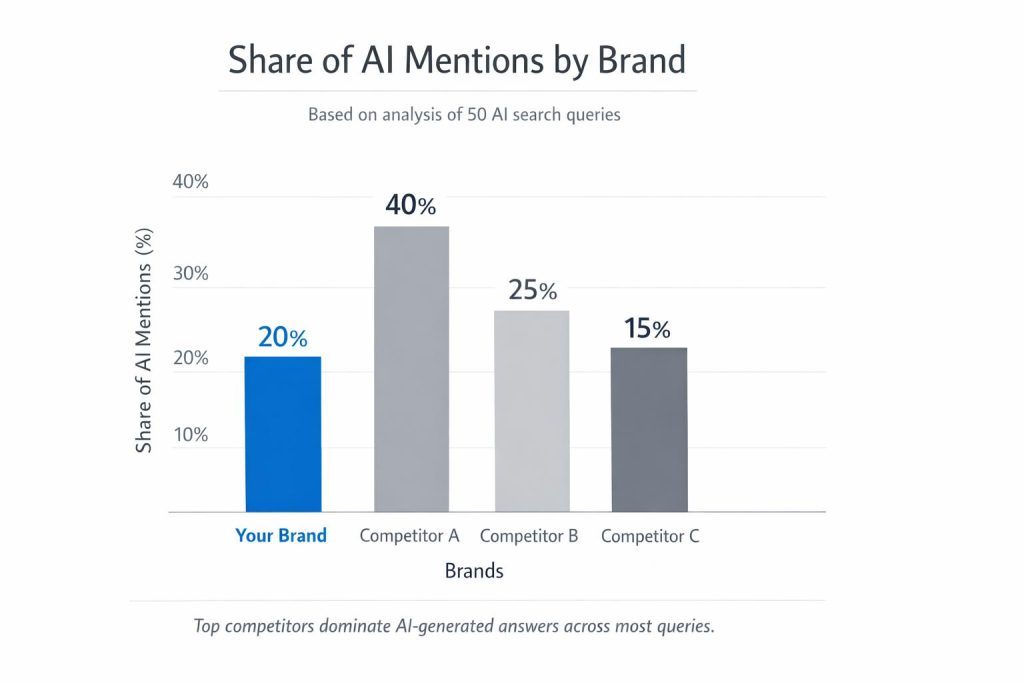
    Share of Mention in AI Visibility

    Share of mentions: The percentage of your tracked queries on which your brand appears. A brand with 40% share of mentions across 30 queries is considerably more visible than one at 10%.

    Query coverage: How many distinct query types surface your brand? A brand that only appears on branded queries but never on comparison or category queries has shallow coverage.

    Competitive positioning: Where do you rank in AI answers relative to direct competitors? Understanding these patterns is the foundation of actionable AI visibility metrics.

    Key Metrics to Track Without Paid Tools

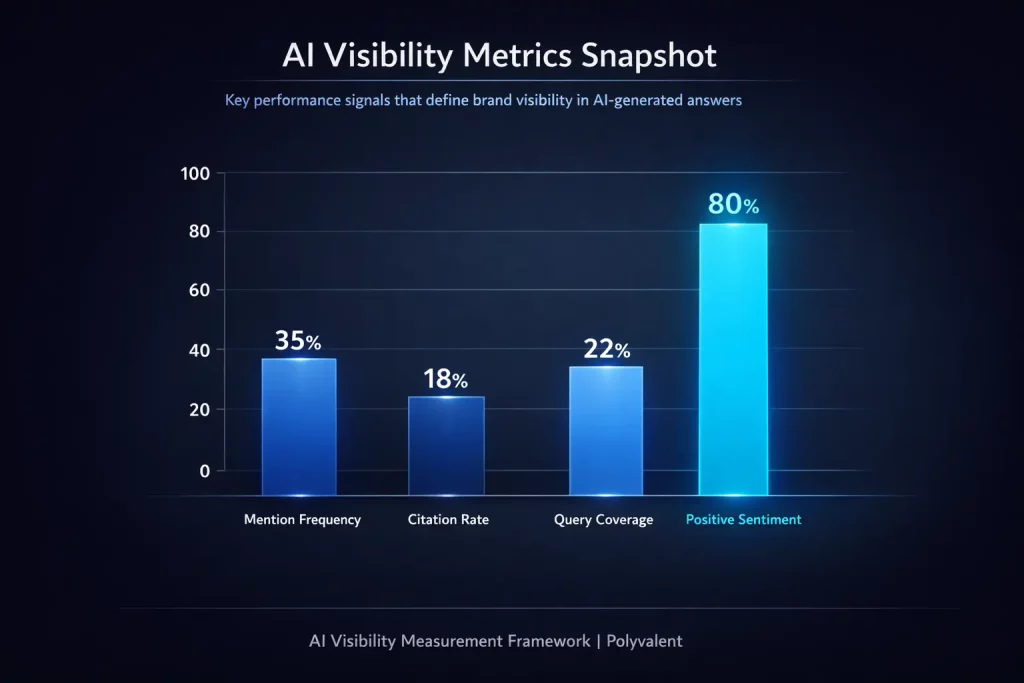
    Even without enterprise software, you can track these five metrics manually:

    AI Visibility Metrics
    • Mention frequency: How often your brand appears across your tracked query set
    • Citation rate: How often you appear as a named source or reference, not just a mention
    • Query coverage: The breadth of topics and intents on which you appear
    • Sentiment: Whether mentions describe you positively, neutrally, or inaccurately
    • Authority sources: Whether your brand appears when the AI references industry-leading content or only in generic lists

    These give you a picture of both presence and quality, which matters more than raw mention count.

    Common Mistakes to Avoid

    Testing too few prompts. Twenty prompts is a starting point. Brands that test only five or six get misleading results. The more diverse your query set, the more accurate your visibility picture.

    Ignoring competitors. Your raw mention count means little without context. A brand with 15 mentions out of 30 queries sounds strong until you realize a competitor appears on 28.

    Confusing rankings with mentions. AI mentions are not the same as search rankings. A brand can rank well on Google and be almost invisible in LLM answers, and vice versa. These are separate signals.

    Tracking inconsistently. AI answers evolve. A one-time audit tells you where you stood that week. Regular tracking tells you whether your visibility is growing, shrinking, or shifting.

    How to Improve AI Visibility After Measurement

    Once you know where you stand, improvement comes from a few reliable levers:

    Entity clarity: Make sure your brand is defined clearly across your website, Wikipedia, Wikidata, and industry databases. LLMs and vector search systems rely heavily on entity recognition. If your brand’s identity is ambiguous, it will be underrepresented.

    Content authority: Publish content that directly addresses the queries in your tracking set. Long-form, well-structured, factually specific content is what Retrieval-Augmented Generation systems tend to surface.

    Consistent mentions in trusted sources: Being cited in respected publications, forums, and review platforms increases the probability that AI models associate your brand with relevant queries.

    Structured data: Schema markup helps search engines and AI crawlers understand what your content is about. This matters particularly for product, organization, and FAQ schema. If you want to go deeper, read our guide on how to optimize for AI overviews.

    FAQ

    What are the best free AI visibility tools available?

    Google AI Overviews, Perplexity, and ChatGPT can all be used manually for free visibility checks. For structured tracking, Google Alerts and Reddit search help extend your coverage. AI Visibility Checker by Polyvalent offers a dedicated, automated option for brands that need consistent multi-LLM tracking.

    How do I measure LLM mentions for my brand?

    Build a set of 20 to 30 relevant prompts, run them through major AI tools, and record whether your brand is mentioned, in what position, and with what sentiment. Repeat this consistently over time to build a meaningful dataset.

    Is there a tool to track ChatGPT citations?

    Not natively. ChatGPT does not expose a citation index. The most practical approach is prompt-based testing: run queries manually or through a tool like AI Visibility Checker and log results in a structured format

    How are AI SEO tools different from traditional SEO tools?

    Traditional SEO tools measure performance in indexed search, tracking rankings, backlinks, and crawlability. AI SEO tools measure brand presence in LLM-generated answers, which requires different inputs like prompt testing, entity analysis, and semantic relevance scoring.

    Is there something like Ahrefs for AI search?

    Not yet at the same scale or maturity, but tools like Profound, Brandwatch AI features, and AI Visibility Checker are moving in that direction. The space is new, and the tooling is developing quickly.

    How does RAG affect brand visibility?

    Retrieval-Augmented Generation means the model pulls from live or recent sources at query time. Brands that are well-represented in high-authority, crawlable web content have a better chance of being surfaced through RAG pipelines. Strong traditional content strategy feeds directly into RAG visibility.

    How do LLMs retrieve and rank sources?

    LLMs do not rank sources the way search engines do. They learn associations from training data and, in RAG setups, retrieve chunks of content based on semantic similarity to the query using vector search. Content that is clear, authoritative, and semantically relevant is retrieved more often.

    What is entity-based optimization for AI search?

    Entity-based SEO means making your brand, products, and people clearly identifiable as named entities that models can recognize and associate with relevant topics. This involves structured data, consistent naming across sources, and presence in knowledge bases like Wikidata.

    How do I increase LLM recall for my brand?

    Create content that directly addresses the queries you want to be recalled for. Build citations in trusted publications. Ensure your entity data is clean. Structured data and consistent brand mentions across authoritative sources all improve the probability of LLM recall.

    What schema markup helps with AI visibility?

    Organization schema, FAQ schema, Product schema, and HowTo schema are the most directly relevant. They help crawlers and AI systems understand what your content covers and who you are, which feeds into both traditional and AI-generated search results.

    How do I optimize for vector search?

    Write content that clusters around specific topics with semantic depth rather than relying on keyword repetition. Use clear headings, structured sections, and complete answers to specific questions. Vector search systems retrieve based on meaning, so content that thoroughly covers a topic performs better than content optimized for exact-match keywords.

  • How LLMs Decide to Mention Brands (And Why Most Never Get Picked)

    How LLMs Decide to Mention Brands (And Why Most Never Get Picked)

    LLM brand mentions are becoming one of the most important signals of visibility in AI-driven search. Your website may rank on page one of Google, your content may be strong, and you may still not appear in AI-generated answers.  So why doesn’t a language model mention your brand?

    That’s not an SEO problem. It’s an AI problem.

    LLMs don’t index websites and rank them. They don’t care about your backlinks or domain authority in the way search engines do. When someone asks an LLM a question, it isn’t retrieving your carefully optimized page from a ranked list. It generates an answer based on patterns it learned during training, potentially combined with real-time retrieved content if the system uses retrieval-augmented generation (RAG).

    Brand visibility is shifting. It’s no longer just about showing up in search results. It’s about being woven into the answers that AI systems generate when people ask questions. That’s a fundamentally different mechanism, and most businesses haven’t adjusted to it yet.

    This post isn’t a checklist of SEO tactics rebranded as “AI optimization.” Instead, it explains the actual mechanics of how LLM brand mentions work, why most brands never appear, and what you can realistically do about it.

    What Most People Get Wrong About AI Mentions

    Before diving into how LLMs mention brands, let’s clear away the misconceptions that are actively misleading people.

    Misconception 1: “If you rank high in Google, you’ll appear in LLM answers.”

    Search rankings and LLM mentions operate on different systems. Google ranks pages based on links, relevance signals, and user behavior. LLMs generate answers based on training data patterns and, in some cases, retrieved content. A brand that ranks #1 for a keyword might never appear in an LLM’s response about that topic. Conversely, a brand with weak SEO might be mentioned frequently by an LLM if it has a strong presence in training data or retrieved documents.

    Misconception 2: “LLMs are just summarizing or rephrasing top-ranking pages.”

    Some LLMs do use retrieval-augmented generation, which pulls in recent information. But even then, which sources get retrieved depends on multiple factors beyond ranking position. The system might weight source authority, topical relevance to the query’s intent, content freshness, and several other signals. A brand mentioned in 50 different contexts across the web has a higher chance of appearing than a brand with one strong, high-ranking page.

    Misconception 3: “You can directly optimize for LLM mentions like you optimize for SEO.”

    You cannot. LLM outputs are probabilistic. The same question, asked twice in a row, might produce slightly different answers. A brand that appears in one response might not in another. There’s no “position 1” in LLM answers. There’s only “this brand was included in this particular generation event.”

    This probabilistic nature is crucial to understand. It means control is limited. What you can do is influence the probability that your brand gets mentioned. You cannot guarantee it.

    What Is a Brand Mention in LLMs

    When we talk about LLM brand mentions, we need to be precise about what we’re counting.

    A brand mentioned in an LLM response is when a language model includes your brand name or product name when generating an answer to a user query. This can happen in several contexts:

    • Direct recommendations: “If you’re looking for project management software, consider Asana or Monday.com.”
    • Comparisons: “Unlike Slack, Discord is designed primarily for gaming communities.”
    • Examples within explanations: “Tools like Figma have democratized design software.”
    • Contextual references: “The machine learning field advanced significantly after the release of tools like TensorFlow.”

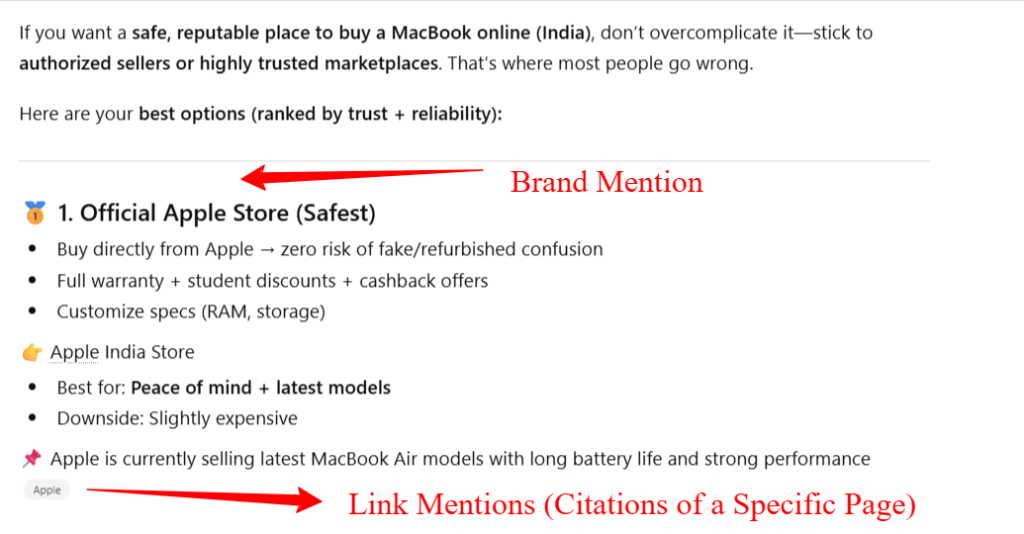
    This is different from a citation, which is a formal attribution of information. Many LLMs include citations when they retrieve content from specific sources. A mention doesn’t require a citation. A brand can be mentioned without a link or source attribution.

    Mentions also exist on a spectrum. A passing reference to a brand is a mention. So is an in-depth discussion of it. Both matter, though for different reasons.

    AI Mentions vs AI Citations (Add A Image Of Mention and Citations) 

    These terms often get confused, so let’s separate them.

    An AI mention is when an LLM includes your brand name in its response because it recognizes it as relevant to the topic or question. The mention exists in the generated text. It might appear with or without a link to your site.

    Brand Mention and Link Mentions

    An AI citation is when an LLM explicitly attributes information to a source. This is common in RAG systems. When an LLM says “According to [source]” or provides a hyperlink to a page, that’s a citation. Citations create direct traffic. They also signal that the LLM treated your content as authoritative enough to reference.

    A summary is different again. It’s when an LLM condenses information from one or more sources into a shorter form. You might be cited in a summary, mentioned without attribution, or not appear at all even if your content was part of the training or retrieval pool.

    Why does this distinction matter? Citations drive traffic. They’re also becoming the standard format for AI-generated answers, especially in systems like Google’s AI Overviews. Mentions influence perception. If users see your brand mentioned repeatedly across multiple LLM conversations, they start to recognize it as a category leader. But mentions alone don’t create traffic.

    For business strategy, citations are more immediately valuable. For brand authority, consistent mentions across different contexts matter more.

    How LLMs Decide to Mention a Brand

    This is where the real mechanism lives. LLMs don’t have a deliberate decision-making process like a human would. But their architecture and training create patterns that determine which brands surface.

    1: Training Data Patterns

    LLMs are trained on massive amounts of text data. During training, the model learns statistical relationships between words, concepts, and entities. If a brand name appears frequently alongside certain topics, the model learns that association.

    For example, if an LLM’s training data included thousands of articles about project management, and “Asana” appeared in hundreds of those articles while discussing task management, the model develops a strong association between “Asana” and “project management.” When a user asks about project management tools, the model’s probabilities for generating “Asana” increase.

    But frequency alone isn’t the only pattern that matters. Co-occurrence patterns matter too. If “Asana” frequently appears alongside “integration,” “collaboration,” and “automation,” the model learns those associations. If a user asks about a tool that helps with integrations, the model’s associations might make “Asana” more likely to appear.

    This is why established brands have an advantage. They’ve been mentioned more often, in more contexts, and alongside more relevant terms. They have deeper pattern roots in the training data.

    Smaller or newer brands face a different problem. If a brand appears only a handful of times in training data, or only in narrow contexts, the model won’t have learned strong associations with it. It becomes invisible.

    2: Retrieval-Augmented Generation (RAG)

    Not all LLMs rely only on training data. Many use RAG, which means they search for current information and incorporate it into their answer generation.

    When a user asks a question, the RAG system might retrieve recent articles, product pages, social media posts, or other documents relevant to the query. These retrieved documents influence what the LLM generates.

    Here’s where visibility becomes tied to retrievability. If your content isn’t easily retrievable through a RAG system’s search process, it might as well not exist. If your brand page uses jargon or terminology that doesn’t match the user’s query language, the retrieval system might skip it.

    Consider a user asking, “What’s the best software for managing customer data?” A RAG system searches for documents about “customer data management,” “CRM,” “customer relationship management,” and similar terms. Your product page exists, but if it uses different terminology like “customer engagement platform,” it might not get retrieved. No retrieval means no inclusion, even if your product is actually relevant.

    The freshness advantage of RAG is real, but it’s conditional. Older content that’s frequently referenced and retrieved still appears. New content that’s poorly discoverable remains invisible.

    3: NLP and Context Understanding

    LLMs don’t just match keywords. They understand semantic meaning and context.

    If a user asks about “tools for remote teams,” an advanced LLM understands that this query relates to collaboration, asynchronous work, distributed communication, and coordination. It searches for brands and products that align with those concepts, not just pages that literally contain those words.

    This is where entity clarity becomes important. An entity is how the model understands a thing to be. If your brand has a clear, consistent entity definition, the model can recognize it across contexts. If your brand is vague or poorly differentiated, the model struggles to connect it to relevant queries.

    A brand that is consistently described as “project management software” has a clear entity. A brand that’s described as “productivity software,” “collaboration tool,” “task manager,” and “work OS” simultaneously has a muddled entity. The model struggles to know what the brand actually is.

    Entity clarity also relates to semantic relationships. If an LLM understands that your brand is related to “remote work,” “asynchronous teams,” and “distributed companies,” it can surface your brand in responses about any of those topics. But this requires consistent messaging across multiple sources.

    4: Authority and Cross-Source Validation

    LLMs don’t trust a single source. They validate information across multiple sources.

    When an LLM generates a claim, it’s drawing from patterns learned across many documents. If a fact or claim appears in 50 different, independent sources, the model considers it more reliable. If it appears in only 2 sources, the model might be more cautious about including it.

    For brands, this means that mentions across multiple independent websites, publications, and platforms increase the likelihood of LLM mention. If your brand is mentioned only on your own website and one partner site, the model has limited external validation. If your brand is mentioned in industry publications, reviews, case studies, and competitor comparisons, the model treats it as more authoritative.

    This is why PR, earned media, and third-party mentions matter more for LLM visibility than they do for traditional SEO. A mention in TechCrunch carries more weight in LLM systems than a mention on your own site, not just because it signals credibility, but because it’s an independent source. Multiple independent mentions create a pattern the model recognizes as significant.

    5: Sentiment and RLHF Influence

    LLMs are trained not just on data, but also on human feedback. This process is called Reinforcement Learning from Human Feedback (RLHF).

    During RLHF, human raters evaluate LLM outputs. They score responses on accuracy, helpfulness, safety, and tone. The model learns not just what to say, but how to say it responsibly.

    This influences which brands appear in answers. If training data includes negative sentiment about a brand, the model might be trained to deprioritize mentioning it. If a brand is described neutrally or positively across sources, the model is more likely to include it.

    Safety considerations also play a role. If a brand has associations with misinformation, scams, or harmful content, the model might avoid mentioning it even if it appears frequently in training data. The RLHF process overrides pure pattern matching when necessary.

    This means a brand with consistent, positive mentions across the web has a higher probability of appearing in LLM responses than a brand with controversial or negative associations.

    Why Some Brands Never Get Mentioned

    Understanding the mechanisms above makes it clear why some brands remain invisible to LLMs.

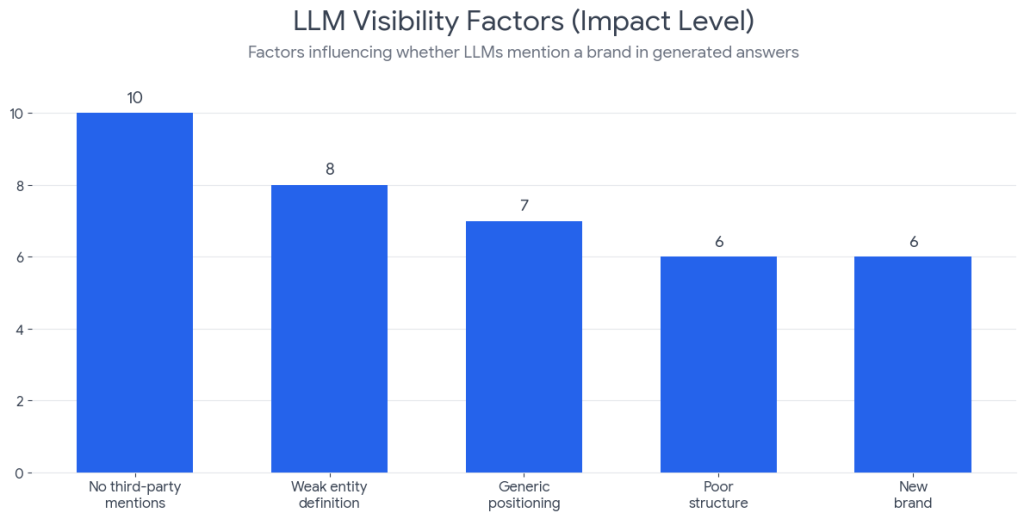
    Weak Entity Definition

    If your brand’s purpose, positioning, and category are unclear, LLMs struggle to understand when to mention you. If you’re simultaneously a “CRM,” a “customer engagement platform,” and a “sales tool,” you lack a coherent entity. The model doesn’t know which queries to associate with you.

    Lack of Third-Party Mentions

    If your brand appears only on your own website, blog, and official channels, the model has limited external validation. It doesn’t recognize you as significant because you’re not being talked about independently. Brands that are discussed by journalists, reviewers, customers, and competitors have stronger presence in LLM patterns.

    Generic Positioning

    “We’re a productivity software that helps teams work together better.” That describes hundreds of products. An LLM reading this has no reason to mention your brand specifically. Generic positioning doesn’t create memorable, distinct patterns. Specific, defensible positioning does.

    LLMs Visibility Factors

    Poor Content Structure

    If your content doesn’t clearly explain what you do, who you’re for, and why you’re different, RAG systems struggle to retrieve it. Semantic understanding helps, but clarity always wins.

    Being New to the Market

    If you launched last month, you’re not in training data. RAG can help surface your content, but you won’t benefit from the deep pattern associations that established brands have. Growth in LLM visibility takes time.

    Ranking on Search Engines Doesn’t Guarantee AI Visibility

    Finally, and crucially: ranking highly on Google doesn’t automatically make you visible to LLMs. These are separate systems with different requirements. You might rank first for your keyword while never being mentioned by LLMs, or vice versa.

    How to Increase LLM Brand Mentions (Strategic, Not SEO Checklist)

    The goal here isn’t to “optimize for LLMs” in the way you optimize for search engines. That’s impossible. Instead, the goal is to become a stronger pattern that LLMs recognize and reference.

    1: Build a Clear Brand Entity

    Define precisely what your brand is, what problem it solves, and who it’s for. This definition should be consistent across your website, content, and marketing. When LLMs encounter multiple sources describing your brand in the same way, they develop a clear entity understanding. That clarity makes you more likely to appear when relevant questions are asked.

    2: Strengthen Presence Across the Web

    Get your brand mentioned in places beyond your own properties. Pitch journalists, contribute to industry publications, participate in roundtables, and be quoted by analysts. When your brand appears in independent sources, the pattern becomes stronger. The model recognizes you across multiple contexts.

    This isn’t about paying for mentions. It’s about becoming genuinely relevant to industry conversations. Earned mentions carry more weight in LLM systems than paid placement.

    3: Create Answer-Ready Content

    Write content that answers specific questions directly. If an LLM uses RAG and retrieves your content, that content should be clear, well-structured, and directly address the question being asked. Content that rambles, buries the answer in lengthy preambles, or requires significant reading to extract value is less likely to be incorporated into an LLM response.

    4: Structure Content for Machine Understanding

    Use clear headings, short paragraphs, and direct language. Include definitions of terms you use. Use schema markup where it applies. Make it easy for both humans and machines to understand what your content is about. This helps RAG systems retrieve it and LLMs understand its relevance.

    5: Reinforce Brand and Topic Association

    Consistently connect your brand to the specific topics, use cases, and problems you solve. If you’re a customer data platform, write about customer data challenges, customer data integration, customer data governance. Each piece of content reinforces the association between your brand and those concepts. Over time, LLMs develop stronger associations, making you more likely to appear in responses about those topics.

    You Cannot Control LLM Mentions?

    Before anyone launches a campaign claiming to “guarantee LLM visibility,” let’s be clear about what’s actually possible.

    You cannot control whether an LLM mentions your brand. You cannot predict with certainty which queries will surface your brand. You cannot game LLM systems the way you can technically game search rankings (though that’s increasingly difficult too).

    LLM outputs vary. The same question asked at different times might produce different answers. Sometimes your brand appears. Sometimes it doesn’t. There’s no position 1 in LLM answers. There’s only probability.

    This is actually clarifying, because it means you should stop thinking about LLM mentions as something to “optimize” like a ranking position. Instead, think about building genuine authority and presence that makes mention more likely across many interactions.

    The Shift from SEO to AI Presence

    For two decades, digital marketing strategy centered on search engines. Get ranked, get traffic, grow. That framework is shifting.

    SEO focuses on page rankings. AI systems focus on answer inclusion. These require different strategies.

    SEO rewards narrow keyword focus, link authority, and ranking signals. AI visibility rewards clarity, broad topical authority, and consistent presence across the web.

    SEO is about being first. AI presence is about being relevant, reliable, and recognizable.

    This shift happens gradually. Search engines still drive traffic. But as AI answer engines become the primary interface for discovery, the rules change. Understanding AI visibility becomes essential to long-term visibility strategy.

    Optimizing for AI overviews requires a different mindset. You’re not building pages for rankings. You’re building authority, clarity, and presence to influence how AI systems understand and represent your brand.

    What Changes as Discovery Moves to AI Systems

    The mechanism of discovery is fundamentally changing. Users increasingly ask AI systems questions and get answers directly, rather than clicking through to websites.

    This reshapes competitive advantage. A brand that appears in AI overviews gets visibility without a click. But that visibility is based on different factors than traditional search visibility.

    For businesses, this means strategy must adapt. Establishing strong GEO and topic authority becomes crucial as answer engines replace traditional search for many queries.

    The brands that thrive in this transition won’t be those that tried to game one system. They’ll be the ones that built genuine authority, clear positioning, and consistent presence across multiple channels.

    FAQs

    What is an LLM brand mention?

    An LLM brand mention is when an AI model includes your brand name in its generated response to a user’s question.

    Do LLMs rank websites like Google?

    No. LLMs do not rank websites. They generate responses based on patterns in training data and retrieved information.

    Can you directly control LLM brand mentions?

    No. You cannot directly control them. You can only influence the probability through authority, content, and brand presence.

    What is the difference between AI mentions and AI citations?

    AI mentions are when your brand name appears in an answer. AI citations are when the model references your content as a source.

    Conclusion

    LLMs don’t choose brands. They repeat patterns.

    The patterns are built from training data, shaped by retrieval systems, influenced by human feedback, and refined by semantic understanding. Your goal is to become the strongest pattern in those systems.

    You cannot directly optimize for LLM mentions. You cannot buy your way to guaranteed visibility. You cannot control the output.

    What you can do is build a brand that deserves to be mentioned. Make that brand clear. Make it distinct. Build genuine authority. Earn mentions from independent sources. Create content that directly answers questions. Structure that content for understanding.

    Do this consistently, across time and across platforms, and the probability that LLMs mention your brand increases.

  • How to Optimize Your Website for AI Overviews

    How to Optimize Your Website for AI Overviews

    Search has changed. Ranking on page one is still important, but in many searches, users now see AI-generated summaries before traditional organic results. These AI Overviews. often answer the query directly and shape which websites get noticed first.

    If your content is not being cited in these summaries, you may be missing visibility even when your rankings look strong. For many businesses, this means SEO is no longer only about earning clicks. It is also about becoming a trusted source that search engines reference.

    People are increasingly getting quick answers without scrolling through multiple links. That shift makes content clarity, credibility, and structure more important than ever.

    To stay competitive, your website needs to do more than rank. It needs to provide useful, well-structured information that search engines can confidently surface in AI-driven results.

    What is AI Overviews?

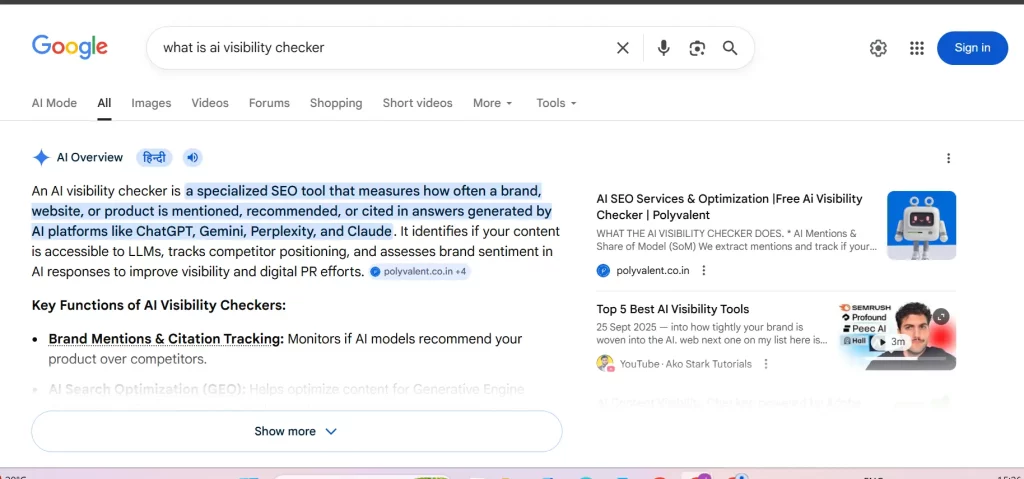
    AI Overviews represent a shift from “search engine” to “answer engine.” When a user submits a query, the system evaluates the top-tier content across the internet and generates a cohesive, easy-to-read summary. This summary appears before the traditional organic listings, providing users with an immediate solution to their problem.

    When AI Overviews Appears

    For business owners, these summaries are critical because they capture the “Position Zero” spot. They offer a unique blend of high visibility and instant credibility. When your website is cited within an overview, you are not just a search result; you are a verified expert.

    When AI Overviews Appears

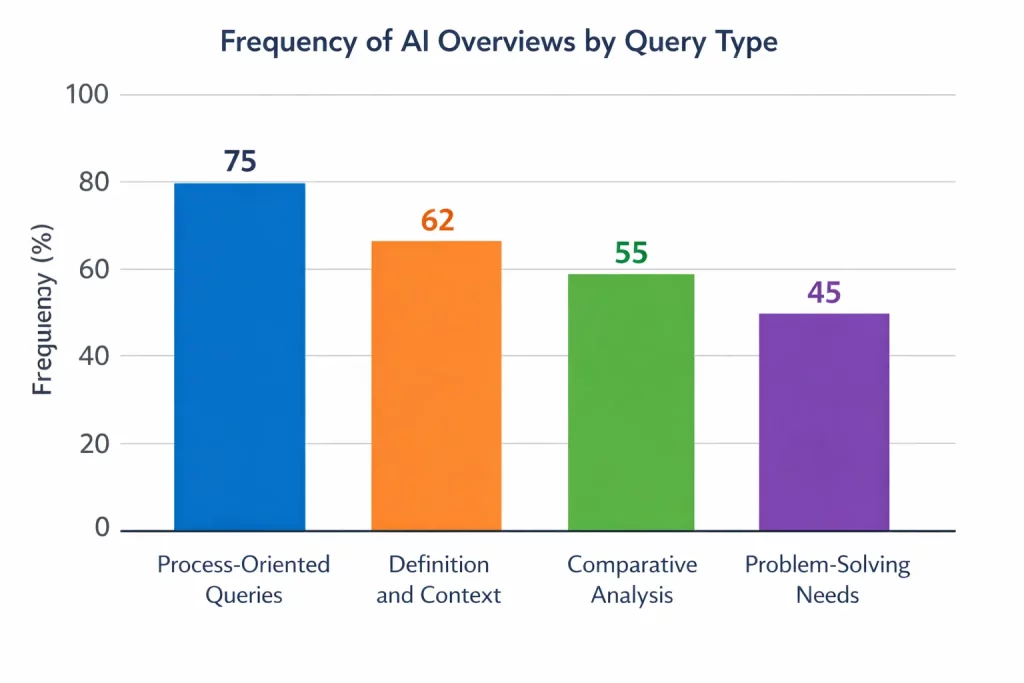
    These generated summaries do not appear for every single search. They are specifically designed for moments when a user needs more than a simple fact but less than a full research paper. You will most commonly see them in the following scenarios:

    Frequency of AI Overviews by Query Type
    • Process-Oriented Queries: Any search that involves “how to” or “steps to” usually triggers a summary to break down the stages of a task.
    • Definition and Context: When a user asks for an explanation of a complex concept or a recent trend.
    • Comparative Analysis: Searches that ask to compare two products, services, or strategies.
    • Problem-Solving Needs: When a user describes a symptom or an issue and looks for potential causes or fixes.

    How AI Overviews is Important for Business and Websites

    The impact of these summaries on your digital performance cannot be overstated. They influence every stage of the marketing funnel.

    Building Trust Through Citations

    When a search engine picks your content to power its summary, it serves as a high-level endorsement. Users are more likely to trust a brand that is featured as a foundational source for an answer.

    Driving Qualified Traffic

    While the summary provides an answer, it also leaves the user wanting more detail. The clicks that come from these summaries are often from users who are deeper in the research phase and are more likely to engage with your site’s specific offerings.

    Staying Ahead of the Competition

    As more companies compete for a limited number of spots, those who optimize early for these overviews will secure a long-term advantage in brand recognition and organic reach.

    How AI Overviews Work

    The logic behind these summaries is based on relevance and clarity. The system does not just look for keywords; it looks for “entities” and “intent.”

    1. Parsing the Query: One of the most critical components of this process is a concept known as Query Fan Out. When a user enters a complex or multifaceted question, the search system does not look for just one answer. Instead, it “fans out” the original query into several related sub-queries. For example, if a user asks “How do I transition my business to a remote model,” the system might generate sub-queries about remote communication tools, legal requirements for home offices, and employee engagement strategies. By gathering data from many different sources simultaneously, the engine can build a comprehensive summary that covers every angle of the user’s intent.
    2. Source Evaluation: It scans indexed pages that have high authority and clear structures.
    3. Information Extraction: It pulls out specific sentences or data points that directly address the user’s intent.
    4. Generative Synthesis: It rewrites that information into a natural, conversational format, providing links back to the original creators.

    7 Strategies to optimize for AI Overviews

    Achieving visibility in these summaries requires a mix of technical precision and high-quality writing. Here are seven ways to prepare your site.

    1. Make Content Scannable

    Search engines need to be able to “read” your page in milliseconds. Use a clear hierarchy with H2 and H3 tags. Use bullet points for lists and keep your paragraphs short. The easier it is for a machine to parse your page, the easier it is for that machine to summarize it.

    2. Keep Content Fresh and Updated

    An outdated page is an untrustworthy page. Ensure your content reflects the most current data, dates, and industry standards. Regularly refreshing your high-traffic posts signals to search engines that your information is still the most accurate choice for an overview.

    3. Ensure Pages are Indexed or Indexable

    Your technical foundation must be solid. Use your search console to ensure there are no crawl errors. If a search engine cannot access your page or if your site architecture is a maze, your content will never be considered for a summary, regardless of how good the writing is.

    4. Perform Keyword Research and Use Long-Tail Keywords

    Focus on “conversational” keywords. Think about how a person would ask a question out loud. Instead of targeting “SEO tips,” target “What are the most effective ways to improve search visibility in 2026?” This aligns your content with the natural language patterns that trigger overviews.

    5. Improve Website Speed and Pass Core Web Vitals

    Performance is a ranking factor that carries over into the world of summaries. A fast-loading site with a stable visual layout provides a better user experience. Engines prefer to cite sources that won’t frustrate the user once they click the link.

    6. Follow Technical SEO and On-Page SEO Best Practices

    Using structured data (Schema markup) is non-negotiable. This hidden code tells the search engine exactly what your content represents whether it is a recipe, a review, or a FAQ. For a complete list of technical requirements, refer to this GEO Checklist to ensure you aren’t missing any critical steps.

    Alongside schema, optimizing internal linking helps search engines better understand your content hierarchy, topical authority, and page relationships, making it easier for both traditional search and AI systems to surface your most valuable pages.

    Authority is still the currency of the web. Focus on earning links from reputable industry publications and news sites. Furthermore, ensure your brand is mentioned across social platforms and forums, as search engines use these broad signals to determine your overall influence.

    How to Check Your Website is Appearing in AI Overviews

    Monitoring your presence in these summaries is different from checking your standard rankings. Because these overviews can be personalized or location-dependent, you need specialized tools to get an accurate picture. Using an AI Visibility Checker allows you to see where your brand is being cited and where you are losing ground to competitors. Regular audits will help you identify which content pieces are performing well and which ones need a rewrite to be more “summarizable.”

    To improve your chances of being featured, focus on these specific types of backlinks:

    • Niche-Specific Directories: Be listed where your industry lives.
    • Educational (.edu) Citations: Provide research or data that schools and universities find valuable.
    • Guest Contributions: Write for high-authority blogs in your sector to prove your thought leadership.
    • Podcast and Webinar Mentions: Digital footprints from audio and video content add to your brand’s perceived authority.

    FAQs

    Will AI Overviews take away all my organic traffic?

    No. AI Overviews may reduce clicks for simple informational searches, but they can still drive traffic for users who want deeper explanations, comparisons, or services. If your content is cited, you can still attract highly qualified visitors.

    How does Query Fan Out help my website?

    Query Fan Out expands one broad search into multiple related questions. If your content clearly answers one of those related questions better than others, your page has a stronger chance of being included as a source.

    How do I know if my content is “summarizable”?

    Your content is easier to summarize when it answers a specific question quickly, uses clear headings, and avoids unnecessary filler. Strong introductions, direct explanations, and structured sections make it easier for search engines to extract useful information.

    Is long-form content still relevant?

    Yes. Detailed content often gives search engines more context, supporting facts, and topical depth. The key is structure. Long-form content works best when it is easy to scan and clearly organized.

    Do I need to use specific tools to rank in these summaries?

    No. Tools can help you monitor visibility, but ranking is more influenced by content quality, technical SEO, page structure, and authority. Useful tools support strategy, but they do not replace strong execution.

    Does mobile optimization affect AI Overviews?

    Yes. Mobile-friendly pages load faster, are easier to use, and provide a better experience after the click. Slow or poorly optimized mobile pages may reduce your chances of staying competitive.

    How often should I update my old blog posts?

    Review important pages every 3 to 6 months. Update outdated statistics, improve weak sections, refresh examples, and check whether the content still matches current search behavior. Regular updates help maintain relevance.