For more than two decades, the search engine optimization practice was simple, optimize for search engines and you were done. You built a page, earned backlinks, and fought for a spot in the top three results to capture the majority of clicks. Ranking higher meant more traffic, and more traffic meant more business.
But the SEO field is shifting. With the rise of tools like ChatGPT, Google Gemini, Claude, and Perplexity, the way people find information has changed. Users are no longer just browsing, they are interacting. They ask complex questions and expect immediate, synthesized answers. This evolution has birthed a new necessity for every modern brand called AI Visibility.
What is AI visibility?
AI visibility refers to how your brand appears in AI-generated answers across platforms like chatbots and large language models. It measures whether these systems recognize, mention, or recommend your brand when users ask relevant questions.
In simple terms, AI visibility is about being part of the answer, not just part of search results. Let’s understand this with a simple example.
When a user asks an AI tool, “Best AI Visibility Tool?” or “Which companies provide AI SEO services?”, the system generates a response. If your brand is included in that response, you have AI visibility. If not, you are missing from that conversation entirely. Now that you understand what AI visibility is, let’s explore another closely related concept: the AI brand visibility score.
What is the AI Brand Visibility Score?
As AI-driven discovery grows, brands need a way to measure their presence. This is where the AI brand visibility score comes in. This is a specialized metric used to quantify your presence in the generative ecosystem. It is typically calculated by taking a set of industry-relevant prompts and measuring:
- Mention Rate: How often your brand name appears in the AI’s generated text.
- Citation Rate: How often the AI provides a clickable link to your site as a source.
- Sentiment Framing: Whether the AI describes your brand in a positive, neutral, or "authoritative" light.
Traditional SEO Visibility vs. New AI Visibility
To truly understand the shift in the 2026 digital ecosystem, we have to look at how the delivery of information has branched away from the legacy models. In the Traditional SEO era, the journey was linear: a user typed a keyword, scrolled through a list of "blue links," and clicked a website to find an answer. Success was measured by how high you ranked (1–10) and your Click-Through Rate (CTR).
New AI Visibility (or Answer Engine Optimization) flips this model entirely.But AI-powered search is not a single experience. Google now delivers visibility through distinct systems, from quick synthesized summaries in AI Overviews to conversational journeys in AI Mode. Understanding AI Mode vs AI Overviews is essential because each shapes how brands are cited, discovered, and trusted in entirely different ways.
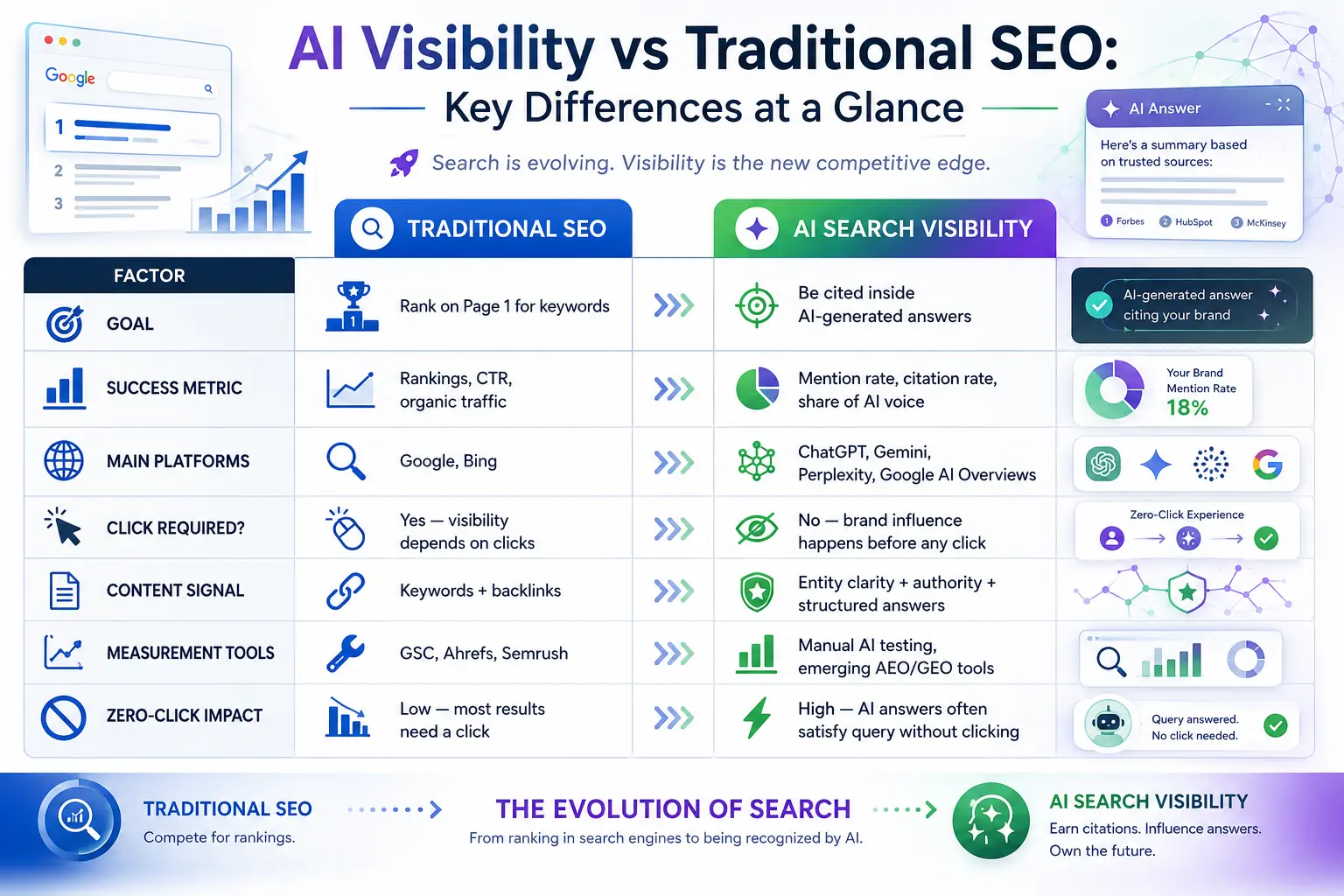
Instead of a list, users now engage in a conversational dialogue where the AI consumes your content and presents the conclusion directly on the search page. The goal is no longer just "ranking" it is inclusion.
If the AI doesn't cite your brand as an authority or an entity within its synthesized answer, you lose the "Share of Voice" before the user even has a chance to click. This requires a pivot from chasing keywords and backlinks to building context, entity-clear data, and undeniable authority that an LLM can easily extract and trust.
LLM Searches vs. Organic Search
The difference between LLM-based search and traditional organic search is becoming more evident through user behavior and industry data.
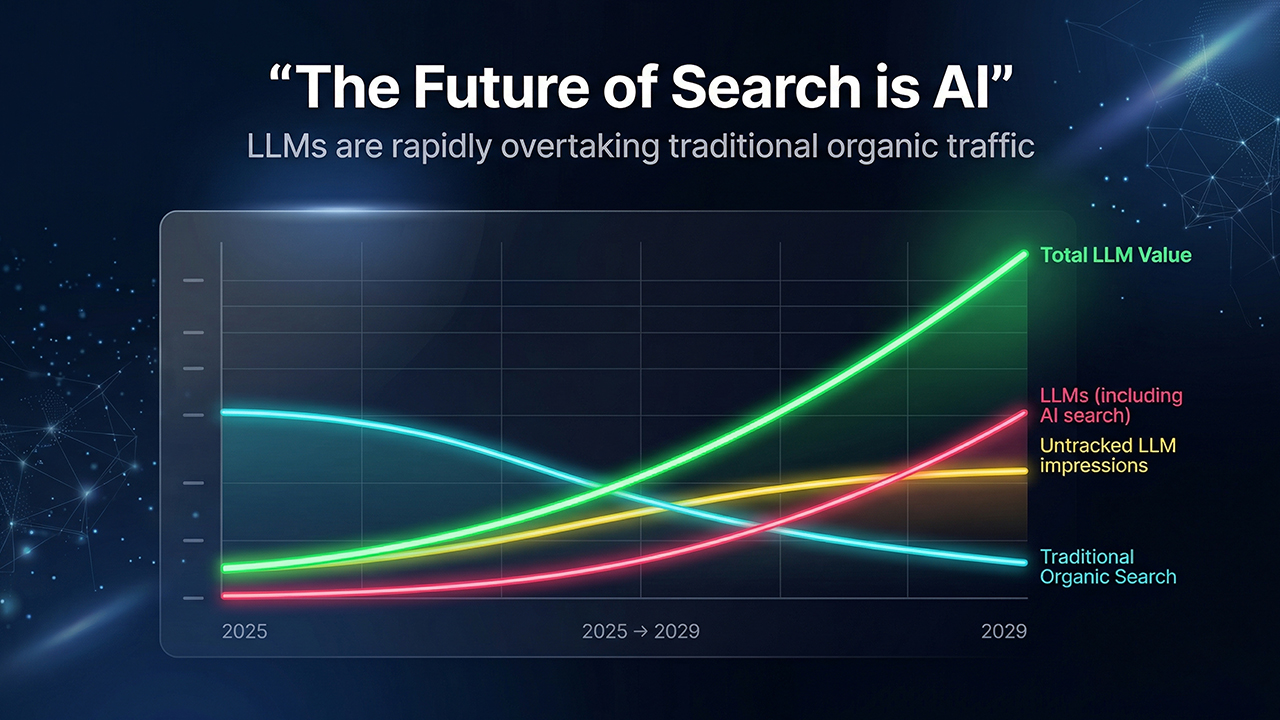
Recent studies in early 2026 have highlighted a growing divide in user behavior. According to Gartner's 2025 forecast, traditional search engine volume was expected to drop 25% by 2026 as users shifted to AI assistants.
- Conversion Power: While organic search still provides higher raw traffic volume, AI-referred visitors often convert at a significantly higher rate. A 2025 study found that users coming from a Perplexity or ChatGPT citation were "warm leads" who had already been "pre-sold" by the AI’s summary.
- Source Diversity: Only about 10-12% of URLs cited by LLMs actually rank in the top 10 of Google’s organic results. This means AI models are looking for quality of information over traditional domain authority.
Why Should I Track AI Brand Visibility?
The most startling trend in 2026 is the rise of the Zero-Click Search. Data from 2025 indicated that nearly 60% of searches ended without a single click, but with the full rollout of AI Overviews, that number has climbed.
When a user asks, "What is an AI visibility checker?" and Google Gemini provides a detailed summary of three specific tools, the user often gets exactly what they need without ever visiting a website.
The Zero-CTR Reality
Even if you rank #1 organically, your CTR can plummet toward zero if an AI Overview sits above you and answers the query completely. Tracking AI visibility allows you to see if you are being "cited" within that overview. Even if the user doesn't click, being the named authority builds massive brand equity and influences the user’s next move, often a branded search for your company later on.
The Shift to Conversational Search
Users are no longer "searching" with fragmented keywords like "best coffee shop delhi." They are "asking" questions like, "Where is a quiet coffee shop in south Delhi where I can work for three hours on a Tuesday?"
AI models handle these long-tail, intent-heavy queries much better than old-school algorithms. If you aren't tracking how AI perceives your brand's specific attributes, you'll miss these high-intent conversational opportunities.
Which Companies Benefit from AI Visibility?
While every brand needs a presence, certain sectors see a disproportionate advantage:
- B2B SaaS & Tech: Buyers use AI to compare features and pricing. High visibility here ensures you make the "shortlist" before a human salesperson even enters the room.
- Healthcare & Finance (YMYL): AI models prioritize highly authoritative, cited data for sensitive topics. Companies that provide clear, fact-checked content become the default "sources" for the AI.
- E-commerce: As AI-driven personal shoppers become common, brands that the AI "knows" and trusts are the ones suggested to consumers.
- Review Platforms: Recent studies show that platforms like Trustpilot have seen a massive surge in traffic because AI models rely on their "authentic human feedback" to judge other brands.
Should You Start Investing in Your Brand’s AI Visibility Now?
If you are waiting for "the right time" to optimize for AI, you might already be behind. In 2025, many brands saw a negative ROI as they experimented with these new systems. However, 2026 has been dubbed the "AI Search ROI Flip." Recent data shows that while organic traffic from Google has declined by 3–5% due to AI Overviews, the quality of traffic has skyrocketed. Users coming from an AI citation are 4.4x more likely to convert than traditional searchers.
The Cost of Inaction
In the AI era, visibility is cumulative. AI models like ChatGPT and Gemini learn from "historical trust."
- The Early Adopter Advantage: Brands that started structuring their data in 2025 are now the "default" answers in 2026.
- The Visibility Gap: If a competitor is cited as the "best solution" for six months, the AI's "Limited Memory" starts to treat them as the industry standard. Displacing them later becomes twice as expensive.
Is it a Good Investment?
Absolutely. Investing in AI visibility isn't just about "getting more clicks" it's about defending your market share. By the time a user sees an AI summary, the "research phase" is over. They aren't looking for a list of links; they are looking for a recommendation. If you aren't the recommendation, the investment you made in traditional SEO at the bottom of the page is essentially wasted.
How to Start Without Breaking the Budget
You don't need to delete your SEO budget to fund AI visibility. Instead, pivot your existing resources:
- Audit First: Use our AI Visibility Tool to see where you currently stand. You might be surprised to find you are already being mentioned or that a minor competitor is stealing your spotlight.
- Optimize High-Value Pages: Don't do the whole site at once. Pick your top 10 conversion pages and rewrite them for "AI Extractability."
- Clean Your Data: Ensure your Schema markup and "llms.txt" files are updated so bots can read your brand values clearly.
AI Visibility FAQs
What does AI visibility mean?
It is a measure of how often an Artificial Intelligence model (like ChatGPT or Gemini) includes your brand, product, or content in its synthesized responses to user questions.
How to do AI visibility?
To improve visibility, focus on Entity-Based SEO. This involves using clear Schema markup, creating FAQ sections that answer specific questions directly, and earning mentions on high-authority "source" sites that AI models use for training.
What are the 4 types of AI?
In the context of technology development, the four types are: Reactive Machines, Limited Memory, Theory of Mind, and Self-Aware AI. (Currently, most search-related AI falls under Limited Memory).
How to check AI visibility?
You can use specialized AEO (Answer Engine Optimization) tools like our AI visibility checker to track your share of voice within LLM responses.