Most websites don’t show up in AI search results because of simple problems that can be fixed. Avoid these 7 common mistakes and learn what really helps your site get mentioned by AI tools like ChatGPT, Claude, and Perplexity.
Search behavior is quietly shifting. People are no longer just browsing links. They are asking questions and expecting direct answers from tools like ChatGPT, Claude, Gemini and Perplexity. These platforms do not simply rank pages. They interpret content, extract meaning, and choose what to cite.
This creates a new layer of competition. Your website might rank well on Google, yet remain completely invisible in AI-generated responses. As Google rolled out AI Overviews, it led to a zero-click shift. That gap usually comes down to a few critical AI visibility mistakes.
In simple terms, if you are wondering what is AI Visibility, it is about how well your content can be discovered, understood, and trusted by AI systems. Let’s break down the most common mistakes that hold websites back. More importantly, you will learn how to fix them with practical, real-world strategies that improve both AI SEO and traditional rankings.
What Are AI Visibility Mistakes?
AI visibility mistakes are content or SEO issues that prevent your website from being selected or cited by AI tools. These mistakes often come from outdated SEO habits. Many websites still focus only on keywords and rankings, while AI systems look for clarity, structure, and trust.
A simple way to understand this:
If a human has to read twice to understand your content, an AI will likely skip it.
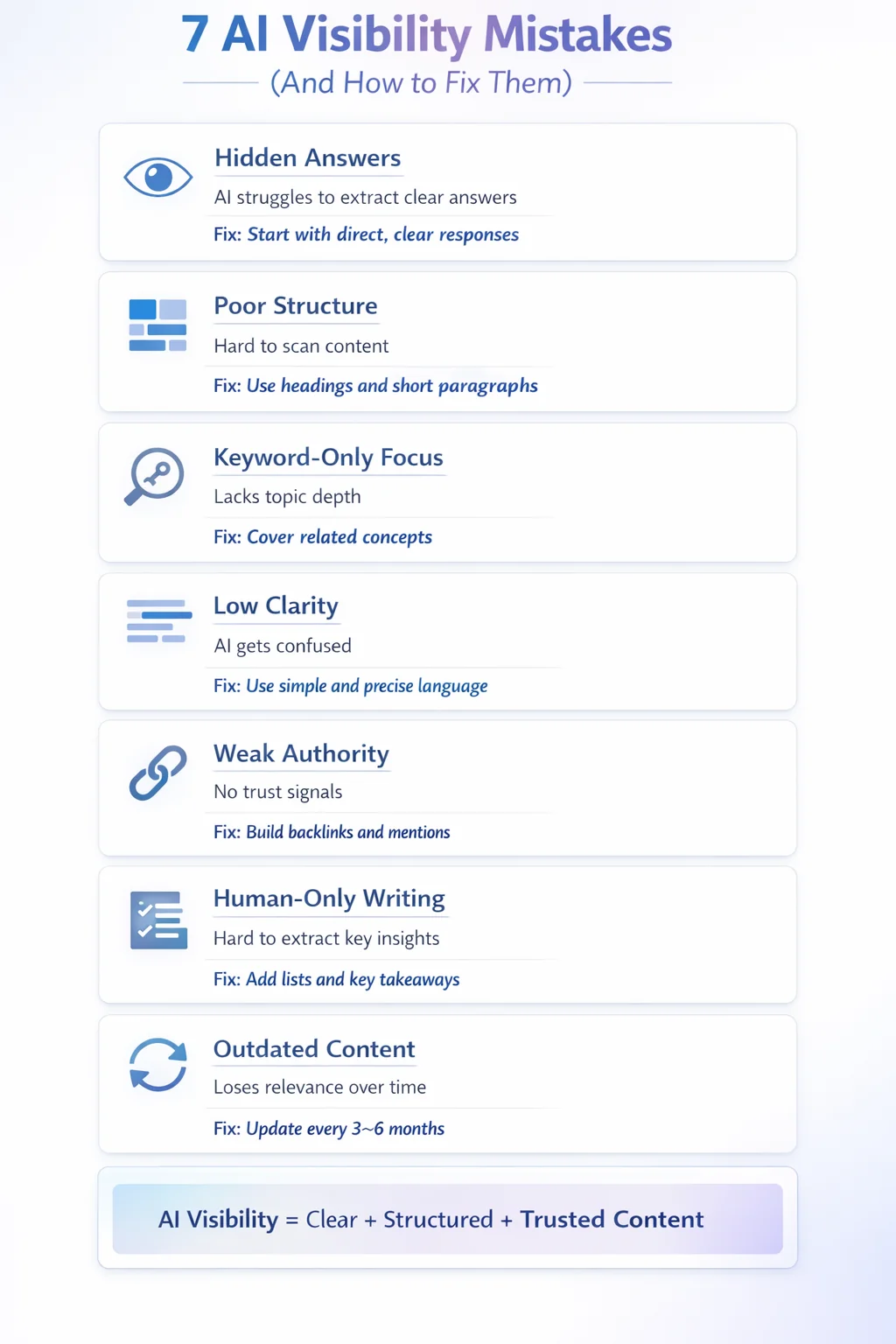
1. Are You Hiding the Answer Instead of Giving It?
A common issue with many web pages is that you delay the actual answer in the content.
The content builds slowly, adds filler, and only reaches the point much later. That might work for storytelling, but it does not work for AI systems. AI tools prefer content that answers the question immediately or is answered directly. They scan for direct, clear statements and they can extract and reuse the content.
For example, imagine someone searches: "What is AI SEO?"
A strong answer looks like this:
AI SEO is the process of optimizing content so that AI tools can understand, summarize, and cite it in their responses.
After that, you can expand with details, examples, and context.
Why this mistake happens
- Writers focus too much on word count
- Content is written for search engines, not answers
- Important points are buried
How to fix it
- Start sections with a clear answer
- Use simple, direct sentences
- Follow the answer with explanation
Think of your content as something that should be easy to quote.
2. Does Your Content Feel Heavy and Hard to Read?
You might have valuable information, but if your content looks dense, it creates friction.
AI systems prefer structured content. So do humans. When paragraphs are too long and there are no clear breaks, both readers and AI struggle to extract meaning.
Instead of large text blocks, create a natural rhythm and aim for visuals also like infographics. A good blog feels like a conversation. It flows. It pauses. It highlights key ideas.
What poor structure looks like
- Long paragraphs
- No headings
- No visual breaks
What works better
- Table of contents.
- Short paragraphs (2 to 3 lines) answer the question in the initial paragraphs.
- Clear headings that guide the reader.
- Occasional bullet points to simplify ideas.
- Use tables where required.
For example:
Good structure improves AI content visibility because:
- It separates ideas clearly
- It highlights important information
- It makes extraction easier
Structure is not just design. It is communication.
3. Are You Thinking in Keywords Instead of Topics?
One of the biggest shifts in SEO is moving from keywords to context. If your content is built around a single keyword like "AI visibility mistakes" and nothing else, it will feel shallow. AI systems look for topical depth. They want to understand if your content truly covers the subject.
That means including related ideas naturally, such as:
- AI SEO.
- New SEO acronyms.
- Explanation of GEO and AI Overviews.
- AI search optimization
- GEO Checklists
- Content structure
- Authority signals
Instead of forcing keywords, focus on answering the bigger question behind the topic.
Example
A weak article might just list mistakes.
A strong article explains:
- How AI reads content
- Why citations matter
- What makes content trustworthy
Fix this by:
- Expanding your coverage
- Add supporting concepts with expertise.
- Add relevant insights or provide data.
- Writing with context, not just keywords
When your content feels complete, AI systems trust it more.
4. Are You Making It Hard for AI to Understand Your Content?
Even great content can fail if it lacks clarity. AI does not ‘guess’ meaning the way humans do. It relies on structure, context, and precision. If your sentences are vague or unclear, your content becomes harder to interpret.
For example:
Bad:
This strategy works really well for better results.
Better:
Internal linking improves crawlability and helps search engines understand page relationships.
The second version is specific and clear. That makes it easier for AI systems to use.
Where most websites go wrong
- Vague language
- Missing context
- No structured signals
Simple improvements
- Use precise language
- Add clear explanations
- Use headings to define sections
You can also support this with:
- FAQ sections
- Schema markup
- Well-organized content
Clarity is one of the strongest drivers of AI search optimization.
5. Why Authority Still Matters More Than You Think
Even if your content is well-written, AI tools will not trust it unless your site has authority.
AI systems rely on signals like:
- Backlinks
- Brand mentions
- Content consistency
If your website has no credibility signals, it is less likely to be cited.
Think of it this way:
AI tools prefer content that already has trust across the web.
Example
Two blogs explain the same topic.
- One has backlinks from trusted sites
- The other is new with no references
The first one is far more likely to be used by AI.
How to improve authority
- Earn high-quality backlinks
- Publish consistently
- Build a recognizable brand
You do not need thousands of links. You need relevant and credible ones.
6. Are You Writing Only for Humans?
Good writing matters. But in AI SEO and optimization for AI visibility, structure matters just as much. Some blogs are engaging and well-written, but they lack clarity in how information is presented.
AI systems are not reading your content like a human. They are extracting key points. That means your content should make those points obvious.
For example, instead of hiding insights in paragraphs, you can highlight them:
Key benefits of AI SEO include:
- Better visibility in AI tools
- Higher authority
- More targeted traffic
This does not reduce quality. It improves usability.
Balance is key
- Keep your tone natural
- Add structure where needed
- Highlight important insights
You are not choosing between human and AI. You are optimizing for both.
7. When Was the Last Time You Updated Your Content?
Content is not static. What worked six months ago may not work today. AI tools prefer fresh, updated information. If your content feels outdated, it becomes less reliable.
Many websites publish content and never revisit it. A common mistake among website owners and publishers is simply updating a blog post without adding new, valuable information. That is a missed opportunity.
Signs your content needs updating
- Outdated examples
- Generic statements
- Missing new trends
Simple update strategy
- Refresh content every 3 to 6 months
- Add new examples
- Improve clarity and structure
For example:
Old:
AI search is growing fast
Updated:
AI tools like Gemini, ChatGPT, and Perplexity are now widely used for direct answers, reducing reliance on traditional search results
Small updates can significantly improve AI content visibility.
Why AI Visibility Matters
AI Visibility is not just another SEO trend. It is a shift in how information is consumed. People trust AI-generated answers because they are quick and direct.
If your content is cited, you gain:
- Instant authority
- Higher trust
- More qualified traffic
Here is a simple definition:
AI visibility is the ability of your content to be selected and cited by AI tools when answering user queries.
Ignoring this shift means losing visibility where attention is moving.
Quick Checklist to Fix AI Visibility Mistakes
We’ve published a detailed GEO Checklist to help you optimize your content effectively. If you’re looking for a simple and practical way to audit your pages, this is the best place to start.
Content clarity
- Does your content answer questions directly?
- Are key ideas easy to understand?
Structure
- Are paragraphs short and readable?
- Do you use headings properly?
Depth
- Does your content cover the full topic?
- Are related concepts included?
Authority
- Do you have backlinks and mentions?
- Is your content trustworthy?
Updates
- Is your content fresh and relevant?
- Have you improved it over time?
This checklist alone can help you fix most AI visibility mistakes.
Conclusion
AI search is changing the rules of visibility. Ranking is no longer the only goal. Being understood and cited is what matters now. The good part is that you do not need complicated strategies to improve.
Focus on what works:
- Clear answers
- Strong structure
- Deep, useful content
- Consistent updates
Start with one article. Improve it using these principles. Then repeat the process. That is how you build long-term visibility in both search engines and AI platforms.
FAQs
What are AI visibility mistakes?
AI visibility mistakes are issues that prevent your content from being understood or cited by AI tools like ChatGPT and Perplexity.
How can I improve AI SEO quickly?
Start by improving clarity, structure, and topical depth. Make your content easy to extract and understand.
Does Google ranking guarantee AI visibility?
No. A page can rank on Google but still not be used by AI tools if it lacks clarity or authority.
What is the role of structure in AI content visibility?
Structure helps AI systems identify key information quickly, making your content easier to extract and cite.
How often should I update content?
Ideally every 3 to 6 months, depending on how fast your industry evolves.