Google search used to be a straightforward transaction. Earlier, a user typed a query into Google and clicked through a list of ten blue links. Now, the experience is very different. Google has become both a search engine and an assistant that can summarize, explain, and guide users through information.
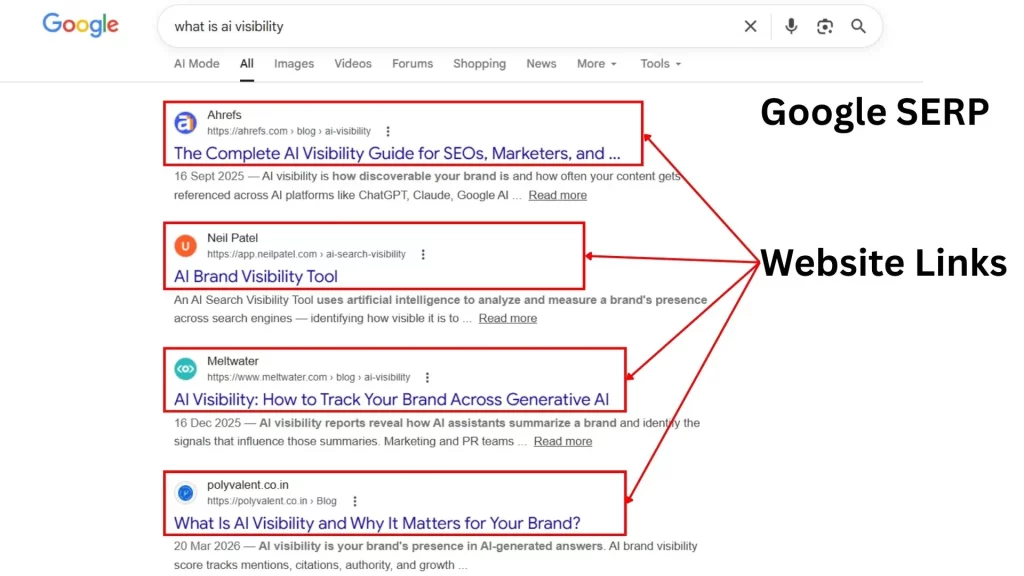
With AI Overviews and the rise of AI Mode powered by Gemini, search now works in two distinct ways. This shift is changing how brands get discovered online.
For businesses and SEO professionals, the goal is no longer only about ranking at the top of search results. It is about understanding how these two experiences work.
AI Overviews focus on quick summaries, while AI Mode creates a more interactive and conversational search journey. Since both surfaces pull and present information differently, they also need different SEO and content strategies.
Why So Many People Are Confused About Google’s AI Features
The confusion starts with branding. Over the past two years, Google has rolled out several AI features across its products, which has made the naming a bit confusing at times. Gemini itself is the AI model that powers many of these experiences.
AI Overviews is a search feature. AI Mode is a separate search experience. They are related but not the same thing.
Most coverage in the SEO industry either conflates these features or discusses them in isolation without explaining the relationship between them. That makes it difficult to understand what you are actually optimizing for, or which feature is even responsible for a drop in your click-through rates.
AI Overviews are the snapshots that appear at the top of the standard search engine results page (SERP). They are designed for speed, providing a quick synthesis of information so the user doesn’t have to click through multiple websites.
AI Mode, often accessed via the Gemini tab or the “Ask a follow up” button, is a dedicated conversational environment. This is where search becomes a dialogue. Instead of a single answer, the user engages in a multi-turn investigation. While they share the same underlying intelligence, the way they select sources and present brands is strikingly different.
What Are AI Overviews?
AI Overviews are the AI-generated summary boxes that appear at the top of Google’s standard search results page for certain queries. Google rolled these out broadly in the United States in mid-2024 following the earlier Search Generative Experience (SGE) testing period.(Now rolled out worldwide as AI Overviews)
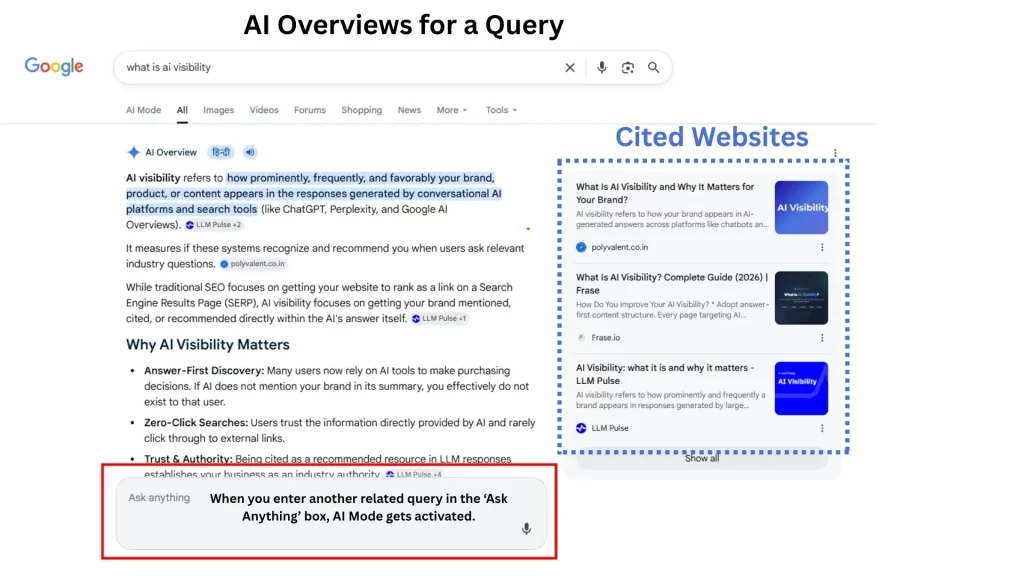
When a user searches for something like “how does compound interest work” or “best approach to content audits,” they may see an AI-generated paragraph or two at the top of the page, pulling from multiple sources and presenting a synthesized answer. Below that, traditional organic results continue to appear.
The visibility implication is significant. For informational queries where AI Overviews appear, many users get a satisfactory answer without clicking through to any website. This is the zero-click problem that SEOs have been discussing since Featured Snippets became common. AI Overviews accelerate that pattern considerably.
That said, AI Overviews do cite sources. If your content is cited, you may appear at the top of the page with an attributed link inside the AI response. That kind of visibility can drive branded awareness even without a direct click. However, earning that citation is not a simple process. Google does not give clear guidelines on which sources it pulls from, and the selections can seem inconsistent from one query to the next.
What Is AI Mode?
AI Mode represents a much bigger shift from traditional search. Introduced in 2025, it moves away from the usual search results page and replaces it with a conversational experience. Instead of scrolling through a list of links, users interact directly with an AI assistant in a back-and-forth conversation. They can also ask follow-up questions naturally, just like chatting with a person.
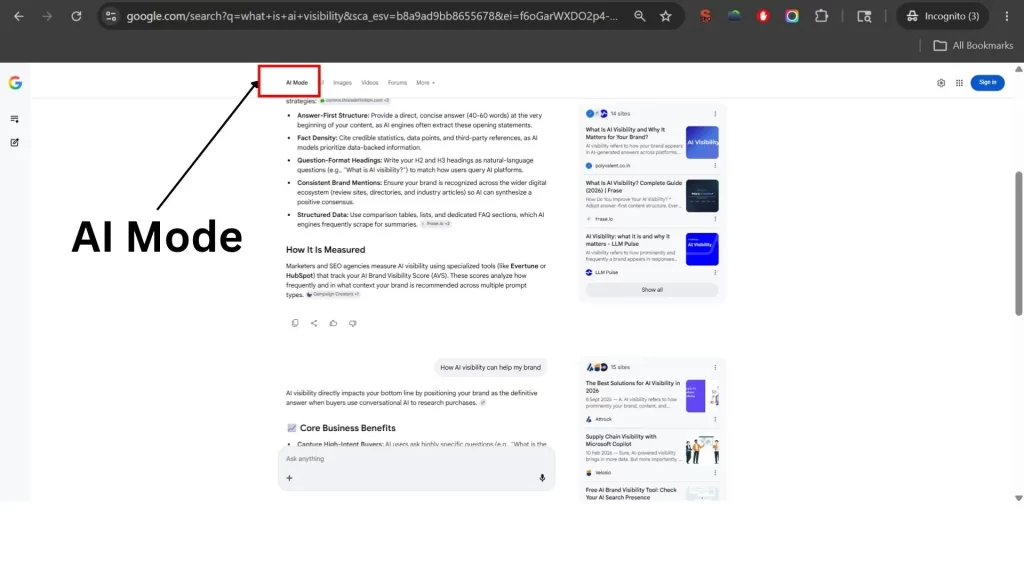
It handles complex, multi-part queries especially well. If someone is trying to research a decision, compare options, or work through a problem, AI Mode allows users to do that within Google’s interface rather than hopping between multiple pages.
For publishers and brands, AI Mode creates a fundamentally different discoverability challenge. When a user never leaves the search interface, the entire web becomes more of a background data source than a destination. Organic traffic as a metric becomes less reliable as a measure of search visibility.
AI Mode vs AI Overviews: What Actually Differs
The most practical distinction is this: AI Overviews appear inside a traditional search results page as a supplemental feature. AI Mode is a separate mode that replaces the search results page with a conversational experience.
From a user behavior perspective, someone using AI Overviews still sees traditional results below the summary and may click on them. Someone using AI Mode is engaging with a conversation thread and may never navigate to a website at all.
From an SEO perspective, AI Overviews are more predictable to track. You can observe when they appear for specific queries, see which sources are cited, and monitor changes over time. AI Mode is harder to analyze because the responses are more dynamic and personalized. There is no fixed SERP to audit.
Both features reduce the volume of clicks that flow to organic results. But they do so through different mechanisms and at different scales. AI Mode, if it becomes the default search experience for a large portion of users, is the more transformative of the two.
The table below captures the most practically useful differences between the two features:
| Dimension | AI Overviews | AI Mode |
| Where it appears | Inside standard Google Search results | Separate conversational interface, replaces the SERP |
| Response length | Concise, 1-3 paragraph summary | Roughly 4x longer than AI Overviews |
| User interaction | One-directional summary | Multi-turn conversational dialogue |
| Citation rate | Sources missing approximately 11% of the time | Sources missing only around 3% of the time |
| Brand/entity mentions | Average ~1.3 entities per response | Average ~3.3 entities per response |
| Preferred content types | Articles, video content, community platforms | Articles, encyclopedic and detailed health sources |
| Responses with no brands mentioned | ~59% contain no brand or entity | ~35% contain no brand or entity |
| Semantic agreement with each other | High: ~86% similarity in meaning | High: ~86% similarity in meaning |
| Source overlap between the two | Only about 14% of cited URLs appear in both | Only about 14% of cited URLs appear in both |
| Best for | Quick informational queries | Research-heavy, complex, multi-step queries |
Why AI Overviews Sometimes Feel Off
Anyone who has spent time reading AI Overview responses has noticed that they are not always accurate. Google has acknowledged this. The model can misattribute claims, oversimplify nuanced topics, or produce responses that sound confident while being factually incomplete.
This creates a trust problem that is still unresolved. Users interacting with AI Overviews often cannot easily assess the reliability of the information they are seeing. The visual presentation is authoritative even when the underlying synthesis is imperfect.
For brands in industries where accuracy is critical, such as healthcare, legal, finance, or technical sectors, this shift deserves close attention. If an AI Overview incorrectly explains your product, service, or expertise, there is no simple way to directly fix or edit that information right now. The most effective approach is to create clear, well-structured, and reliable content that gives AI systems accurate information to reference.
This also highlights the growing importance of entity authority. The better Google understands your brand, what you do, and the topics you are associated with, the more accurately it is likely to present and summarize your business.
How AI Search Is Changing the Foundation of SEO
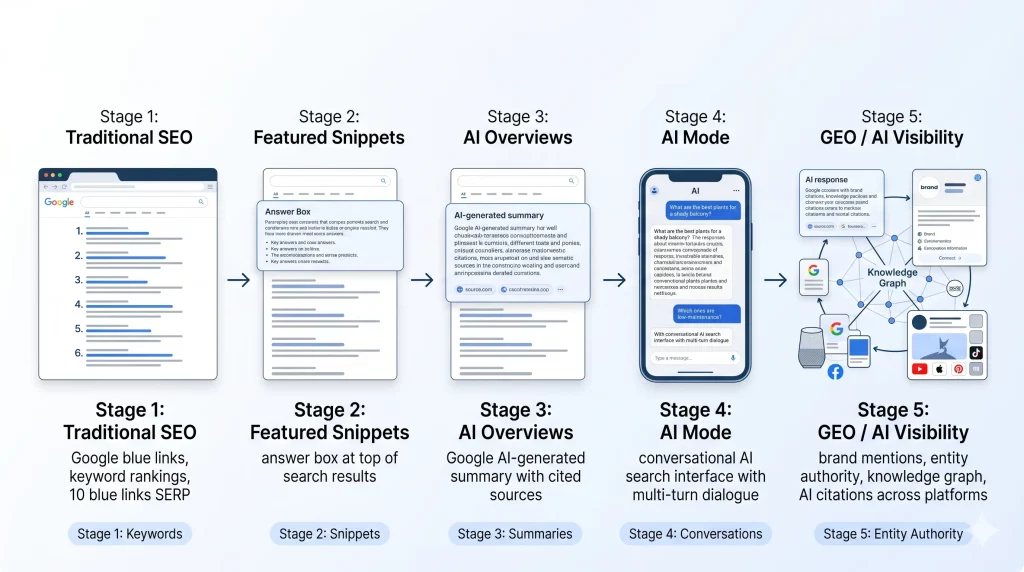
The shift toward AI visibility means that traditional keyword density is becoming a relic. We are moving into the era of Generative Engine Optimization (GEO).
Entity Authority and the Knowledge Graph
Google is no longer just looking for keywords; it is looking for entities. An entity is a well-defined person, place, or thing that Google recognizes in its Knowledge Graph. If you want to appear in AI Mode, your brand needs to be recognized as an authority on a specific entity. This is achieved through consistent mentions across high-authority platforms, deep topical coverage, and a clear “digital footprint” that links your brand to its expertise.
Semantic Relevance Over Exact Matches
In a conversational search, the user’s intent is often buried in the context of their previous questions. AI Mode uses “query fan-out,” where it runs multiple background searches to satisfy a single user prompt. This means your content needs to be semantically rich. It should answer the primary question while also addressing the “next” three questions a user is likely to ask.
The Role of Structured Data
Structured content and Schema markup have moved from “nice-to-have” to mandatory. While traditional SEO uses Schema to get rich snippets, AI SEO uses it to provide a roadmap for the LLM. By using technical markers to define exactly what a page is about—whether it’s a product review, a technical tutorial, or a case study—you help the AI cite you with greater accuracy and confidence.
The Shift from Rankings to Visibility
In the old world, we tracked rankings. In the new world, we track AI visibility.
As search evolves beyond traditional rankings, brands must understand what is AI Visibility and why it is becoming central to modern SEO. AI visibility measures how often and how accurately your brand is cited, mentioned, or surfaced across AI-powered search experiences like Google AI Overviews, AI Mode, and generative engines. In a search landscape shaped by summaries and conversations, visibility increasingly depends on being recognized as a trusted source.
In the old world, we tracked rankings. In the new world, we track AI visibility. Ranking #1 for a keyword is meaningless if an AI Overview occupies the top 800 pixels of the screen and doesn’t mention you.
At Polyvalent, we focus on “Mention-Based SEO.” This involves monitoring how often a brand is included in the generative responses of Gemini and other models. Visibility is about being the “Source of Truth” that the AI relies on to build its answer. If the AI uses your data but doesn’t link to you, that is a failure of visibility. If it mentions your brand as the leading solution in a conversational thread, that is a modern SEO win.
What Businesses Should Do Next
Success in this era requires a departure from the “content treadmill” of generic posts. Instead, the focus must shift toward Generative Engine Optimization by becoming a definitive reference point for models.
Start by auditing your high-priority pages through the lens of a researcher. If a user asks a follow-up question, does your content provide the answer? If not, you will likely be cut from the AI Mode conversation. Use AI visibility tools to identify these gaps where competitors are currently capturing the conversation.
Next, prioritize “Encyclopedic Depth” as a pillar of your AI SEO strategy. Since Google AI search favors comprehensive, well-cited information, your AI search optimization should focus on semantic breadth. By integrating Answer Engine Optimization principles, you ensure the AI cannot ignore your site as a primary source.
Finally, embrace the community. Because AI Overviews pull heavily from Reddit and specialized forums, your presence on these platforms is critical for AI visibility. The engine often weights its source selection, whether in Gemini vs AI Mode, based on trusted human discussions. Aligning your strategy with these shifts ensures a lasting AI Overviews SEO impact that extends beyond a single search session.
The Future of Conversational Search
We are witnessing the end of search as a static list. Search is becoming a fluid, iterative process where the interface adapts to the user’s needs in real-time. This doesn’t mean SEO is disappearing; it means it is becoming more sophisticated.
The winners in this new landscape will be the brands that move beyond the “search box” mindset. By understanding the functional differences between the quick summary of an AI Overview and the deep investigation of AI Mode, you can position your brand to be present at every stage of the user’s journey. At Polyvalent, we believe that visibility in the age of AI isn’t about gaming an algorithm—it’s about becoming the most reliable, authoritative voice in the digital conversation.
FAQ
Is AI Overview better than AI Mode?
Neither is inherently better; they serve different intents. AI Overviews are superior for quick factual retrieval and “at-a-glance” information. AI Mode is far better for complex tasks, multi-step planning, and deep research where the user needs to iterate on their original thought.
How does AI Mode affect SEO?
AI Mode shifts the focus from individual keywords to long-context authority. Because it generates much longer responses, it provides more space for brand mentions, but it also demands higher-quality, more comprehensive content to be considered a viable source for a multi-turn conversation.
What is AI SEO?
AI SEO, often called Generative Engine Optimization (GEO), is the practice of optimizing content to be recognized, synthesized, and cited by large language models. It prioritizes entity authority, semantic depth, and structured data over traditional ranking factors like exact-match keywords.
Is Gemini the same as AI Mode?
Gemini is the brand name for Google’s AI model and its standalone chatbot interface. AI Mode refers specifically to the conversational search experience within Google Search that is powered by the Gemini model. While they are part of the same family, AI Mode is integrated directly into the search journey.
Conclusion
Google Search is no longer just about rankings. It is evolving into an AI-driven ecosystem shaped by summaries, conversations, and entity authority. Brands that understand the difference between AI Overviews and AI Mode, and adapt with GEO-focused strategies, will be better positioned to stay visible as search shifts from blue links to AI-powered discovery.