AI cites third-party sources instead of your website because it prioritizes consensus, authority, structured trust signals, and retrievability over rankings alone. To fix this, brands need stronger AI visibility through source authority, digital PR, entity SEO, and generative optimization.
Why Top Rankings No Longer Guarantee AI Citations
You have spent years mastering the art of search engine optimization. Your website ranks on the first page for your target keywords, your backlink profile is healthy, and your content is objectively better than the competition. Yet, when you ask ChatGPT, Perplexity, or Google Gemini a question about your niche, they cite Reddit, a massive aggregator, or a third-party review site instead of your domain.
This is the new reality of the “citation gap.” Ranking at the top of a traditional search engine no longer guarantees that you will be the source of truth for Artificial Intelligence. For brands and publishers, this shift is more than just a blow to the ego. It represents a fundamental change in how traffic and trust are distributed across the internet.
If you want to survive the transition to Generative Engine Optimization (GEO), you need to understand why these models choose their sources and how to position your brand as an undeniable authority that AI cannot ignore.
What Are Citations in AI?
In the context of generative AI, a citation is a digital footnote. It is the specific link or reference an AI model provides to justify the information it has generated. Unlike a traditional search result, which is an entry in a list, an AI citation is an endorsement of accuracy.
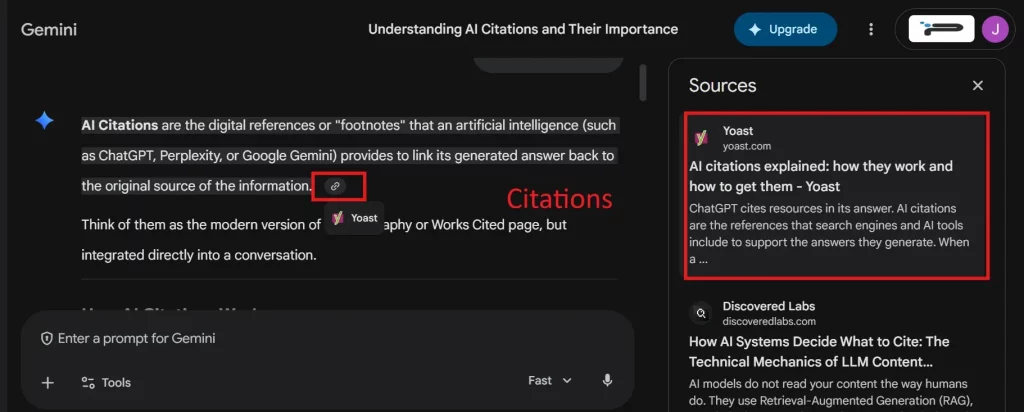
When an AI provides a citation, it is telling the user: “I didn’t make this up; I found this evidence here.” These citations appear as small superscript numbers, clickable cards, or “Sources” sections at the bottom of a chat response. They are the primary drivers of referral traffic in a world where users interact with chatbots instead of scrolling through pages of blue links.
Are Citations and Brand Mentions the Same Thing?
It is common to confuse a brand mention with a citation, but the distinction is critical for your SEO strategy.
A brand mention is when an AI talks about your company. For example, if you ask an AI for a list of top CRM software and it lists your brand, that is a mention. However, if the AI explains “How to set up a CRM pipeline” and uses a link to a HubSpot guide to verify its instructions, that is a citation.
Mentions build awareness, but citations build authority and drive high-intent traffic. You can be mentioned a thousand times as a “top player” while your competitors get all the citations because their content is structured as the foundational source of truth.
What Are First-Party and Third-Party Citations?
Understanding the hierarchy of sources is the first step toward fixing your visibility.
- First-Party Citations: These occur when an AI links directly to your website as the source of a fact, data point, or instructional step. This is the gold standard of AI SEO.
- Third-Party Citations: These occur when the AI cites another platform that is talking about you. Instead of citing your product page, the AI cites a Reddit thread, a G2 review, or a news article from a tech publication.
When third-party citations dominate, you lose control of the narrative. You are no longer the narrator of your own story; you are merely a character in someone else’s.
How AI Chatbots Display Sources and Citations
The way an AI displays a source often dictates the click-through rate (CTR).
- Perplexity AI: Uses prominent citations at the top of the interface and inline numbers. It functions almost like a “research engine,” making citations central to the user experience.
- ChatGPT (SearchGPT features): Integrates links within the flow of the text or in a side-bar “Sources” drawer.
- Google AI Overviews: Often displays a “carousel” of links above or alongside the generated text.
- Gemini: Provides a “double-check” feature and “Sources” dropdowns at the bottom of responses.
Each platform has a different “tolerance” for how many sources it will cite, but they all share a common goal: minimizing the risk of “hallucination” by anchoring their text to external data.
How to Check Whether AI Is Citing Your Website or Your Competitors
You cannot fix what you cannot measure. Traditional rank trackers are blind to the nuances of AI chat responses. To understand your current standing, you must perform manual and automated audits.
Automated checks are far better than manual checks.
How to Check Sources in AI Chatbots
The manual method involves “prompt engineering” your way to an audit. Ask the AI specific questions related to your core service or product:
- “Who are the leaders in [Industry] and what makes them unique?”
- “How do I perform [Specific Task] using [Your Product]?”
- “Compare [Your Brand] vs [Competitor].”
Observe which links appear in the footnotes. Are they citing your documentation, or are they citing a “Best 10” listicle from a third-party affiliate site?
Now, let’s look at how you can easily track your brand’s AI visibility with automated tools.
How to Check If Your Website Appears in AI Answers (Mention Polyvalent AI Visibility Checker)
Manual checks are time-consuming and often biased by your own chat history. For a more objective, data-driven approach, tools like the Polyvalent AI Visibility Checker are becoming essential. These tools allow you to track your “AI Share of Voice” by scanning how different LLMs (Large Language Models) perceive your brand across thousands of queries.
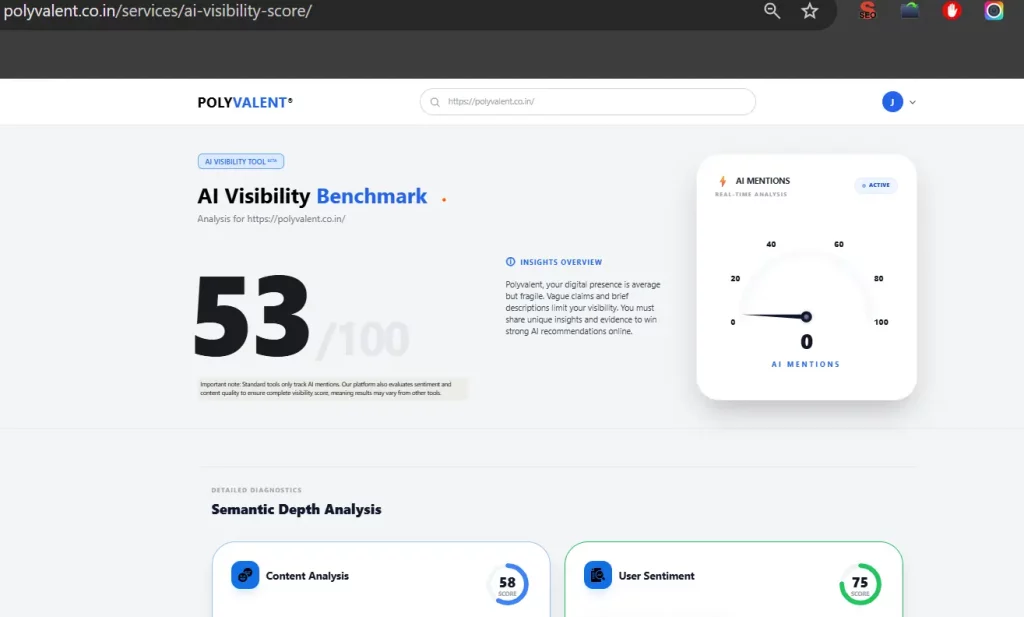
Using a visibility checker helps you identify the “Citation Gap”—those specific topics where you rank #1 on Google but are completely invisible in ChatGPT or Claude.
What Types of Third-Party Sources Are Being Cited Instead of Your Website?
If the AI isn’t citing you, it is citing someone else. Usually, these sources fall into three categories:
- Aggregators: Sites like G2, Capterra, or Trustpilot.
- Authority Media: New York Times, TechCrunch, or niche-specific trade journals.
- Community Hubs: Reddit, Quora, and Stack Overflow.
These sites are cited because the AI views them as “unbiased” or “consensus-driven” environments.
Why AI Tools Cite Aggregators, Review Sites, and Listicles
AI models are programmed to find the “consensus” view. If fifty people on a review site say your software is good for small businesses, the AI views that as a more reliable fact than your own website claiming you are the best for small businesses.
Aggregators and listicles provide a pre-digested summary of information. AI models find it easier to parse a structured list of “Pros and Cons” from a third-party reviewer than to extract that same information from your marketing copy, which the AI might perceive as biased “sales talk.”
Why AI Heavily Focuses on Reddit, Quora, and Other Forum Websites
The “Reddit-fication” of AI search is a result of the quest for “hidden gems” and human experience. Google and OpenAI have both recognized that users value first-hand perspectives.
When a user asks “Is [Product] worth it?”, the AI knows that a marketing page will say “Yes.” However, a Reddit thread will contain a variety of perspectives, troubleshooting tips, and raw opinions. This “human-verified” content is highly weighted in retrieval systems because it feels more authentic than polished corporate content.
Why Your Website Can Rank in Search but Still Not Be Cited in AI Answers
This is the most frustrating scenario for SEOs. You have the “Blue Link” at the top of Google, but the AI Overview above it ignores you. Why?
- Complexity vs. Conciseness: Your page might be a 4,000-word deep dive. While Google loves this for “coverage,” an AI might find it too difficult to extract a 50-word summary compared to a competitor’s concise FAQ page.
- Lack of Semantic Clarity: Traditional SEO relies on keywords. AI SEO relies on “Entities.” If the AI cannot clearly identify the “Subject-Predicate-Object” in your content, it won’t use you as a source.
- Data Recency: Some AI models rely on training data that is months old, while others use real-time web retrieval. If your site is new or recently updated, the “retrieval” phase might miss you if your technical SEO (like sitemaps or crawl speed) is lagging.
LLM Training Data vs Real-Time Retrieval: Why Your Website May Be Missing
To fix your citation problem, you must understand the two ways AI “knows” things:
- Training Data (The Knowledge Base): This is what the AI learned during its initial development. If your site wasn’t authoritative when GPT-4 was being trained, you won’t be part of its “internal” knowledge.
- RAG (Retrieval-Augmented Generation): This is when the AI searches the live web to answer a prompt (like Perplexity or ChatGPT with Search).
If you are missing from the training data, you have to work twice as hard to be found in the retrieval phase. This requires a technical infrastructure that allows AI crawlers (like GPTBot) to easily navigate and ingest your content.
How Different AI Platforms (ChatGPT, Google AI Overviews, Perplexity, Gemini, Claude) Choose Sources
| Platform | Primary Source Preference | Citation Style |
| Perplexity | Real-time news, academic papers, official docs | Heavy, academic-style footnotes |
| ChatGPT | High-authority media, Wikipedia, Reddit | Integrated links, “Source” buttons |
| Google AI Overviews | Sites already in Top 10 Google rankings | Carousel cards, “Show more” links |
| Gemini | Google’s own ecosystem, YouTube, News | Double-check icons, Footer links |
| Claude | High-quality long-form text, technical docs | Less frequent, context-heavy citations |
How AI Systems Decide Which Websites to Cite
The decision-making process for an AI isn’t about “backlinks” in the traditional sense. It’s about Probability of Accuracy.
AI systems use a process called “reranking.” The system pulls 20 or 30 potential sources from the web and then uses a smaller, highly intelligent model to grade those sources. It asks:
- Does this source directly answer the prompt?
- Is the source reputable (E-E-A-T)?
- Is the information formatted in a way that is easy to summarize?
If your website fails any of these checks, the AI moves to the next candidate—often a third-party site that has already summarized your info for you.
The Role of E-E-A-T, Structured Data, Entity SEO, and Digital PR in AI Citations
To become a primary source, you must master four pillars:
- E-E-A-T (Experience, Expertise, Authoritativeness, Trust): This isn’t just a Google guideline anymore. AI models look for “signals of trust.” If your authors have no digital footprint, the AI is less likely to cite them.
- Structured Data (Schema): Think of Schema as the “instruction manual” for the AI. It tells the model exactly what a piece of data is, whether it’s a price, a recipe step, or a software feature.
- Entity SEO: You want the AI to recognize your brand as an “Entity” (a distinct thing) rather than just a collection of keywords. This involves being mentioned in “knowledge bases” like Wikidata or being consistently associated with specific topics across the web.
- Digital PR: When high-authority news sites link to you, they are telling the AI’s training data that you are an important source.
Common Reasons Your Website Is Ignored by AI Tools
- The “Paywall” Problem: If your best content is behind a login or a hard paywall, AI crawlers can’t read it, so they can’t cite it.
- Robots.txt Blocks: Many sites accidentally block GPTBot or CCBot out of fear of data scraping, effectively opting out of the AI citation economy.
- Thin Content: If your page is 80% fluff and 20% facts, the AI will find a more “dense” source.
- JavaScript Dependency: If your content requires complex JavaScript to render, some AI crawlers might see a blank page.
How You Can Increase Your Website’s Chances of Being Cited by AI
To bridge the citation gap, follow this actionable framework:
- Adopt a “Direct-to-Answer” Format: Place the answer to the likely user query in the first paragraph. Use the “Inverted Pyramid” style of journalism.
- Optimize for “Natural Language” Queries: Stop targeting “best CRM 2024” and start answering “Which CRM is best for a 5-person remote marketing team?”
- Publish Original Research: AI loves data. If you produce a “2026 Industry Report” with original statistics, third-party sites will cite you, and eventually, the AI will go straight to you as the primary source.
- Double Down on Digital PR: Get quoted in industry publications. When an AI sees your CEO’s name associated with a topic on five different high-authority sites, it begins to treat your domain as an authority.
- Implement Advanced Schema: Go beyond basic Article schema. Use Product, FAQ, Review, and Organization schema to provide a clear map of your data.
How to Track Your AI Citation Share Over Time
You need a dashboard that monitors “Generative Visibility.” Like Poyvalent AI Visibility checker do. It is free and you can track your website visibility.
- Identify Core Queries: List the top 50 questions your customers ask.
- Establish a Baseline: Use a tool like Polyvalent Air Visibility tool to see how many times you are cited vs. competitors.
- Monitor the “Source Mix”: If the AI cites Reddit 50% of the time for your keywords, your strategy should include “Reddit SEO” (engaging in community discussions) alongside on-site SEO.
How to Become a Primary Source Instead of a Third-Party Mention
The real goal is to move from simply being mentioned to becoming the source AI actually cites.
That requires a shift in how you approach content. Instead of just commenting on what others are doing, focus on creating the original insights, expertise, and authority others reference.
In simple terms, your brand needs to publish trustworthy, E-E-A-T-driven content that positions you as a genuine authority in your space.
Host tools, calculators, original datasets, and comprehensive “How-To” videos. The more “unique utility” your website provides, the harder it is for an AI to substitute your site with a generic Reddit thread.
You want the AI to conclude: “I could summarize the Reddit thread, but the actual tool/data is located at [YourWebsite.com], making it the most helpful source for the user.”
FAQs
Why does ChatGPT cite Reddit more than my website?
ChatGPT prioritizes Reddit because it contains high-volume, human-centric discussions and diverse perspectives. It views forum content as less “biased” than corporate marketing material. To counter this, ensure your content includes objective data, pros/cons, and expert bylines.
Can ranking on Google improve AI citations?
Yes, but they are not the same thing. While Google’s AI Overviews heavily draw from top-ranking search results, other models like Claude or Perplexity have their own methods for determining authority. High rankings help with “discoverability,” but “citatability” depends on content structure and clarity.
How do I track AI brand mentions?
You can use specialized AI visibility tools or set up advanced social listening queries. Monitoring mentions on platforms like Reddit and Quora is also vital, as these often feed into AI responses.
What is AI citation share?
AI citation share is the percentage of time your brand or website is cited as a source in response to a specific set of prompts, compared to your competitors and third-party aggregators.
How do I optimize for generative search?
Focus on “Entity SEO” by defining your brand’s relationship to specific topics. Use structured data, maintain a high-quality “About” page with verifiable credentials, and create content that answers “Who, What, Why, and How” in a concise, authoritative manner.
Conclusion
The transition from a “Search Economy” to an “Answer Economy” is fundamentally changing the rules of digital visibility. If you find that AI tools are citing third-party sources instead of your website, it is a signal that your “Authority Gap” is showing.
AI models aren’t trying to steal your traffic; they are trying to provide the most reliable, easy-to-digest answer possible. By restructuring your content for clarity, doubling down on original research, and ensuring your brand is recognized as a verified “Entity,” you can reclaim your position as a primary source.