Schema Markup is structured code added to your website that helps search engines understand what your content means, not just what it says. When you add it correctly, Google can show extra details in search results and AI tools can accurately describe your business when users ask questions.
What Is Schema Markup?
Schema Markup is structured data most commonly implemented through JSON-LD, a machine-readable format placed inside a script tag on a web page. It does not alter how the page appears to users. Instead, it provides search engines and AI systems with a structured summary of the page’s meaning.
The vocabulary comes from Schema.org, a standardized framework supported by major search engines including Google, Bing, Yahoo, and Yandex. It defines hundreds of entity types such as organizations, services, products, articles, people, and events. When properly implemented, this shared language helps search engines interpret content with greater accuracy.
Here is a simple example of Organization Schema:
<script type="application/ld+json">
{
  "@context": "https://schema.org",
  "@type": "Organization",
  "name": "Polyvalent Digital Services Pvt. Ltd.",
  "url": "https://polyvalent.co.in",
  "sameAs": ["https://linkedin.com/company/polyvalent-digital-services/"]
}
</script>
This code tells crawlers that the page represents an organization called Polyvalent Digital Services Pvt. Ltd., identifies its official website, and connects it to its LinkedIn profile. These structured relationships strengthen entity recognition, improve consistency across the web, and support stronger SEO and AI visibility.
This example is intentionally simplified. A complete Organization Schema would typically also include additional fields such as logo, contact information, address, founder, and social profiles for deeper contextual clarity.
How Schema Markup Works
Schema Markup adds structured data to your website so search engines and AI systems can understand your content more clearly. Instead of only reading page text, they can identify exactly what the page represents, whether it is a business, service, article, product, or FAQ.
This reduces confusion, improves search clarity, and helps machines interpret your website more accurately. JSON-LD is the most common format because it is simple to implement and easy to maintain.
How Schema Markup Helps Your SEO
Schema markup does not directly increase your keyword rankings. What it does is help search engines better understand your page, which leads to three measurable SEO benefits.
1. Rich Results in Google Search
Rich results are enhanced listings in Google’s search results. They show extra information alongside your link: star ratings, FAQ dropdowns, breadcrumbs, product prices, or event dates. These features make your result stand out visually, which increases your click-through rate even without ranking higher.
Each rich result type is triggered by a specific schema type. If you want FAQ dropdowns to appear under your search result, you need FAQPage schema on the page. If you want star ratings, you need Review or AggregateRating schema. Without the structured data, Google does not have a reliable signal to display these features.
2. Better Crawl Efficiency and Page Understanding
When Googlebot crawls a page, it reads the content and tries to classify what the page is about. Natural language is ambiguous. Schema markup removes the ambiguity. A page with a properly implemented Service schema tells the crawler exactly what service is being offered, who provides it, and what geographic area it covers, without the crawler needing to infer it from paragraphs of text.
This is especially important for businesses with similar names to other companies, technical topics, or service categories that overlap. Schema markup is how you make your entity unambiguous.
3. Competitive Advantage in the SERPs
The majority of websites still do not implement schema markup correctly. A well-structured schema implementation across your site gives you rich result eligibility, stronger entity signals, and better Knowledge Panel candidacy that most competitors do not have. The gap between sites with schema and those without it is widening as Google places more weight on structured data for AI-driven search features.
Schema Markup and AI Visibility
Schema Markup is no longer just about SEO. It also helps AI systems understand who you are, what you do, and why your brand is relevant.
When people use tools like ChatGPT, Google AI Overviews, or Perplexity, these platforms look for trustworthy, clearly defined sources. If your website only uses plain text, AI may understand your content broadly, but it may miss important context about your business.
For example, we offer AI SEO services, and AI can read that statement. But without Schema, it may not clearly understand your business type, location, service focus, or brand identity.
Schema removes that confusion by giving AI structured information about your business. It helps define your company as a real entity, connect your services, and improve how search engines and AI platforms interpret your website.
This makes Schema an important part of AI visibility. The clearer your digital identity is, the easier it becomes for AI systems to recognize and trust your brand.
If your goal is to improve discoverability for AI SEO services, Schema Markup helps build the technical foundation that supports that visibility.
Types of Schema Markup That Matter Most
Schema.org includes hundreds of entity types, but most business websites only need a focused set of Schema types that directly improve SEO, search clarity, and AI visibility. In practice, the most valuable schemas are the ones that clearly define your business, services, content, and website structure. Here are the Schema types that matter most.
Below are the Schema types most commonly used to improve SEO, search clarity, and AI visibility.
| Schema Type | What It Declares | Primary SEO Benefit |
| Organization | Your brand as a named entity with URL, logo, and social profiles | Knowledge Panel eligibility, entity trust |
| LocalBusiness | Geographic scope, address, phone number, and opening hours | Local pack rankings, AI local query answers |
| Service | Specific services: name, description, provider, area served | Service-specific rich results, AI citations |
| FAQPage | Question-and-answer pairs on a page | FAQ dropdowns in Google, direct AI extraction |
| Article / BlogPosting | Headline, author, dates, publisher for editorial content | Author trust (EEAT), article rich results |
| BreadcrumbList | Navigation path from homepage to current page | Clean URL breadcrumbs in SERPs |
| WebSite | Top-level site identity with a search action | Sitelinks search box eligibility |
| Product | Product name, price, availability, and reviews | Shopping results, price rich snippets |
| Review / AggregateRating | Average rating and total review count | Star ratings in search results |
| Person | Author or team member as a named entity | Author credibility, EEAT signals |
| Event | Event name, date, location, and organiser | Event listings in Google Search |
| HowTo | Step-by-step instructions for a process | HowTo rich results with numbered steps |
For any business aiming to secure AI visibility and rich search results, prioritize these schema types:
- Organization & WebSite: Deploy these sitewide in the document head to establish your brand identity and machine-readable summary.
- Service or Product: Use these on relevant pages to define your offerings, the provider, and the areaServed.
- FAQPage: Implement this on pages with question-and-answer content to enable direct AI answer extraction and rich snippets.
- Article or BlogPosting: Use these for all editorial content, ensuring a named author and publisher are declared to build trust.
- BreadcrumbList: Apply this to all interior pages to clearly map site structure and improve crawl efficiency.
Here is Screenshot of Schema Applied to our Blogs.
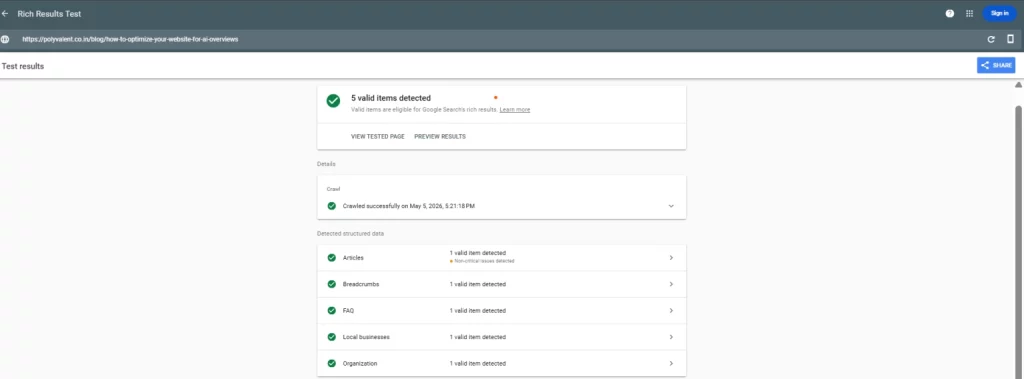
This sequence ensures your site architecture is fully defined for AI search agents. Without this structured foundation, a brand can appear less clearly defined to search engines and AI systems.
How to Implement Schema Markup on Your Website
We can implement the schema by multiple methods like if the website is wordpress it can be done through the plugins help and also you can use Google Tag Manager to implement the schema.
Implementing the Schema with Tag manager is the most effective way.
Step 1: Identify the Entity on Each Page
Every page on your website represents an entity. Your homepage represents your business. A service page represents a specific service. A blog post represents a piece of editorial content. Before writing any schema, identify the primary entity the page is about. That determines which @type you use.
Step 2: Write the JSON-LD Block
Write your schema as a JSON-LD script block and place it inside the <head> of your HTML document. Use the Schema.org documentation for your chosen type to identify which properties are required, which are recommended, and which are optional.
Required properties must be included or the schema will be invalid. Recommended properties should be included because they provide the contextual detail that makes your entity declaration useful to AI systems and search engines.
Step 3: Nest Your Entities
Do not write every schema as a standalone block. Nest related entities inside each other to declare the relationships between them. For a Service schema, the provider property should not just say your company name as a plain string. It should embed a full Organization object with its own @type, name, and URL.
"provider": {

  "@type": "Organization",

  "name": "Polyvalent Digital Services Pvt. Ltd.",

  "url": "https://polyvalent.co.in"

}
This tells the crawler that the service is a verified property of that organisation, not just loosely associated with it by name.
Step 4: Add the sameAs Property for Entity Linking
The sameAs property is one of the highest-impact fields in schema markup for AI visibility. It connects your entity to its verified identifiers on other platforms: your LinkedIn page, your Google Business Profile, your Crunchbase listing, your social media profiles.
When a search engine or AI crawler sees the same entity referenced with consistent sameAs links across multiple documents on the web, it consolidates those signals into a high-confidence entity node. That is how brands enter the Knowledge Graph and start getting cited by AI tools.
Step 5: Validate Before Publishing
Every schema block must be tested before it goes live. Two tools matter:
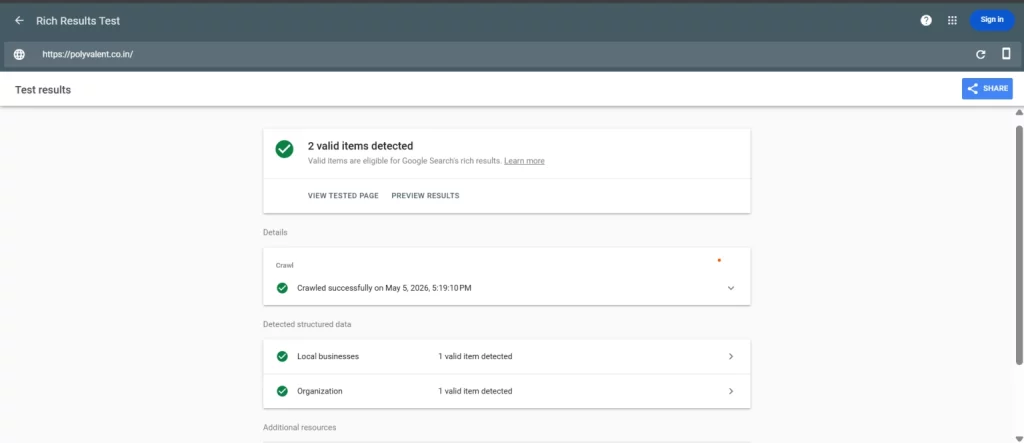
• Google’s Rich Results Test: Visit Rich Result website Paste a URL or code block. Google shows which schema types it detected, which properties it read, and whether the page qualifies for rich results. Zero errors required.
• Schema.org Validator: Tests vocabulary compliance. Catches wrong property types, unknown fields, and missing required values.
A schema block with errors is silently ignored by crawlers. The work you put into writing it produces no result. Always validate before deploying.
How to Optimize Existing Schema Markup
- Use the most specific Schema type for each page instead of relying only on generic WebPage or Organization markup.
- Add important properties like sameAs, areaServed, author, and service details to strengthen entity clarity.
- Connect related entities properly by nesting services, articles, or local business details within your broader brand structure.
- Regularly audit and update Schema when your services, business details, or website content changes.
- Validate your Schema frequently to catch errors, missing fields, or outdated markup that may reduce SEO or AI visibility.
Why Most Websites Get Schema Markup Wrong
Many websites use basic plugin-generated Schema and assume that is enough. In reality, generic or incomplete Schema often misses important business signals.
Common issues include using the wrong Schema type, missing key properties, poor entity linking, or failing to update Schema over time.
Schema works best when it is treated as an active part of your SEO and AI visibility strategy, not just a one-time setup.
Common Schema Markup Mistakes to Avoid
Using Relative URLs Instead of Absolute URLs
Image, logo, and URL property values must use full absolute URLs. Writing “logo”: “logo.png” will fail validation. The correct format is “logo”: “https://yourdomain.com/logo.png”.
Schema That Does Not Match the Page Content
Google’s guidelines are clear: structured data that misrepresents the page will be treated as spam. If you declare a five-star rating on a page with no visible reviews, or list a service that the page does not actually describe, Google may apply a manual action to the site. Schema must reflect what is actually on the page.
Declaring Nested Objects Without @type
When you nest an entity inside another schema, always include the @type property in the nested object. Without it, crawlers cannot classify the nested entity and the relationship is lost.
Treating Schema as a One-Time Task
Schema markup needs to be maintained. When you add new service pages, publish new blog posts, or update your business details, the schema must be updated to match. A stale schema that contradicts current page content is actively harmful.
Frequently Asked Questions About Schema Markup
These are some of the most common questions businesses owner or websites owners ask when implementing Schema Markup.
Does schema markup directly improve Google rankings?
No. Schema markup does not directly boost rankings, but it can improve rich results, click-through rates, and search engine understanding.
What is the difference between schema markup and structured data?
Structured data is the broader system of organizing information for machines, while Schema Markup is the specific vocabulary commonly used to create it.
How long does it take for schema markup to show in Google?
Once Google crawls and processes your updated page, results can appear within days or weeks, but rich results are not guaranteed.
Can schema markup hurt my SEO if done wrong?
Yes. Invalid, misleading, or outdated Schema can be ignored or may create SEO issues if it violates Google guidelines.
What schema types are most important for a service business?
Organization, Service, FAQPage, and Article Schema are usually the most important for defining your brand, services, and content clearly.
Final Takeaway
Schema Markup is no longer optional for businesses that want stronger search visibility and AI discoverability. Schema Markup helps search engines and AI systems better understand your website, services, and brand. Without it, your site is harder to interpret, less likely to earn rich results, and less visible in AI-driven search experiences.
For businesses that want stronger SEO and better AI visibility, Schema is a practical foundation. Start with the essentials like Organization, Service, FAQPage, and Article schema, validate them properly, and keep them updated as your website grows.
The clearer your website is to machines, the stronger your visibility becomes.