Google Ads has changed dramatically over the past few years. Campaign management is no longer centered only around manual bidding, keyword targeting, and endless audience segmentation. Artificial intelligence now plays a major role in how campaigns are built, optimized, and scaled across Google’s ecosystem.
At the center of this transformation are Google Performance Max Ads.
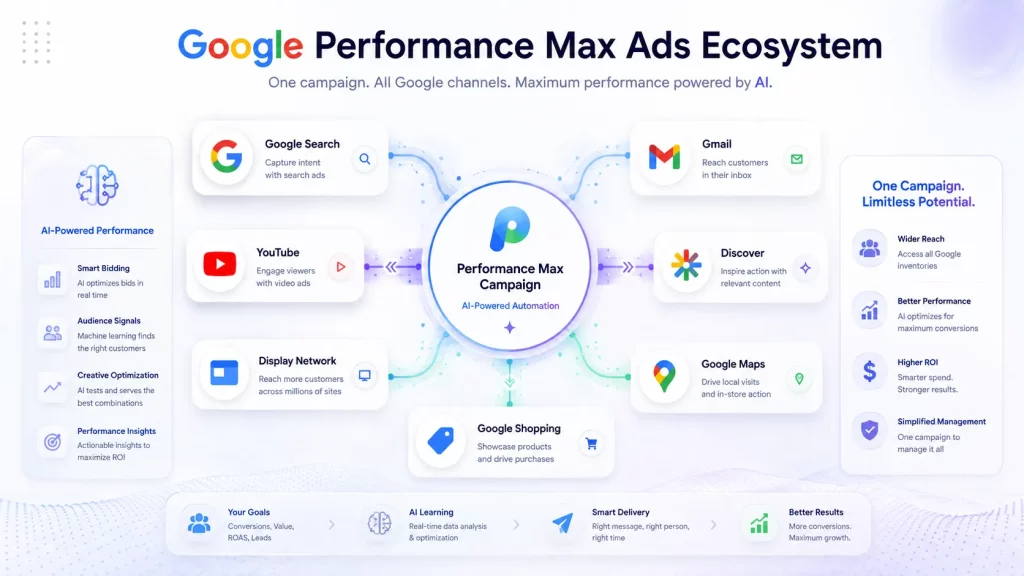
Performance Max campaigns are designed to help businesses use Google’s machine learning systems to drive conversions across Search, YouTube, Display, Gmail, Discover, Maps, and Shopping from a single campaign structure. Instead of manually managing multiple campaign types independently, advertisers provide Google with business goals, creative assets, audience data, and conversion signals while the platform automates delivery and optimization.
For businesses looking to scale efficiently in 2026, understanding how Performance Max works is becoming increasingly important. Whether the goal is ecommerce growth, local lead generation, or customer acquisition at scale, Performance Max campaigns are now a major part of modern paid advertising strategy.
The challenge is that many advertisers still misunderstand how these campaigns operate. Some expect automation to replace strategy completely, while others avoid Performance Max because they believe it removes too much control.
The reality sits somewhere in the middle.
Google Performance Max Ads can produce exceptional results when paired with strong creative direction, accurate conversion tracking, and a clear AI-driven Google Ads strategy. Without those foundations, even advanced automation struggles to perform effectively.
What Google Performance Max Ads Actually Are
Google Performance Max Ads are goal-based campaigns powered by Google’s machine learning systems. Instead of targeting only one placement type like Search or Display, Performance Max campaigns run across Google’s entire advertising network using automated optimization.
This includes:
- Google Search
- YouTube
- Display Network
- Gmail
- Google Discover
- Google Maps
- Google Shopping placements
The advertiser defines conversion goals such as purchases, form submissions, phone calls, or demo bookings. Google’s automation system then analyzes user intent, browsing behavior, engagement patterns, device activity, and historical conversion signals to determine where ads should appear.
Unlike traditional campaigns, Performance Max does not rely solely on manual keyword targeting. The platform uses predictive modeling to identify users most likely to convert across multiple environments and stages of the customer journey.
This shift reflects Google’s broader movement toward automation-first advertising.
Why Performance Max Campaigns Are Becoming More Important
As Google Search evolves with AI Overviews, advertisers are no longer competing only for clicks inside traditional search results. Brands now need advertising and content strategies that improve visibility across AI-powered search experiences where recommendations, summaries, and product suggestions increasingly influence buying decisions.
A user may discover a product on YouTube, revisit the website through Display remarketing, search for the brand days later, and finally convert through a Shopping ad. Traditional campaign structures often struggle to optimize efficiently across these fragmented touchpoints.
Performance Max campaigns attempt to solve this problem by allowing Google’s AI to evaluate conversion opportunities holistically rather than channel by channel.
At the same time, Google continues introducing stronger automation features inside the advertising platform. Recent updates include:
- AI-generated ad assets
- Predictive audience expansion
- Conversational campaign setup
- Automated video creation
- Dynamic creative adaptation
- Enhanced attribution modeling
These updates are shaping a more AI-driven Google Ads strategy where campaign success depends less on manual controls and more on strategic inputs.
Businesses that understand how to guide automation effectively are often outperforming advertisers still relying entirely on older campaign management approaches.
How Performance Max Campaigns Work
Performance Max campaigns rely heavily on machine learning.
After defining campaign goals, advertisers upload creative assets into what Google calls asset groups. These asset groups contain:
- Headlines
- Descriptions
- Images
- Logos
- Videos
- Product feeds
- Call-to-action messaging
Google dynamically combines these assets depending on placement type, audience behavior, and conversion probability.
For example:
- A YouTube viewer may receive a video-first ad variation
- A Search user may see text-focused messaging
- A Gmail user may receive a visually rich ad format
The system continuously tests creative combinations and reallocates impressions toward stronger-performing assets over time.
One of the most important concepts within Performance Max campaigns is the relationship between asset groups & audience signals.
Audience signals are not strict targeting instructions. Instead, they help Google understand which types of users may initially be more relevant during the learning phase. These signals may include:
- Website visitors
- Existing customers
- In-market audiences
- Competitor interest audiences
- CRM customer lists
- Custom intent audiences
Strong audience signals combined with high-quality creative assets help accelerate campaign learning and improve optimization efficiency.
The Real Benefits of Google Performance Max Ads
The primary advantage of Performance Max campaigns is reach combined with automation.
Instead of building separate campaigns across multiple Google properties, advertisers can use one campaign structure optimized toward conversion goals.
This creates several meaningful benefits.
Broader Inventory Access
Performance Max campaigns can place ads across every major Google-owned advertising environment. This allows businesses to influence potential customers throughout different stages of the buying journey rather than relying only on direct search intent.
Faster Campaign Scaling
Automation allows campaigns to scale more efficiently without requiring constant manual bid adjustments and targeting refinements. Businesses can often expand budget and reach faster compared to traditional campaign structures.
Improved Cross-Channel Optimization
Google’s machine learning evaluates performance across placements collectively rather than independently. This often creates stronger overall conversion efficiency.
Better Ecommerce Performance
For ecommerce brands with optimized product feeds, Performance Max can integrate Shopping inventory, YouTube discovery, Display remarketing, and Search placements into a unified acquisition strategy.
Smarter Lead Generation
Lead generation with PMax has improved significantly in recent years, especially for businesses integrating offline conversion tracking and CRM-based lead quality signals.
Industries such as:
- Real estate
- SaaS
- Healthcare
- Education
- Home services
- Financial services
are increasingly using Performance Max campaigns to improve scalable lead acquisition.
Where Performance Max Campaigns Still Create Challenges
Despite their advantages, Performance Max campaigns are not perfect.
One of the biggest concerns advertisers continue raising involves visibility and reporting.
Google has made several reporting/transparency updates in 2025 that improved advertiser access to campaign insights. These updates included:
- Better asset-level reporting
- Expanded search category visibility
- Improved audience diagnostics
- Enhanced placement reporting
- Additional brand exclusion controls
While these changes helped, Performance Max campaigns still provide less granular visibility compared to traditional Search campaigns.
Many advertisers also struggle with reduced manual control.
Since Google automates placements, bidding, and targeting decisions, experienced media buyers sometimes feel disconnected from campaign-level optimizations they previously controlled directly.
Another challenge is creative dependency.
Automation does not compensate for weak messaging, poor visuals, or low-quality landing pages. In many cases, businesses blaming Performance Max performance issues are actually dealing with:
- Weak offers
- Slow websites
- Poor conversion UX
- Generic creative
- Inaccurate conversion tracking
The machine learning system amplifies the quality of the inputs it receives.
PMax vs Search Campaigns: Which Is Better?
The debate around PMax vs Search campaigns continues to grow as advertisers evaluate automation against manual control.
The reality is that these campaign types serve different purposes.
Search campaigns remain highly valuable for capturing explicit intent. When users search directly for a product or service, keyword targeting provides precision that automation alone cannot always replicate.
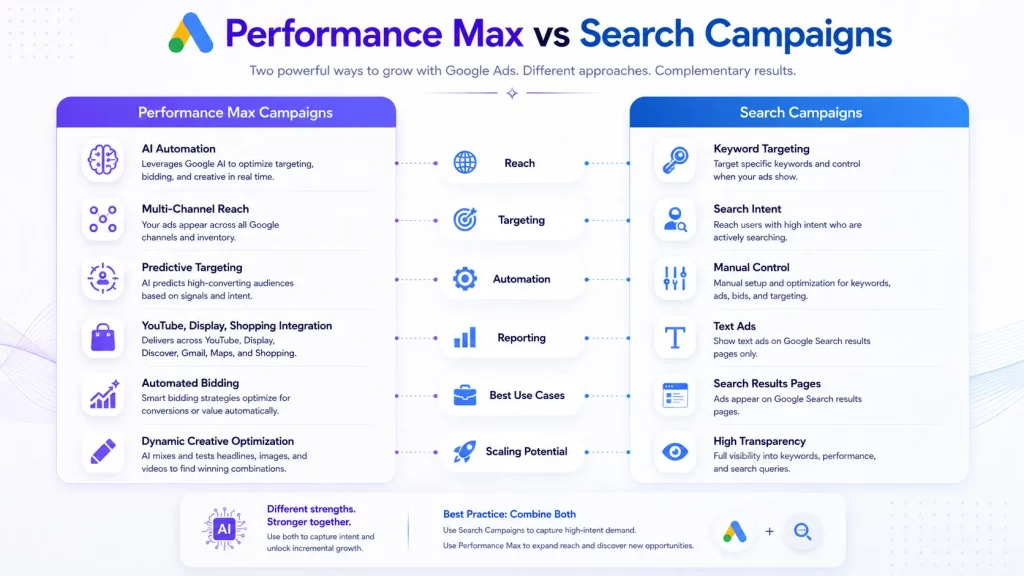
Performance Max campaigns focus more on predictive targeting and cross-channel reach.
The difference becomes clearer when comparing them directly.
| Feature | Performance Max Campaigns | Search Campaigns |
| Targeting | AI-driven predictive targeting | Keyword targeting |
| Inventory Reach | Entire Google ecosystem | Search only |
| Optimization | Automated | Manual + automated |
| Reporting Visibility | Moderate | High |
| Creative Formats | Multi-format | Primarily text |
| Scaling Potential | High | Moderate |
| Best Use Case | Cross-channel growth | High-intent acquisition |
Most mature advertisers are not choosing one over the other.
Instead, they use Search campaigns for:
- Branded keywords
- High-intent commercial queries
- Competitor targeting
- Precise search control
while using Performance Max campaigns for:
- Scaling
- Discovery
- Cross-channel remarketing
- Ecommerce expansion
- Audience growth
The strongest paid media strategies in 2026 often combine both approaches strategically.
Building a Strong Performance Max Optimization Strategy
Successful Performance Max optimization requires a different mindset compared to older Google Ads workflows.
Optimization is no longer centered entirely around manual bid changes and keyword adjustments. Instead, the focus shifts toward improving the quality of campaign inputs.
Many businesses are also using an AI Visibility Tool alongside Google Ads reporting to understand how their brand appears across AI-generated search experiences, conversational search engines, and automated recommendation systems. This additional visibility helps marketers identify gaps in messaging, positioning, and search presence beyond traditional keyword rankings.
Conversion Tracking Accuracy
Reliable conversion tracking is essential.
Businesses should implement:
- Enhanced conversions
- CRM integration
- Offline conversion imports
- Lead quality tracking
- Proper attribution setup
Without accurate conversion data, Google’s machine learning cannot optimize effectively.
Creative Refresh Cycles
Creative fatigue impacts Performance Max campaigns heavily.
Advertisers should regularly update:
- Headlines
- Descriptions
- Images
- Video assets
- Promotional messaging
Campaigns with stale creative often lose efficiency over time.
Campaign Segmentation
Combining unrelated products, audiences, or business goals inside one campaign can confuse optimization models.
Better-performing accounts typically segment campaigns by:
- Product category
- Geography
- Audience type
- Funnel stage
- Margin profile
Feed Optimization
For ecommerce advertisers, product feed quality directly influences Shopping performance inside Performance Max campaigns.
Optimized feeds include:
- Clear product titles
- Accurate categorization
- Strong imagery
- Updated pricing
- Proper GTIN usage
Common Mistakes Businesses Continue Making
Many advertisers still approach Performance Max incorrectly.
One of the most common mistakes is launching campaigns without enough historical conversion data. Automation performs best when machine learning systems have reliable signals to analyze.
Another issue is making aggressive changes during the learning phase. Businesses frequently pause campaigns, change budgets, replace assets, or alter targeting too quickly before optimization stabilizes.
Weak audience signals also limit performance. Advertisers who fail to provide useful first-party data often slow down campaign learning unnecessarily.
Creative quality remains another major issue. Generic messaging rarely performs well across modern Google inventory.
Some businesses also ignore landing page optimization entirely. Even strong campaigns struggle when users encounter:
- Slow-loading pages
- Poor mobile experiences
- Weak offers
- Confusing forms
- Low trust signals
Performance Max campaigns amplify strong systems, but they also expose weak ones quickly.
The Future of AI-Driven Google Ads Strategy
Google Ads is moving deeper into automation every year.
Artificial intelligence is becoming the foundation of campaign delivery, audience targeting, bidding, attribution, and creative testing.
This does not mean marketers become irrelevant.
It means the role of marketers is evolving.
The most effective advertisers in 2026 focus less on micromanaging campaigns and more on:
- Data quality
- Creative direction
- Customer psychology
- Funnel optimization
- Conversion infrastructure
- Strategic segmentation
The businesses achieving the best results with Google Performance Max Ads are not abandoning strategy. They are combining strategic thinking with machine learning capabilities more effectively than competitors.
As AI-powered discovery platforms continue growing, LLM Brand Mentions are becoming increasingly important for digital visibility. Businesses are now optimizing not only for search rankings and ad performance but also for how AI systems reference, summarize, and recommend brands across conversational search environments.
FAQs on Google Performance Max Ads
Are Performance Max campaigns good for lead generation?
Yes. Lead generation with PMax can work extremely well when businesses use accurate conversion tracking, CRM integration, and optimized landing pages.
How long does Performance Max take to optimize?
Most campaigns require several weeks of stable conversion data before machine learning performance improves consistently.
Can Performance Max replace Search campaigns?
Not entirely. Search campaigns still provide valuable keyword-level control and high-intent targeting capabilities.
Are audience signals mandatory?
No, but strong asset groups & audience signals help Google’s AI learn faster and improve targeting quality during the initial learning phase.
Have reporting features improved recently?
Yes. Google introduced several reporting/transparency updates in 2025 that improved visibility into search categories, asset performance, and audience insights.
Conclusion
Google Performance Max Ads are becoming one of the most important campaign types inside modern digital advertising.
The platform combines automation, predictive targeting, cross-channel delivery, and machine learning into a system designed to maximize conversion performance across Google’s ecosystem.
However, successful campaigns still require strategic oversight.
Businesses seeing the strongest results are focusing on:
- Better Performance Max optimization
- Strong creative assets
- Accurate conversion tracking
- Smarter segmentation
- High-quality first-party data
- Long-term AI-driven Google Ads strategy
As automation continues reshaping paid advertising, understanding how to guide machine learning effectively will become one of the biggest competitive advantages in digital marketing.
Scale Smarter With Polyvalent Digital
If your business wants to improve Google Ads performance, reduce wasted ad spend, and build a scalable paid acquisition system,Polyvalent helps brands grow through advanced Google Ads management, conversion-focused strategy, and AI-powered campaign optimization.
From ecommerce scaling to lead generation with PMax, Polyvalent Digital helps businesses build modern advertising systems designed for measurable growth in 2026 and beyond.