On page seo for ai is becoming essential as AI-powered search experiences reshape how people find information online. With the growing impact of AI Overviews and platforms like ChatGPT Search, Perplexity, and Gemini, users are increasingly receiving direct answers, summaries, and recommendations instead of browsing through a list of search results.
This change means that ranking on the first page of search engines is no longer the only goal. Brands and website owners must also ensure that their content is visible and referenced in AI-generated responses.
On page seo for ai focuses on more than just keywords and rankings. It prioritizes content structure, context, clarity, and machine-readable signals that help AI systems understand, interpret, and accurately cite information. The goal is to create content that delivers value to users while making it easier for AI-powered search tools to identify and surface relevant insights.
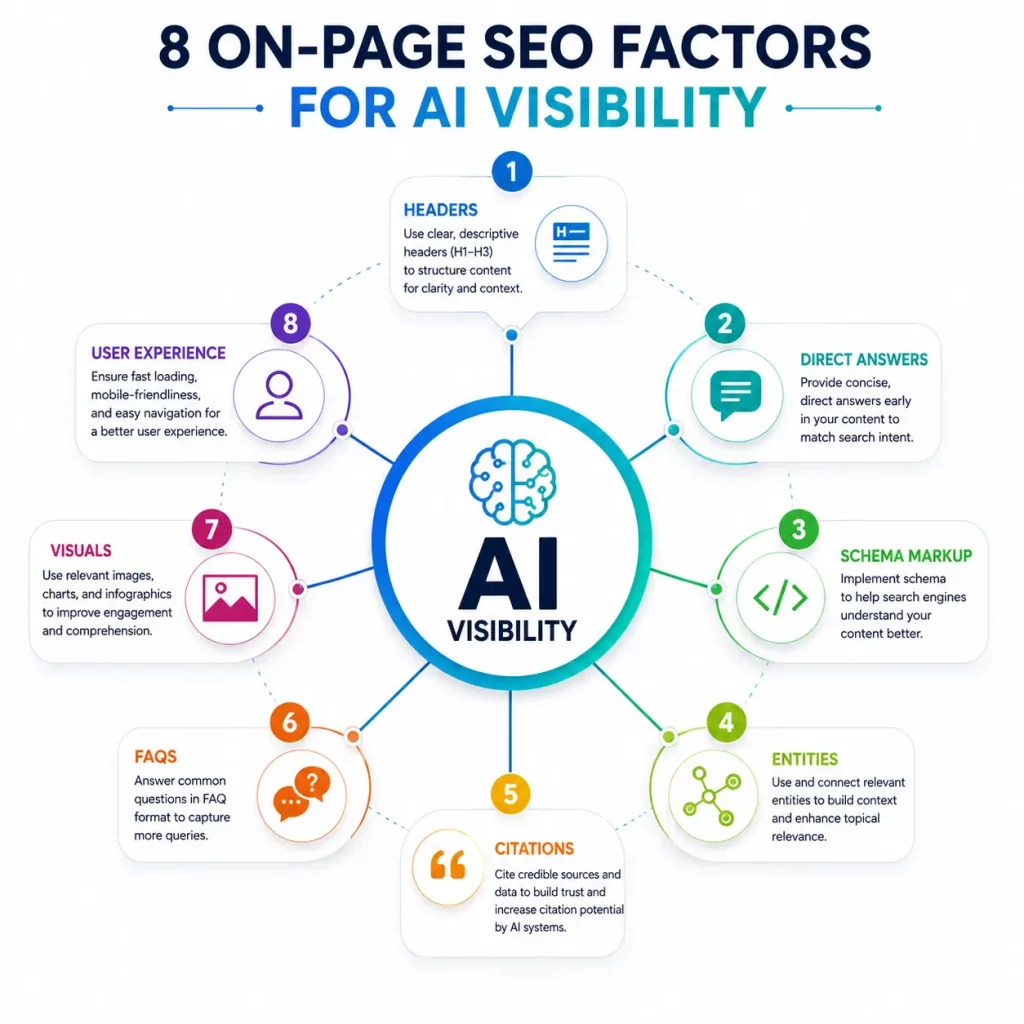
The following eight on-page SEO elements can help improve your content’s visibility in AI-generated answers and modern search experiences.
1. Natural Language & Conversational Headers
Traditional search engine optimization often involved creating rigid, slightly awkward headings designed solely to match exact-match search volume. Large Language Models (LLMs) do not read like old-school algorithms. They are trained to process complex human phrasing, semantic nuances, and natural speech patterns.
When structuring your content, write your H2 and H3 subheadings as direct questions or natural statements that a real person would speak aloud.
As the LLMs Chatbots easily can understand the language and can provide answers as expert of the subject.
For example, a heading like:
“What Is Entity Optimization and Why Does It Matter?”
is often more useful than:
“Entity Optimization SEO Guide”
The first version mirrors how users naturally search and how AI systems interpret conversational queries.
This is one of the most effective seo strategies for ai visibility because AI-generated answers frequently originate from content that closely matches the wording of user questions.
Examples of Effective Header Structures
H2 Example
How Do AI Search Engines Process Natural Language?
H3 Example
Why Do LLMs Favor Question-Based Phrasing Over Pure Keywords?
Question-driven structures create stronger alignment between search intent and content relevance.
They also help AI systems identify sections that can be extracted and presented as direct answers.
When planning content, think about the questions your audience asks rather than the keywords they type.
2. Direct and Concise Answers Under Every Section
One of the most overlooked aspects of ai seo optimization is answer formatting.
AI systems frequently scan content looking for concise explanations that can be quoted, summarized, or referenced in generated responses.
Long introductions before answering a question often make extraction more difficult.
A useful technique is placing a short answer immediately after every major heading.
Think of it as an “AI snack” that delivers the core information in two or three sentences before expanding into greater detail.
Example
What Is Schema Markup?
Schema markup is structured data that helps search engines and AI systems understand the meaning and context of webpage content. It provides machine-readable information that improves content interpretation and discoverability.
After providing the concise answer, you can then expand with examples, benefits, and implementation guidance.
This structure benefits both users and AI systems.
Readers get immediate value, while AI models can easily identify and extract the most relevant information.
AI bots are designed to save users time by extracting quick, highly accurate summaries from the web. If an engine has to read through five paragraphs of introductory fluff to find a simple definition, it will likely skip your page and source the answer from a competitor.
To capture these citations, place a direct, two to three sentence summary immediately below your conversational headers. This layout technique acts as an information snapshot, or an “AI snack,” that a crawler can easily extract and blockquote in a chat response.
Example :
[Conversational H2 Header: What is technical SEO for AI?]
[The AI Snack: Technical SEO for AI focuses on optimizing a website’s backend architecture so large language models can crawl, process, and index content without friction. By utilizing server-side rendering, clean HTML code structures, and open bot permissions, you ensure that AI engines can instantly retrieve and accurately cite your data in real-time user chats.]
This specific layout choice serves as a simple framework for quick ai seo optimization. It satisfies the user’s need for immediate clarity while handing the AI crawler a perfect, pre-formatted summary on a silver platter.
Example: 3
What is on-page SEO optimization for AI? : On-page SEO for AI focuses on optimizing front-end content structures and context so large language models can crawl, process, and summarize information efficiently. By placing a direct, two-to-three-sentence summary immediately below your conversational headers, you give AI search bots a perfect snapshot to extract and blockquote in real-time user chat responses.
3. Structured Data & Schema Markup
While natural language is vital for the front-end of your website, structured data (Schema) remains critical for the backend. Schema markup is a standardized code format that provides explicit context about your page to an engine, removing any room for misinterpretation.
By implementing specific schema types, such as FAQPage, Article, Product, or Organization, you tell the crawler exactly what your data represents. For example, instead of letting an algorithm guess the price or availability of a product, Product schema explicitly defines those variables in a universal language.
Important Schema Types for AI Visibility
Article Schema
Article schema helps identify the page as a piece of editorial content and provides information about authorship, publication dates, and headlines.
FAQ Schema
FAQ schema clearly communicates questions and answers, making content easier to interpret and potentially surface in conversational search experiences.
Organization Schema
Organization schema helps establish brand identity, company information, and relationships between content and its publisher.
These structured signals improve content comprehension and support stronger visibility across AI-powered search platforms.
These structured signals improve content comprehension and support stronger visibility across AI-powered search platforms.
Foundational AI Note: When evaluating what elements are foundational for SEO with AI, structured data sits at the absolute top of the list. While LLMs excel at processing natural front-end language, backend schema removes all semantic ambiguity, handing AI engines an undisputed, clean data baseline.
4. Entity-Based Keywords & Contextual Depth
SEO has moved far beyond simple keyword repetition.
Modern AI systems understand relationships between concepts, topics, organizations, products, and people. This approach is commonly known as entity-based optimization.
For example, an article about AI search visibility should naturally reference related concepts such as:
- Semantic SEO
- Search intent
- Schema markup
- Knowledge graphs
- Topical authority
- Content structure
- User experience
These related entities help establish context.
Instead of repeatedly targeting the same keyword, effective on page seo for ai focuses on building a complete topic ecosystem around the subject.
Consider the difference:
A shallow article may mention “AI visibility Tool” twenty times.
A strong article discusses AI visibility tools alongside search behavior, semantic relevance, structured data, authority signals, content quality, and entity relationships.
The second approach provides richer context that AI systems can understand and trust.
This depth is a major contributor to topical authority and long-term discoverability.
5. High-Quality External Citations & Sources
Trust matters more than ever.
AI systems are increasingly focused on identifying reliable information sources. Content that references credible research, authoritative publications, and trusted industry resources often carries stronger signals of expertise and reliability.
External citations help support factual claims and demonstrate that information is grounded in evidence rather than opinion.
Best Practices for Source Attribution
- Reference reputable industry studies.
- Link to official documentation whenever possible.
- Use current statistics from authoritative sources.
- Verify data before publishing.
- Update citations regularly.
6. Comprehensive FAQs (Frequently Asked Questions)
Users rarely stop at a single question when interacting with a conversational search tool. They tend to ask follow-up questions to drill down into specific details or clarify a nuance.
Adding a comprehensive FAQ section to the bottom of your articles allows you to target these precise long-tail, informational queries. Think about the tangential concerns your audience might have and address them in a clear, question-and-answer format.
Why FAQs Scale Visibility
- They naturally capture conversational variation in user prompts.
- They provide a dense cluster of high-value informational snippets on a single page.
- They allow you to expand your coverage of related entities effortlessly.
Detailing these specific points in a dedicated FAQ block naturally helps you scale up your advanced seo strategies for ai visibility without disrupting the narrative flow of your main article body.
7. Optimizing Visuals with Context-Rich Alt Text
Modern search engines are increasingly multimodal. They no longer look at text in isolation; they analyze graphics, charts, diagrams, and text simultaneously to understand the full scope of an article.
This means your image alt text can no longer be a lazy string of keywords. Your alt text needs to be context-rich and descriptive, explaining exactly what data or concept the image communicates. If you display a chart showing rising inflation rates, the alt text should explain what the trend line indicates.
For Example:
[Bad Alt Text]: alt=”inflation chart graph”
[Good Alt Text]: alt=”Line graph showing a 4% increase in core inflation rates between 2024 and 2026
Writing clear alt text that describes the data in an image reinforces your core topic and helps conversational tools index your media. Utilizing the best ai visibility tools can help you track how your media and content perform across these diverse search environments.
8. User Experience (UX) & Content Readability
Many AI visibility discussions focus heavily on technical factors while overlooking user experience.
However, content that is difficult to read rarely performs well with either humans or machines.
AI systems increasingly evaluate quality through patterns associated with user satisfaction, content clarity, and overall usefulness.
Readability contributes directly to content effectiveness.
Best Practices for Better Readability
- Use short paragraphs.
- Break up large blocks of text.
- Create logical heading hierarchies.
- Use bullet points where appropriate.
- Maintain clear navigation structures.
- Improve page speed and loading performance.
- Focus on mobile usability.
Content should feel effortless to consume.
Users should quickly find answers, understand key concepts, and navigate through the page without friction.
Businesses looking to strengthen their overall AI search strategy should also evaluate the best AI visibility tools available today. These platforms can help identify optimization opportunities, monitor AI-generated brand mentions, and uncover visibility gaps across emerging search experiences.
Ultimately, content readability remains one of the strongest indicators of quality for both users and AI systems.
How to Use AI for On-Page SEO
Optimizing your site for modern search engines doesn’t mean you have to abandon your favorite AI tools. In fact, you can use large language models as collaborative partners to speed up your optimization workflow. The trick is to avoid letting AI write your actual content, and instead use it to audit your structure and logic.
Here is how you can practically use AI to sharpen your on-page strategy:
- Map out hidden semantic gaps: You can paste your draft into an AI tool alongside a list of your top competitor URLs. Ask the model to analyze the topical depth and pinpoint specific subtopics or industry terms you might have completely missed.
- Generate real-world conversational headers: Instead of guessing how people speak, feed your primary keywords into an AI and ask it to generate ten realistic questions a human would ask an assistant out loud. This gives you a quick list of question-based subheadings to use in your draft.
- Audit your “AI Snack” summaries: Before you publish, paste your section summaries into a chatbot and ask, “If you had to answer a user prompt in under 40 words using only this text, does it provide a complete answer?” If the AI struggles to extract a clean quote, rewrite the summary for better clarity.
Using AI this way ensures your content remains deeply human and authentic, while your underlying architecture becomes perfectly tuned for machine extraction.
Frequently Asked Questions
What is on page SEO for AI?
On page SEO for AI refers to optimizing webpage content, structure, context, and machine-readable elements to improve visibility within AI-powered search experiences. It focuses on helping AI systems understand, extract, and reference content accurately while maintaining a strong user experience.
How do AI search engines choose which websites to cite?
AI platforms prioritize websites that offer clear, direct answers to user queries, backed by structured data and authoritative external links. They look for high topical authority, conversational formatting, and content that directly matches the intent of the user’s prompt.
Will traditional keyword research become completely obsolete?
Not entirely, but its application is changing. Instead of finding a single keyword to repeat throughout an article, keyword research is now used to identify clusters of related concepts, questions, and entities that help build a comprehensive semantic network.
How can I track my website’s visibility in AI search results?
Tracking AI visibility requires monitoring your brand mentions and citations within AI generated summaries. You can use specialized AI visibility tools, monitor referral traffic from AI platforms in your analytics dashboard, and manually test common industry prompts to see if your site is being cited.
Does schema markup directly impact AI optimization?
Yes. Schema markup does not change how your page looks to human visitors, but it gives AI crawlers explicit, unambiguous data about your content. This makes it significantly easier for an algorithm to index your page accurately and use it in conversational answers.
How long does it take to see results from AI SEO optimization?
The timeline depends on how frequently AI engines update their underlying search indexes and web models. Generally, structural changes like adding schema or rewriting headers can show positive shifts in citation rates within a few weeks as bots recrawl your site.
What elements are foundational for SEO with AI search visibility?
The elements that are foundational for SEO with AI include conversational heading structures (H2s and H3s written as direct questions), immediate direct answers optimized for “AI snack” extraction, error-free structured data markup (Schema), and deep entity-based contextual coverage. Securing these core backend and frontend elements ensures that AI search engines can seamlessly parse, validate, and cite your content.
Building a Future-Proof Content Strategy
The future of search is increasingly shaped by AI-generated experiences.
Success is no longer determined solely by rankings. Visibility now depends on how effectively AI systems can understand, interpret, and reference your content.
The eight on-page elements covered in this guide provide a practical framework for improving discoverability:
- Natural language headers
- Direct answers
- Structured data
- Entity optimization
- High-quality citations
- FAQ sections
- Visual optimization
- User experience and readability
Together, these elements strengthen content relevance, contextual understanding, and authority across modern search environments.
Most importantly, they reinforce a principle that remains unchanged despite technological shifts: creating genuinely useful content for users.
When content quality, structure, technical foundations, and ai seo optimization work together, businesses place themselves in a stronger position to earn visibility across both traditional search results and AI-generated answers.
Now is a good time to review your existing content. Audit key pages, identify opportunities to improve structure and context, and apply the recommendations outlined in this guide. Small improvements today can create significant visibility gains as AI-powered search continues to evolve.