There is a lot of noise about AI in marketing right now. Every tool claims to be intelligent, every webinar promises a revolution, and most social media managers are left wondering what is real and what is a sales pitch.
So instead of theory, let’s look at behavior. When over 1,100 social media marketers were surveyed about how they actually use AI day to day, a clear picture emerged. The teams getting results are not automating everything. They are being selective about where AI helps and where it hurts. One number sums up the payoff: 72% of marketers said their AI-assisted social content performs better than what they produce without it.
Here is what those teams are doing, what they are avoiding, and where all of this is likely headed.
The Content Shift Nobody Predicted: Video First, Captions Second
Most people assumed marketers would use generative AI mainly for writing. The survey flipped that assumption. Short-form video is the number one content type marketers create with AI at 55%, ahead of images at 53% and text posts at 45%.
Why does this matter? Because video was always the expensive format. Scripting, shooting, editing, and repurposing a single Reel used to eat an entire workday. Now a lean team can script with AI, cut long recordings into clips automatically, and publish video at a pace that only agencies could sustain a few years ago.
The competitive implication is simple. If video volume is no longer a budget problem, the brands that win will be the ones with the sharpest ideas, not the biggest production teams.
Distribution Is Changing Too: Your Content Now Has Two Audiences
Here is something most social media guides skip entirely. Your posts are no longer read only by humans scrolling a feed. AI systems increasingly summarize, cite, and recommend brand content when people ask chatbots and answer engines for suggestions.
That means the same post is performing two jobs at once: engaging your followers and signaling to AI systems what your brand is about. Marketers who understand what AI visibility is and why it matters for a brand are already adjusting how they write, structure, and publish social content so it works for both audiences.
This also explains a pattern many brands find frustrating: strong social presence, yet AI assistants rarely mention them. The mechanics behind how LLMs decide which brands to mention are worth understanding before you pour more budget into content that machines cannot interpret.
Listening and Research: From Scrolling to Signal Detection
Manual social listening is effectively dead. There are simply too many conversations. AI-powered listening tools now do the heavy lifting by sorting mentions according to topic, emotion, and urgency, then flagging only what deserves human attention.
Two use cases stood out in the survey responses:
Early warning. A sudden spike in negative mentions gets flagged within minutes, giving teams a head start before a small complaint snowballs into a public problem.
Better audience models. Instead of static personas built on age and location, AI groups audiences by behavior: what they engage with, how they buy, and which messaging they respond to. Personalization built on these clusters is one reason 93% of marketers now say personalization directly improves leads or purchases, according to HubSpot’s 2026 State of Marketing research.
Analytics: The First Draft Rule
AI analytics tools have moved past reporting numbers. They now explain them. Feed your post data into an AI assistant and ask which topics, formats, and hooks drive engagement, and you get in minutes what used to take an afternoon of spreadsheet work.
But experienced marketers apply one discipline consistently, and it is worth stealing: treat AI analysis as a first draft, never a verdict. Verify the numbers before building strategy on them, and definitely before presenting them upstairs. AI finds patterns quickly. Occasionally it finds patterns that do not exist.
Paid Social: AI Moves From Bidding to Creative
Ad platforms have run AI-powered bidding for years, so that part is old news. The 2026 shift is on the creative side. Teams now generate dozens of visual variations, test copy at scale, and predict which combination of headline, image, and call to action will convert before spending a rupee on the campaign.
Based on where the survey data points, here is what to prepare for:
Editing beats drafting as the core skill. Anyone can generate a post. The marketers who stand out will be the ones who brief AI precisely and then sharpen the output with genuine perspective.
Sameness becomes the biggest risk. As feeds fill with AI-generated content, posts with a real opinion, a specific story, or a distinct voice will earn attention precisely because they are harder to fake.
AI answer engines become a distribution channel. Brands will optimize social and web content for citation by chatbots the same way they once optimized for Google rankings.
Human sign-off becomes company policy. Expect formal rules about what AI may publish unattended, especially around health, finance, and crisis communication.
Data transparency turns into law. Disclosing how audience data feeds AI systems is shifting from best practice to regulatory requirement across more markets.
A Sensible Way to Start
If your team is early in this journey, skip the temptation to automate everything at once. The pattern among successful teams looks like this:
Pick one specific goal, such as growing LinkedIn engagement, and choose tools that serve that goal only.
Run one small experiment, measure it honestly, and expand only what works.
Write detailed prompts. Context, audience, channel, and tone. Vague prompts produce the generic content audiences have learned to scroll past.
Keep a human between AI and the publish button. Every claim and statistic gets checked.
Audit outputs for bias and accuracy on a schedule, not just once.
Conclusion
AI has not replaced social media marketers, and the survey data suggests it will not. What it has done is remove the volume problem. Production, monitoring, and analysis now happen at machine speed, which means the human hours saved should go where machines still fall short: judgment, taste, and real connection with an audience.
The brands that get that balance right will not just perform better on social feeds. They will also be the ones AI systems learn to recognize, cite, and recommend.
Traditional search engine optimization focuses heavily on ranking for specific keywords on a search results page. You optimize the website for ranking purposes and get traffic from search engines.
But now search behavior is changing. More people are now getting information directly from AI chat interfaces and conversational search tools.
When someone asks an AI for a product recommendation, software comparison, or strategic advice, it generates a combined answer based on available information. If your brand is not included in that response, you miss out on both visibility and potential user attention.
Getting cited by AI systems requires a shift in how we approach content distribution and how LLMs identify your brand. It is no longer only about optimizing for search engine crawlers, but also about shaping the information ecosystems that large language models rely on.
As the LLMs brand mentions increase it can help to increase your overall AI visibility.
What is LLM Seeding?
LLM Seeding is the intentional process of distributing a brand’s core messaging, facts, and entity data across the specific digital channels that large language models use for training, fine-tuning, and real-time retrieval.
Instead of waiting for an AI model to accidentally find your website, you proactively plant “seeds” of consistent information across the web. The goal is to make your brand the most authoritative, logical, and readily available answer when an LLM synthesizes a response for a user query.
Think of it as public relations for AI. You are ensuring that the data sources these models rely on are deeply familiar with who you are, what you do, and why you are an authority in your niche.
How LLMs Pick Up Brand Information
To influence what an AI says about your business, you need to understand how it acquires knowledge in the first place. LLMs generally pull brand data from three primary mechanisms.
Training Data Sources
During their initial training phases, models ingest massive datasets consisting of books, research papers, scraped web text, and public forums. If your brand is highly visible and frequently discussed across the web during the model’s training window, that knowledge becomes baked into its core weights.
Retrieval-Augmented Generation (RAG)
Most modern AI chat systems do not rely only on what they were trained on. Many now use retrieval-augmented generation (RAG) to fetch fresh information from the live web. When someone asks a question, they can pull in real-time data, combine it with their existing knowledge, and then generate an answer. If your content is easy to find, properly indexed, and well-structured, it becomes more likely to be retrieved and used in those responses.
External Knowledge Graphs and Directories
AI engines lean heavily on trusted, highly structured data sources to verify facts. Platforms like Wikidata, Wikipedia, major industry directories, and official review aggregates act as anchor points. Knowledge graphs can help your brand to increase and establish AI visibility.
How LLM Seeding Works in Real Terms
LLM Seeding is not about manipulating algorithms through hidden text or keyword stuffing; it is a strategic practice focused on creating a consistent and credible digital footprint.
Brand Mentions Across the Web
LLM builds confidence in a brand when it sees that brand mentioned across multiple independent sources. If twenty different industry blogs, news sites, and forums all mention your software as a top solution for mid-market compliance, the LLM develops a strong statistical association between your brand name and that specific use case.
Content Consistency
If your website describes your product as a “data analytics tool,” your LinkedIn profile positions it as a “business intelligence suite,” and your press releases refer to it as a “predictive forecasting engine,” you create conflicting signals for language models. LLM Seeding requires consistency in how you describe your business, products, features, and target audience across every digital touchpoint.
This means clearly defining your brand identity and communicating the same core message wherever your brand appears, whether on your website, social media profiles, company listings, press releases, review platforms, or other online sources.
Entity Reinforcement
In the eyes of an AI, your business is an “entity” connected to other entities (like your founders, your industry, your competitors, and your location). Seeding means explicitly clarifying these relationships. For example, ensuring your company is consistently linked to its specific industry category makes it easier for an LLM to categorize your brand correctly.
Topical Associations with the brand
To get brand mentions in AI answers, your brand must be inextricably linked to the topics you want to own. This means producing comprehensive, authoritative content on those subjects so that the LLM’s vector space maps your brand name closely to those specific concepts.
Third Party Citations
A major challenge in AI visibility is the “citation gap,” where a brand ranks well in standard search but gets ignored by AI bots. When looking for evidence, conversational engines often bypass a brand’s website in favor of third-party citations like industry directories, forum threads, or media publications. They do this because they are programmed to seek out unbiased, multi-source agreement free from marketing bias.
LLM Seeding Strategy Framework
To implement this strategy successfully, you need a structured framework that targets both the AI’s training memory and its real-time search capabilities. The LLM Seeding Framework is built around three core pillars: Entity Alignment, Content Clusters, and Digital Footprint.
Entity Alignment focuses on maintaining consistency in structured data such as schema markup and ensuring uniform messaging across all brand profiles. Content Clusters emphasize creating well-organized, in-depth content with clear answer formats that reinforce topic authority. Digital Footprint involves expanding and strengthening your presence through PR and media coverage, as well as industry reviews that reinforce credibility across external sources.
1. Creating a Consistent Brand Identity
Start by auditing every public-facing profile your company owns. Your Crunchbase, LinkedIn, G2, Wikipedia (if applicable), and About Us pages should use identical core language to define your company. This establishes a clean, undeniable baseline for the AI to ingest.
2. Publishing Supporting Content Clusters
Build deep, interconnected clusters of content around your core expertise. If you want to be known for “remote team onboarding,” create a pillar page on that topic and support it with dozens of detailed sub-articles. This heavy concentration of semantic relevance makes your site a primary target for RAG-based AI searches.
3. Securing Third-Party Mentions
AI models trust what others say about you more than what you say about yourself. Prioritize digital PR, guest contributions on authoritative industry sites, and podcast appearances. When external authors mention your brand name alongside relevant keywords, it strengthens your AI search visibility.
4. Writing Answer-Style Content
Modify your content formatting to match how people ask questions in AI interfaces. Use clear, direct question headings (H2 or H3) followed immediately by a concise, one-to-two-sentence answer. This structure is highly scannable for retrieval bots looking to pull direct quotes for users.
5. Deploying Advanced Structured Data
Use Organization, Product, Article, and SameAs schema markup on your website. The SameAs attribute is particularly powerful for LLM Seeding, as it explicitly tells search crawlers: “This website belongs to the same company represented by this official LinkedIn page and this Wikidata entry.
LLM Seeding vs. SEO vs. GEO
While these strategies share the broad goal of increasing digital visibility, they approach the problem differently.
Strategy
Primary Goal
Core Tactic
Success Metric
Traditional SEO
Rank higher in traditional search engines.
Keyword optimization, backlink building, technical site health.
Organic search rankings, clicks, impressions.
GEO (Generative Engine Optimization)
Optimize specific web pages to be cited by AI engines.
Structuring content for RAG bots, adding citations, formatting for summaries.
Citation inclusion rate in AI search responses.
LLM Seeding
Embed a brand into the foundational knowledge and memory of AI models.
Broad brand mentions across conversational AI tools over time.
Traditional SEO optimizes your own website for a search engine. GEO optimizes your pages so an AI engine can easily extract data during a real-time web search. LLM Seeding works one layer deeper: it ensures that regardless of whether the AI does a real-time search or relies on its internal training data, your brand is already a recognized authority in its network of knowledge.
Step-by-Step Implementation Guide
Step 1: Define Your Brand Entity for LLMs
Write down a clear, two-sentence definition of your company. It should state exactly what you are, who you serve, and your primary differentiator.
Example: “Polyvalent AI visibility tool that helps companies understand how they appear across AI systems like ChatGPT, Claude, and Gemini. It tracks brand mentions, analyzes positioning, and improves how consistently a brand is represented in AI-generated responses.
Step 2: Create Seed Content Pages
Identify the top five foundational concepts you want your brand associated with. Write exhaustive, data-rich guides on these topics on your own site. Include original research, proprietary data, and unique frameworks. Original data is highly attractive to LLMs looking for authoritative reference material. This can also include PR for your brand.
Step 3: Build External Mentions
Reach out to industry publications, review platforms, and forums (like Reddit and Quora) where your target audience discusses industry problems. Participate in or facilitate discussions where your brand name is mentioned naturally alongside your core topics.
Step 4: Strengthen Internal Linking and Schema
Connect your seed content pages using clear, descriptive, and relevant anchor text. Implement detailed schema markup across your entire website to define your team members, products, and parent organization. Schema is important for technical compliance and overall site structure, and it also helps LLMs better understand your brand.
Step 5: Track Your AI Visibility
Regularly check how your brand appears in major AI tools like ChatGPT, Claude, Gemini, and Perplexity by using general, non-branded questions related to your industry.
For example, you can ask: “What are the best software tools for mid-sized e-commerce inventory management?”
Pay attention to whether your brand is mentioned, how it is described, and if the AI references your website or other external profiles.
Common Mistakes to Avoid
Because this is a relatively new discipline, it is easy to fall into old optimization habits that do not translate well to AI models.
Inconsistent Brand Descriptions
Allowing different departments to describe your company in completely different terms dilutes your entity strength. If your sales team, HR team, and marketing team use conflicting language on public platforms, AI models will struggle to categorize your business accurately.
Over-Optimizing Keywords
LLMs understand context, synonyms, and intent far better than old search algorithms. Writing unnatural sentences just to repeat a specific phrase will hurt your user experience and will not trick a modern language model. Focus on topic depth and clarity instead.
Ignoring External Profiles
Many brands spend all their energy on their own website while leaving their external directory profiles, social media accounts, and industry forum threads abandoned. LLMs look at the entire web ecosystem; an unoptimized, outdated profile on a major review site can drag down your overall AI visibility.
Overlapping Content Themes
Creating multiple pages that target essentially the same topic confuses the retrieval systems used by AI engines. If a RAG bot cannot tell which page on your site provides the definitive answer to a query, it may bypass your site entirely and look for a clearer source.
Conclusion
As conversational interfaces continue to gain market share, the companies that thrive will be those that treat data distribution as a core marketing pillar. LLM Seeding is not a quick fix or a temporary hack. It is a long-term strategy centered on clarity, authority, and repetition across the digital landscape. By systematically placing consistent, high-quality data points where AI models look for answers, you ensure that when a potential customer asks an LLM for advice, your brand is the recommendation they receive.
FAQs
What is the main difference between traditional SEO and LLM Seeding?
Traditional SEO focuses on ranking a specific website on search engine results pages. LLM Seeding focuses on training and informing AI models so they naturally mention your brand in their generated responses, regardless of where the data is pulled from.
How long does it take to see results from LLM Seeding?
It varies depending on the AI model. For real-time search engines and RAG tools, updates can happen within days of crawling your content. For foundational model updates, it can take months until the AI vendor trains a new iteration of their model.
Do I need to pay AI companies to be included in their answers?
No. LLMs pull their information organically from public training data, web indexes, and real-time search results. LLM Seeding is an organic visibility strategy, not a paid advertising channel.
Can small brands compete with enterprise companies in LLM Seeding?
Yes. AI models value highly specific, accurate, and consistent data. By dominating a narrow niche with deep content clusters and clear schema markup, a small brand can easily become the definitive answer for that topic over a generic enterprise competitor.
Which AI models should I test my brand visibility on?
You should regularly test the most popular conversational engines and chatbots. This includes OpenAI’s ChatGPT, Anthropic’s Claude, Google’s Gemini, and dedicated AI search engines like Perplexity.
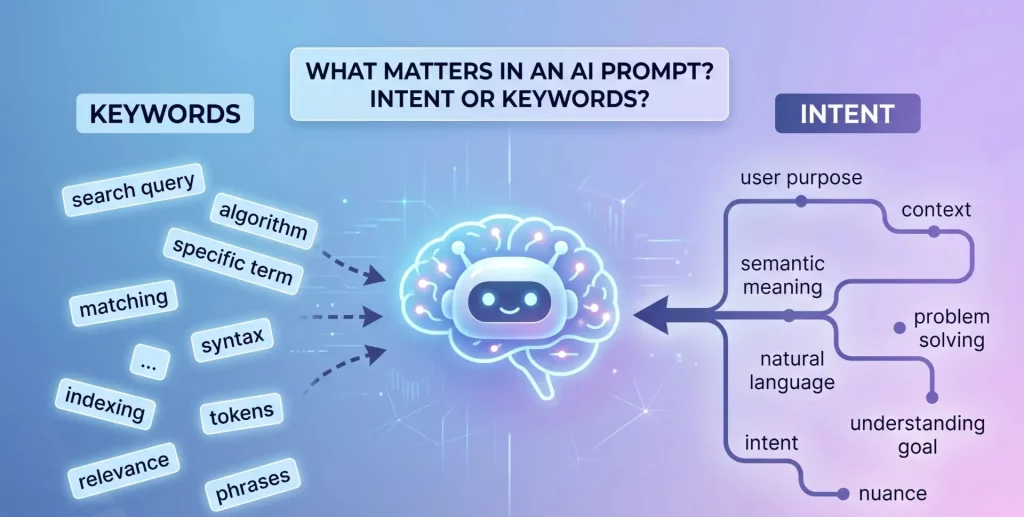
The short answer is that intent matters more than keywords in modern AI systems.
Keywords still help chatbots and AI search engines understand the topic of a query, but intent determines what the user is actually trying to accomplish. It influences how an AI interprets a request, selects relevant information, and structures its response. In other words, keywords provide context, while intent provides direction.
As AI-powered search experiences become more common, marketers and business owners are asking new questions. Should content still be optimized primarily for keywords?
Which On-Page SEO Elements influence AI visibility? And how do systems like ChatGPT, Gemini, Claude, and Google’s AI Overviews decide which brands, websites, and sources appear in generated answers?
A common assumption is that ranking highly for a keyword is enough to earn visibility in AI-generated responses. If your website ranks well in traditional search results, will your brand automatically be mentioned when users ask AI assistants about your products, services, or industry? Not necessarily.
Modern AI systems do far more than match keywords. They analyze meaning, context, relationships between concepts, and the underlying intent behind a user’s question. As a result, AI visibility increasingly depends on how effectively your content helps satisfy user intent while demonstrating relevance, expertise, and contextual value.
This shift is changing how information is discovered, summarized, and recommended. It is also reshaping SEO strategy, content creation, and optimization for AI-driven search experiences.
How AI Understands Prompts Differently From Traditional Search Engines
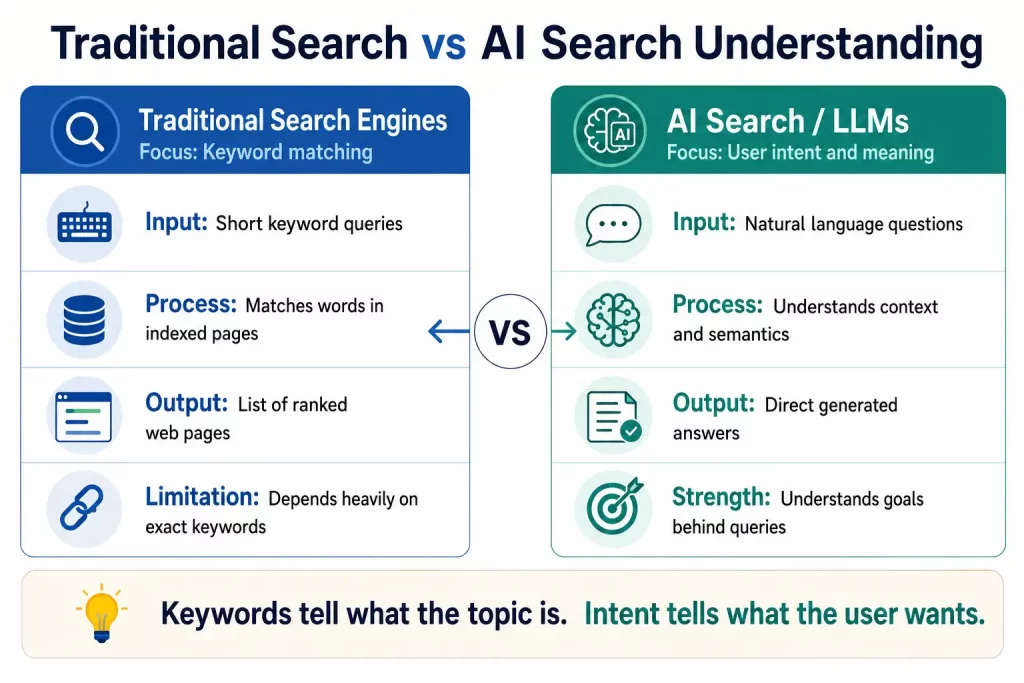
For years, traditional search engines relied heavily on keywords. Users had to enter specific phrases, and search engines looked for pages that closely matched those terms. Rankings were influenced by factors such as content relevance, backlinks, and domain authority. While search became better at understanding intent over time, users often still had to adapt their queries to find the right information.
Large Language Models (LLMs) do not use literal string matching. Instead, they process language through neural networks that map the conceptual and contextual relationships between words. When you submit a prompt, the model maps the semantic meaning of your text rather than just tracking individual characters.
Consider how this looks in practice. If you type “best ai seo agency” into an old-school search bar, it looks for articles with those exact words in the title or headers.
When you use the same phrase in an AI chatbot, the system goes beyond keyword matching. It tries to understand what you actually mean. Are you looking for agency recommendations, evaluation criteria, pricing information, case studies, or expert services?
Instead of focusing only on the words, the AI interprets the intent behind the query and generates a response based on the broader context. This shift from matching keywords to understanding intent is one of the biggest differences between modern AI systems and traditional search.
What Is User Intent in AI Prompts?
User intent in an AI prompt is the core objective you want the model to achieve, the specific perspective it should adopt, and the unstated rules it needs to follow. Unlike old-school search intent, which usually stops at commercial or informational categories, prompt intent is deeply layered.
When an LLM processes a prompt, it decodes the problem you are trying to solve. Intent covers the implicit context you leave out of the text. For instance, if a founder asks an LLM to critique a landing page hero copy, the literal request is text analysis. The deeper, structural intent is to fix a conversion drop-off and hold a visitor’s attention.
Forms of intent change based on very subtle shifts in how you frame a sentence. A prompt can intend to audit, expand, summarize, or restructure. If you ask an AI to read a competitor’s product documentation to extract product gaps, your intent is competitive positioning. If you ask it to read the same document to create a brief for a new developer, the intent shifts to technical utility and onboarding. The AI model is designed to recognize these operational shifts, prioritizing your structural goals over the nouns you use to describe the topic.
Do Keywords Still Matter in AI Prompts?
Because language models (LLMs) are built to interpret abstract concepts, it is easy to assume keywords no longer matter in prompt engineering. That is a mistake. Keywords are still highly relevant, but their role has completely changed. They are no longer strings used for database retrieval; they are context signals.
Keywords act as conceptual anchors that define the boundaries of your request. They tell the model which specific domain of knowledge or industry logic to pull from. If you write a prompt about improving a website’s conversion rate, using keywords like “Time to First Byte,” “hydration budget,” or “Core Web Vitals” tells the AI to look at the issue through a Technical SEO performance lens rather than a copywriting lens.
Without these anchor terms, the model has to guess the boundaries of your query, which usually results in generic responses. Keywords eliminate this ambiguity. However, using them in isolation won’t work. If you stack five industry terms together without giving the model explicit direction on what to do with them, it will simply define those terms back to you. Keywords provide the raw ingredients, but your intent provides the actual recipe.
Intent vs Keywords: Which Has More Influence on AI Responses?
When you look at what drives high-quality LLM outputs, intent consistently outperforms a keyword-heavy approach. Keywords show the AI the topic, but intent dictates its thinking process.
Traditional Search vs AI Search
Look at how this plays out with two different approaches to generating a content brief:
Prompt A (Keyword Heavy): Write a content strategy brief for a B2B SaaS startup focused on AI visibility, search engine rankings, organic traffic, and generative engine optimization.
Prompt B (Intent Focused): We are a venture-backed B2B SaaS platform. Buyers frequently ask AI search tools for vendor recommendations in our space, but our product isn’t showing up in those summaries. Create a content strategy brief that identifies the exact types of technical articles and documentation we need to publish so that LLMs recognize our feature set and cite us as a top solution.
Prompt A uses all the right buzzwords. But because it lacks explicit intent, the AI will likely output a basic, textbook definition of content marketing. It will tell you to write high-quality content, update your metadata, and build links. It repeats your keywords without giving you an actual strategy.
Prompt B uses fewer buzzwords but communicates an exact business challenge. It specifies the business model, the exact technical challenge, and the concrete outcome required. The resulting AI output will be practical and tactical, focusing on structural data, entity relationships, and natural language alignment. The intent forces the model to build a real solution instead of a surface-level overview. The response of prompt B will be unique and
The Role of AI Prompt Engineering
Real prompt engineering is not about finding “magic words” to trick an LLM into working. It is the practical habit of clarifying context, constraints, goals, and audience parameters so the model can grasp your intent on the first try.
When you write a great prompt, you are building a logical box for the model to work inside. An effective prompt relies on four distinct pillars:
Role Identification: Defining the exact viewpoint the model should take (e.g., a skeptical enterprise buyer or a veteran product manager).
Contextual Constraints: Providing internal data, technical limitations, or market realities that narrow the scope of the answer.
Audience Mapping: Explaining who will read the output so the model can naturally adjust its tone, density, and vocabulary.
Output Specifications: Dictating the exact structure, format, and layout required for the final deliverable.
When you define these pillars, you define the intent. You can place relevant keywords inside this framework to keep the topic on track, but the structural box is what keeps the model from hallucinating or generating fluff.
What This Means for AI Search and Content Strategy
The shift from keywords to intent within LLMs does not just change how we write prompts. It completely changes how modern search engines function, which directly impacts your company’s content playbook. The industry is moving rapidly away from old-school search engine optimization toward an environment defined by answer engines and AI Overviews.
When prospective buyers use AI engines to find software or services, they don’t type in short keyword strings. They type out complex, multi-layered scenarios and specific organizational problems. Because AI models evaluate these inputs based on semantic meaning rather than exact word matches, legacy SEO tactics are hitting a point of diminishing returns.
For brands looking to maintain market share, survival requires a deep commitment to tracking and improving your AI Visibility. AI engines look for content that addresses the user’s core intent with genuine depth, unique perspectives, and verifiable facts. If your pages contain all the right keywords but fail to actually resolve the user’s underlying problem, an LLM will not synthesize your data or cite your brand in its answer.
Optimizing Content for LLM Understanding
To ensure your company gets cited by answer engines, your public-facing content needs to align directly with how AI models read, index, and verify information. This requires a transition to deep topical authority.
First, your content strategy must prioritize information depth over generic word counts. AI models analyze how comprehensively an article covers a topic’s entities and concepts. Instead of launching five separate, thin blog posts targeting slightly different keyword variations, you should focus on building comprehensive, structurally sound resources that address a business challenge from multiple strategic angles.
Second, formatting clean information architecture is non-negotiable for AI Overviews and standard LLM web scraping. Using clear, logical header hierarchies, answering complex technical questions directly in your introductory paragraphs, and using clean schema markup helps engines unpack and credit your points quickly.
Finally, your team needs to adopt an active Generative Engine Optimization (GEO) workflow. This means moving away from rewritten, generic content and anchoring your pages with proprietary data, direct expert quotes, and verifiable case studies. AI engines prefer content that provides distinct proof points over articles that simply rephrase old topics to hit basic keyword targets.
FAQs
1. What is prompt intent in AI?
Prompt intent is the real goal behind a user’s question or request. It tells the AI what you want to achieve, not just what words you use.
2. Do keywords still matter in AI prompts?
Yes. Keywords still help AI understand the topic, but they are not the main factor. Intent has more impact on the response.
3. How is AI search different from traditional search?
Traditional search matches keywords. AI search understands meaning and context to give more relevant answers.
4. Why is intent important for SEO and AI visibility?
Intent helps content match what users actually need. This increases the chances of being included in AI-generated answers.
Conclusion
So, what matters more in a prompt: intent or keywords?
Keywords help define the topic, but intent determines the outcome. The clearer the goal, the better the response.
The same applies to search visibility. Ranking for keywords still matters, but content that truly answers user questions has a better chance of being surfaced and recommended.
As search evolves, brands need to focus on understanding user needs, building topical authority, and creating genuinely useful content.
Keyword research helps you identify the search terms that a user can use while searching for something and the topics they want information about. Keyword research is one of the most important on page SEO activities for improving content visibility and attracting relevant traffic.
If your keyword research is accurate, the traffic will be more relevant and valuable.
Most of the websites trying to grow organic traffic make the same mistake. They focus only on keywords with high search volume and stop there. They do not think about who is searching, what they really want, or if the page can actually rank.
If proper planning of keywords is not done it can lead to Keyword Cannibalization which might affect your website seo overall.
This leads to content that may get impressions but no clicks, or clicks that do not turn into results or sales.
What Is Keyword Research in SEO?
Keyword research is the process of finding the phrases and exact words people type into search engines (Google, Yahoo, Bing etc) and chatbots like ChatGPT and Gemini, and then choosing the best fits for your business need
If you have done your keyword research correctly, it shows you what content to create, how to structure it, and what topics you are missing. When done poorly, it leads to wasted time on content that does not rank or brings in the wrong audience.
What Are the Different Types of Keywords in SEO?
Let’s understand the types of keywords. Simply keywords can be classified based on the shorter and longer and eventually based on the intent of keywords.
Short Tail or Head terms are short, high-volume phrases like “Best AI SEO Agency ” or “running shoes.” They’re competitive and broad, which means converting traffic from them is harder. They still matter, but they shouldn’t dominate your strategy.
Long-tail keywords: These are more specific phrases, usually three words or more, like “Technical SEO Issue for AI Visibility” or “best running shoes for flat feet.” Lower volume, higher intent, and far more achievable for newer or mid-authority sites.
Also keywords can be classified on the basis of intent of keyword.
Informational keywords signal that someone’s looking to learn. “How does compound interest work” or “what is content marketing” fall here. These are valuable for awareness and brand building, but they rarely convert directly.
Commercial investigation keywords are the ones buyers use when they’re comparing options. Think “best CRM for small businesses” or “Shopify vs WooCommerce.” These convert well and are worth significant investment.
Transactional keywords signal purchase intent. “Buy standing desk online” or “hire freelance copywriter” belong here. High value, high competition.
Knowing which type you’re targeting shapes the content format, the page structure, and what success even looks like.
How To Find Keywords for SEO?
Start with what you already know about your business. Think about the problems your product or service solves, the questions customers ask, and the words they use in sales calls, reviews, or support messages. This is useful information that most keyword tools cannot provide.
From there, a few practical approaches:
Seed keyword expansion. Take a broad term that’s central to your business and plug it into a tool. You’ll get dozens of related phrases, questions, and variations. The goal isn’t to target all of them. It’s to understand the full picture.
Competitor gap analysis. Find sites ranking in your space, look at what they rank for, and identify terms you’re not covering. This surfaces real opportunities, not just theoretical ones.
Search autocomplete and “People also ask.” Google itself is telling you what people search for. Type your seed term into Google, watch what populates, and scroll through the related questions. It’s low-tech and underused.
Customer language mining. Go read your brand specific industries reviews, your competitors’ reviews, Reddit threads in your niche, and Quora questions and answers. The specific words people use to describe their problems are often better keywords than anything a tool generates.
How to Do Keyword Research at Scale
Keyword research changes shape once your website has hundreds or thousands of pages. A blogger picking ten keywords for a month of content is solving a different problem than an e-commerce site with 5,000 product pages or a marketplace adding new city or category pages every week. At that scale, manual keyword-by-keyword research breaks down. You need a system, not a list.
Cluster before you target. Instead of researching keywords one at a time, pull a large batch (often 500 to 5,000+ keywords) from a tool like Ahrefs or Semrush around your core topics, then group them by shared search intent and semantic similarity. A single well-structured page can rank for dozens of keywords inside one cluster, so the goal is to find clusters, not individual terms.
Map keywords to URLs before you write anything. For large sites, the biggest risk is not missing keywords, it is assigning the same keyword intent to multiple pages without realizing it. Before content gets briefed or written, every keyword cluster should be mapped to exactly one target URL. This single step prevents most large-scale keyword cannibalization before it happens.
Use bulk export and filtering, not manual lookup. Tools built for scale matter here. Ahrefs and Semrush both allow bulk keyword export by seed list or competitor domain. Screaming Frog combined with a keyword list can help you audit which existing pages already rank for which terms, so new content only gets created where a real gap exists. For very large keyword sets, exporting to a spreadsheet and using formulas or scripts to filter by volume, difficulty, and intent is far faster than reviewing keywords individually inside a tool’s interface.
Prioritize by page-creation cost, not just opportunity. When you are dealing with thousands of keywords, the question is rarely “is this keyword worth targeting.” It usually is. The real question is which few hundred keywords give you the best return for the content and development effort required. Rank clusters by traffic potential per page, not traffic potential per keyword, since one page in a large-scale strategy is expected to carry many keywords at once.
Revisit clusters quarterly, not keyword by keyword. On a large site, keyword strategy shifts faster than any one person can track manually. Instead of reviewing individual keywords, review whole clusters every quarter: which ones are growing, which are flat, and which pages are now competing against each other for the same terms.
Can AI Help With Keyword Research?
Yes, AI can help with keyword research by generating keyword ideas, related topics, and common questions people may ask. It can also help you discover long-tail keywords and organize content into topic clusters.
That said, AI should not be the only tool you rely on. It cannot provide accurate search volume, keyword difficulty, or ranking data. Before targeting any keyword, it is always a good idea to verify the data using tools like Google Search Console, Google Keyword Planner, Ahrefs, or Semrush.
The best approach is to use AI for brainstorming and traditional SEO tools for validation.
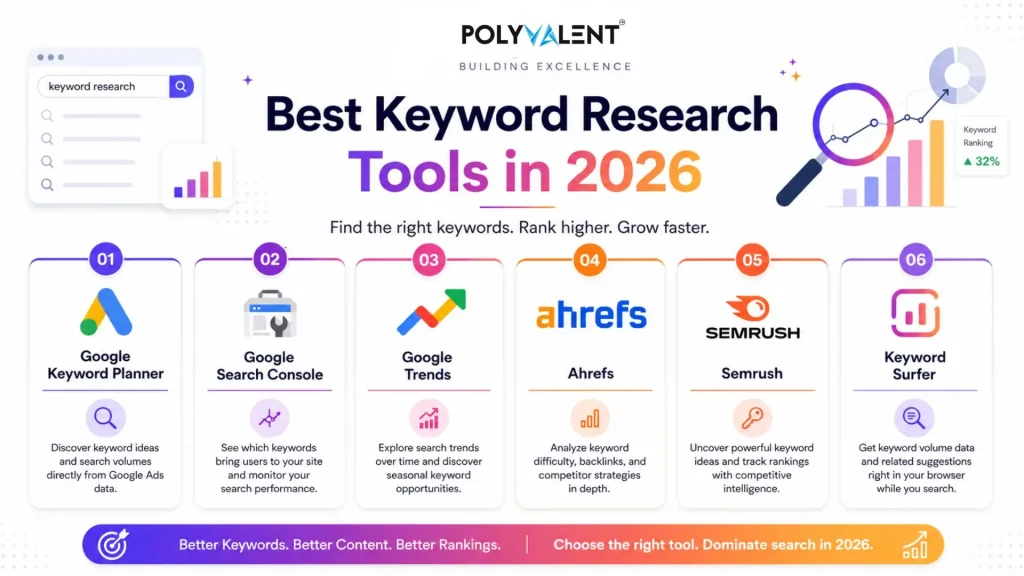
What Are the Best Keyword Research Tools in 2026?
We have tested multiple tools for seo purpose here are top recommendations from our side if you are just starting out or looking for a great keyword research tool.
When choosing keyword research tools, it makes sense to start with the free options before investing in paid platforms. Many businesses can find valuable keyword opportunities using Google’s own tools, especially during the early stages of keyword research for content alignment.
To start keyword research, your first step is to use the google free tools like Google Keyword Planner, Google Trends, and Google Search Console. Together, these tools provide enough data to identify keyword ideas, understand search demand, and help you to find new opportunities already available within your website.
Google Keyword Planner : It helps generate keyword ideas and provides estimated search volume data. While the numbers are not always precise, it remains a useful tool for understanding how often people search for specific terms and for finding related keyword opportunities.
Google Trends: It is useful for analyzing search interest over time. It helps identify seasonal topics, rising trends, and keywords that may be losing popularity. This additional context can prevent targeting keywords that are declining in relevance. With this tool you can also find trending searches and topics in your industry.
When checking a keyword in Trends, switch to the 5-year view before deciding anything. A term that spikes every year around the same time is a genuine seasonal keyword worth planning content around in advance. A term that spiked once and never recovered is a trend that already passed, and building core content around it is a much weaker bet.
Google Search Console: It provides actual search queries that are generating impressions and clicks for your website. Reviewing these queries often reveals keywords that are already ranking on page two or three of search results, creating opportunities for quick SEO improvements.
Once enough data has been gathered from these free keyword research tools, paid keyword research platforms can be used for deeper analysis.
Note: For a new website, Google Search Console will not have sufficient data because the site is still building impressions and clicks. It usually takes some time before enough search data becomes available. In the beginning, you can use tools like Google Keyword Planner and Google Trends to find keyword opportunities while your Search Console data grows.
Ahrefs remains one of the most trusted tools for SEO professionals. Its Keyword Explorer provides search volume, keyword difficulty, traffic potential, and click metrics. The Traffic Potential metric is particularly useful because it looks beyond a single keyword and estimates the total organic traffic a page could attract from related search terms.
Semrush is also a strong option for keyword research. It helps to find the keywords competitors rank for, identify content gaps, and discover new opportunities within a niche. For businesses operating in competitive industries, this data can help shape a more effective content strategy.
Both semrush and Ahref are good for keyword research you can go with anyone as per your requirements and budget
For those looking for additional free keyword research tools, a few options are worth considering:
Google Keyword Planner for keyword ideas and search demand
Google Search Console for performance data and ranking opportunities
Google Trends for seasonal and trending topics
Keyword Surfer for quick keyword insights directly within Google search results
One important thing to remember is that no keyword research tool provides perfectly accurate search volume data. Keyword research tools use different data sources and estimation methods. Instead of treating search volume as an exact number.
The goal is not to find perfect data. The goal is to find keywords that align with search intent, match business objectives, and offer realistic ranking opportunities.
How to Analyze Keywords Before Targeting Them
Finding keywords is the easy part. Deciding which ones are worth targeting takes more judgment.
Search intent alignment. If your webpage content intent is not matched with the user’s intent it will not rank and you will waste your resources on creating the content to understand the intent. Look at the top-ranking pages for your keyword. Are they blog posts, product pages, comparison articles, or something else? If you’re planning a long-form guide and the SERPs are full of product listings, you’re fighting the wrong battle.
Keyword Research for New Websites: New websites should approach keyword research differently from established ones, because domain authority is the constraint that matters most in the first year.
Start almost entirely with long-tail, low-competition keywords. A high-volume head term might look attractive, but a brand-new site has no link history or topical authority to compete for it, and publishing content that never ranks wastes both time and budget.
Instead, look for keywords with lower search volume but clear, specific intent, the kind of phrases someone types when they already know what they want.
A realistic first 90 days often looks like this: 15 to 20 long-tail keywords, each with a clear, singular intent, each mapped to its own page, with no two pages competing for the same term.
As those pages start ranking and the site earns some authority, broader and more competitive keywords become realistic targets. Trying to skip this stage by going straight after head terms is the most common reason new sites see impressions climb in Search Console while clicks stay flat.
Keyword difficulty vs. domain authority. These metrics are not officially by google however they are present in the seo industry. High difficulty scores don’t automatically mean not to pick the keyword. They mean you need to be realistic about how long it’ll take to rank and whether your site has the authority to compete. A DR 30 site going after DR 80 territory is a slow burn at best. A new website can publish a blog on high DA or DR keywords , but it will be difficult for the website to rank at the top.
Traffic potential over search volume. A keyword with 500 monthly searches might drive far more traffic than one with 2,000 if it has a better CTR distribution. Look beyond the headline number. No tool provides the exact true search volume they estimate.
Business value. A keyword that brings 10,000 visitors who never convert is worth less than one that brings 500 who do. Always tie keyword targets back to business outcomes.
A Simple Keyword Prioritization Framework
Search volume alone is a poor way to decide what to target. A more reliable approach is to score each keyword candidate across the factors that actually predict results, then compare scores instead of comparing volume.
Factor
What to Ask
Score (1–5)
Intent Match
Does this keyword’s intent match the content format you can realistically produce?
3.5
Difficulty
Is this achievable given your current domain authority and content depth?
5
Traffic Potential
Beyond the exact keyword, how much related search traffic could this page realistically capture?
4
Business Value
If this keyword ranks and converts, does it move a real business outcome?
5
That is why keyword strategy should focus on all stages of the funnel. TOFU keywords can bring thousands of visits, but they rarely lead to direct conversions. However, that does not mean TOFU content should be avoided. It is not true. TOFU content still plays an important role in attracting and educating your audience.
The key is to create content for each stage of the funnel so users are guided from awareness to consideration and finally to conversion.
Best SEO Keyword Research Checklist
Free Keyword Research Tracking Template
Use this structure to track keyword opportunities as you find them. You can copy it directly into a spreadsheet.
Table 1: Keyword Discovery Tracker
Keyword
Seed
Source
Country
Autocomplete Position
Difficulty
Hot Keyword (Y/N)
Relevancy Score
e.g. best crm for small business
crm
Ahrefs
India
2
38
Y
8/10
Seed: the broader term this keyword came from
Source: where you found it (Ahrefs, Search Console, autocomplete, competitor gap, customer language)
Autocomplete Position: where it appeared in Google’s suggested searches, if applicable
Hot Keyword: mark yes if search volume is trending up or it’s tied to a current event or seasonal spike
Relevancy Score: your own 1 to 10 rating of how closely this matches your business, not just the topic
Table 2: Keyword-to-Page Mapping
Target URL
Primary Keyword
Secondary Keywords
Search Intent
Notes / Target Outcome
e.g. /blog/best-crm-software
best crm for small business
crm comparison, crm pricing
Commercial investigation
Drive demo sign-ups, update quarterly
Primary Keyword: the one keyword this page is built to rank for
Secondary Keywords: supporting terms the same page should naturally cover
Search Intent: informational, commercial investigation, or transactional
Notes / Target Outcome: what success looks like for this page (leads, sign-ups, rank position, etc.)
Filling out Table 2 before you assign content to a writer is what prevents keyword cannibalization. If two rows have the same primary keyword, that’s your signal to merge the pages instead of publishing both.
Before finalizing any keyword to target, run it through this quick check:
Does the search intent match what you’re planning to create?
Is the keyword difficulty realistic for your current domain authority?
Is the traffic potential worth the investment?
Are there commercial or transactional modifiers you should account for?
Does this keyword support a specific stage of the buyer journey?
Is there an existing page on your site that already covers this (cannibalization risk)?
Is search volume trending up, stable, or declining?
A keyword that passes most of these checks is worth pursuing. One that fails several of them deserves a harder look before you commit.
Common Keyword Research Mistakes to Avoid
Targeting only high-volume head terms. This is where most businesses start and get stuck. High-volume keywords look attractive in spreadsheets. They’re brutal in practice, especially for newer sites without strong link profiles.
Ignoring search intent entirely. Ranking for a keyword that doesn’t match your content type rarely ends well. Google is increasingly good at understanding what a searcher actually wants, and if your page doesn’t deliver that, the ranking won’t stick.
Building pages for every keyword variation. More pages don’t automatically mean more traffic. A single well-optimized page can rank for hundreds of related terms. Creating separate thin pages for every slight variation often causes cannibalization.
Chasing volume spikes without context. A sudden rise in search volume might look like an opportunity. Sometimes it is. But trends fade, and building core content around a moment rather than an enduring need is a risky bet.
Not revisiting keyword strategy. This one is more common than it sounds. A keyword strategy built 18 months ago doesn’t reflect where your competitors are now, what new terms have emerged, or which pages have already gained traction. Keyword research isn’t a one-time project.
FAQs
Q1: How often should I do keyword research?
Keyword Research depends on your requirements; there is no target rule to follow.
Q2: How many keywords should I target on one page?
In SEO, there is no specific number for a single page, but you can go with 1 primary keyword and 2 to 3 secondary keywords. Use keyword variations and avoid forcing keywords throughout the content.
Q3: Is keyword research still important with semantic search?
Yes. It helps you understand what people search for and the content they expect, even if exact-match keywords matter less.
Q4: Can AI fully replace manual keyword research?
No, AI can support keyword research, but human judgment is still needed to choose the right keywords based on business goals and audience.
Conclusion
The websites that consistently win on organic search aren’t necessarily the ones with the biggest budgets or the most content. They’re the ones that understand what their audience is searching for and build content that actually satisfies that need, better than what’s already out there.
That starts with keyword research, but it doesn’t end there. Use it as a foundation for your content decisions, not a checklist to complete and file away. The more often you revisit it, the sharper your strategy gets.
On page seo for ai is becoming essential as AI-powered search experiences reshape how people find information online. With the growing impact of AI Overviews and platforms like ChatGPT Search, Perplexity, and Gemini, users are increasingly receiving direct answers, summaries, and recommendations instead of browsing through a list of search results.
This change means that ranking on the first page of search engines is no longer the only goal. Brands and website owners must also ensure that their content is visible and referenced in AI-generated responses.
On page seo for ai focuses on more than just keywords and rankings. It prioritizes content structure, context, clarity, and machine-readable signals that help AI systems understand, interpret, and accurately cite information. The goal is to create content that delivers value to users while making it easier for AI-powered search tools to identify and surface relevant insights.
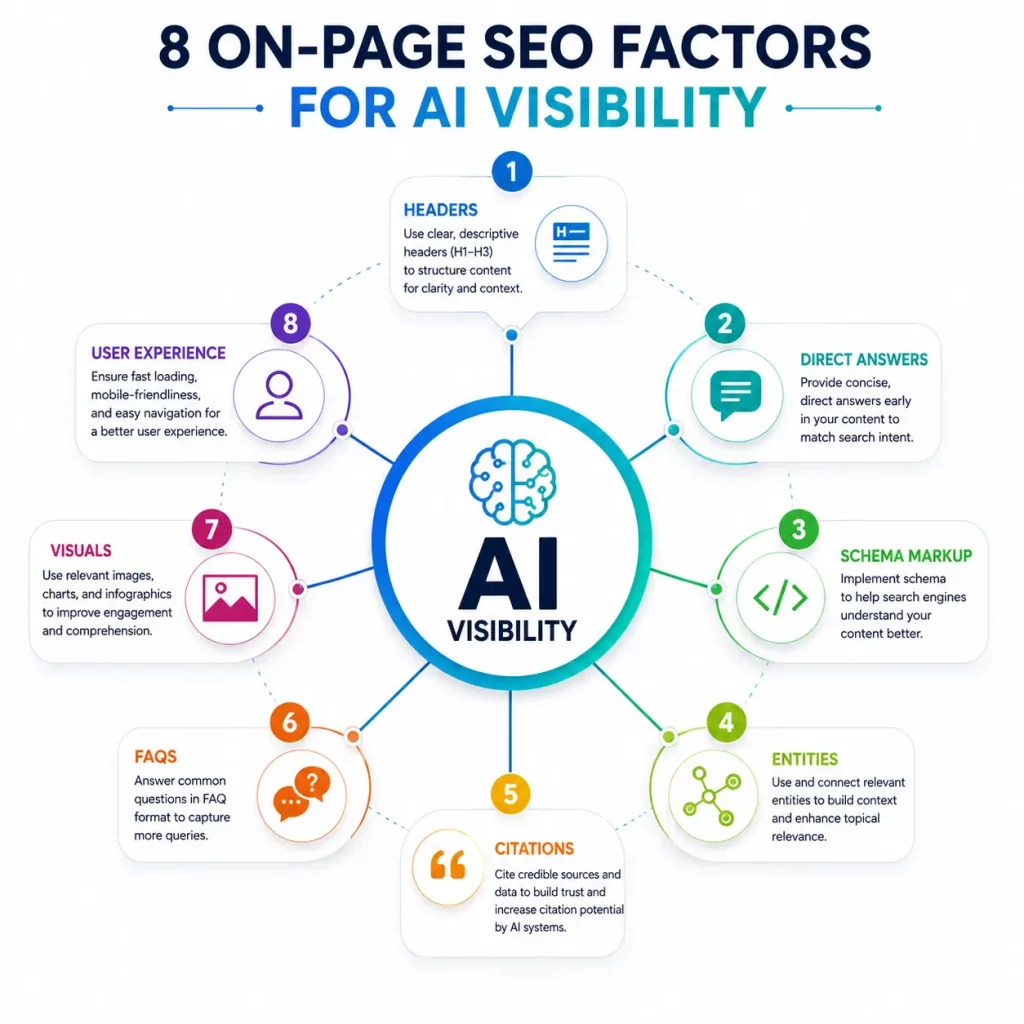
The following eight on-page SEO elements can help improve your content’s visibility in AI-generated answers and modern search experiences.
1. Natural Language & Conversational Headers
Traditional search engine optimization often involved creating rigid, slightly awkward headings designed solely to match exact-match search volume. Large Language Models (LLMs) do not read like old-school algorithms. They are trained to process complex human phrasing, semantic nuances, and natural speech patterns.
When structuring your content, write your H2 and H3 subheadings as direct questions or natural statements that a real person would speak aloud.
As the LLMs Chatbots easily can understand the language and can provide answers as expert of the subject.
For example, a heading like:
“What Is Entity Optimization and Why Does It Matter?”
is often more useful than:
“Entity Optimization SEO Guide”
The first version mirrors how users naturally search and how AI systems interpret conversational queries.
This is one of the most effective seo strategies for ai visibility because AI-generated answers frequently originate from content that closely matches the wording of user questions.
Examples of Effective Header Structures
H2 Example
How Do AI Search Engines Process Natural Language?
H3 Example
Why Do LLMs Favor Question-Based Phrasing Over Pure Keywords?
Question-driven structures create stronger alignment between search intent and content relevance.
They also help AI systems identify sections that can be extracted and presented as direct answers.
When planning content, think about the questions your audience asks rather than the keywords they type.
2. Direct and Concise Answers Under Every Section
One of the most overlooked aspects of ai seo optimization is answer formatting.
AI systems frequently scan content looking for concise explanations that can be quoted, summarized, or referenced in generated responses.
Long introductions before answering a question often make extraction more difficult.
A useful technique is placing a short answer immediately after every major heading.
Think of it as an “AI snack” that delivers the core information in two or three sentences before expanding into greater detail.
Example
What Is Schema Markup?
Schema markup is structured data that helps search engines and AI systems understand the meaning and context of webpage content. It provides machine-readable information that improves content interpretation and discoverability.
After providing the concise answer, you can then expand with examples, benefits, and implementation guidance.
This structure benefits both users and AI systems.
Readers get immediate value, while AI models can easily identify and extract the most relevant information.
AI bots are designed to save users time by extracting quick, highly accurate summaries from the web. If an engine has to read through five paragraphs of introductory fluff to find a simple definition, it will likely skip your page and source the answer from a competitor.
To capture these citations, place a direct, two to three sentence summary immediately below your conversational headers. This layout technique acts as an information snapshot, or an “AI snack,” that a crawler can easily extract and blockquote in a chat response.
Example :
[Conversational H2 Header: What is technical SEO for AI?]
[The AI Snack: Technical SEO for AI focuses on optimizing a website’s backend architecture so large language models can crawl, process, and index content without friction. By utilizing server-side rendering, clean HTML code structures, and open bot permissions, you ensure that AI engines can instantly retrieve and accurately cite your data in real-time user chats.]
This specific layout choice serves as a simple framework for quick ai seo optimization. It satisfies the user’s need for immediate clarity while handing the AI crawler a perfect, pre-formatted summary on a silver platter.
Example: 3
What is on-page SEO optimization for AI? : On-page SEO for AI focuses on optimizing front-end content structures and context so large language models can crawl, process, and summarize information efficiently. By placing a direct, two-to-three-sentence summary immediately below your conversational headers, you give AI search bots a perfect snapshot to extract and blockquote in real-time user chat responses.
3. Structured Data & Schema Markup
While natural language is vital for the front-end of your website, structured data (Schema) remains critical for the backend. Schema markup is a standardized code format that provides explicit context about your page to an engine, removing any room for misinterpretation.
By implementing specific schema types, such as FAQPage, Article, Product, or Organization, you tell the crawler exactly what your data represents. For example, instead of letting an algorithm guess the price or availability of a product, Product schema explicitly defines those variables in a universal language.
Important Schema Types for AI Visibility
Article Schema
Article schema helps identify the page as a piece of editorial content and provides information about authorship, publication dates, and headlines.
FAQ Schema
FAQ schema clearly communicates questions and answers, making content easier to interpret and potentially surface in conversational search experiences.
Organization Schema
Organization schema helps establish brand identity, company information, and relationships between content and its publisher.
These structured signals improve content comprehension and support stronger visibility across AI-powered search platforms.
These structured signals improve content comprehension and support stronger visibility across AI-powered search platforms.
Foundational AI Note: When evaluating what elements are foundational for SEO with AI, structured data sits at the absolute top of the list. While LLMs excel at processing natural front-end language, backend schema removes all semantic ambiguity, handing AI engines an undisputed, clean data baseline.
4. Entity-Based Keywords & Contextual Depth
SEO has moved far beyond simple keyword repetition.
Modern AI systems understand relationships between concepts, topics, organizations, products, and people. This approach is commonly known as entity-based optimization.
For example, an article about AI search visibility should naturally reference related concepts such as:
Semantic SEO
Search intent
Schema markup
Knowledge graphs
Topical authority
Content structure
User experience
These related entities help establish context.
Instead of repeatedly targeting the same keyword, effective on page seo for ai focuses on building a complete topic ecosystem around the subject.
A strong article discusses AI visibility tools alongside search behavior, semantic relevance, structured data, authority signals, content quality, and entity relationships.
The second approach provides richer context that AI systems can understand and trust.
This depth is a major contributor to topical authority and long-term discoverability.
5. High-Quality External Citations & Sources
Trust matters more than ever.
AI systems are increasingly focused on identifying reliable information sources. Content that references credible research, authoritative publications, and trusted industry resources often carries stronger signals of expertise and reliability.
External citations help support factual claims and demonstrate that information is grounded in evidence rather than opinion.
Best Practices for Source Attribution
Reference reputable industry studies.
Link to official documentation whenever possible.
Use current statistics from authoritative sources.
Users rarely stop at a single question when interacting with a conversational search tool. They tend to ask follow-up questions to drill down into specific details or clarify a nuance.
Adding a comprehensive FAQ section to the bottom of your articles allows you to target these precise long-tail, informational queries. Think about the tangential concerns your audience might have and address them in a clear, question-and-answer format.
Why FAQs Scale Visibility
They naturally capture conversational variation in user prompts.
They provide a dense cluster of high-value informational snippets on a single page.
They allow you to expand your coverage of related entities effortlessly.
Detailing these specific points in a dedicated FAQ block naturally helps you scale up your advanced seo strategies for ai visibility without disrupting the narrative flow of your main article body.
7. Optimizing Visuals with Context-Rich Alt Text
Modern search engines are increasingly multimodal. They no longer look at text in isolation; they analyze graphics, charts, diagrams, and text simultaneously to understand the full scope of an article.
This means your image alt text can no longer be a lazy string of keywords. Your alt text needs to be context-rich and descriptive, explaining exactly what data or concept the image communicates. If you display a chart showing rising inflation rates, the alt text should explain what the trend line indicates.
For Example:
[Bad Alt Text]: alt=”inflation chart graph”
[Good Alt Text]: alt=”Line graph showing a 4% increase in core inflation rates between 2024 and 2026
Writing clear alt text that describes the data in an image reinforces your core topic and helps conversational tools index your media. Utilizing the best ai visibility tools can help you track how your media and content perform across these diverse search environments.
8. User Experience (UX) & Content Readability
Many AI visibility discussions focus heavily on technical factors while overlooking user experience.
However, content that is difficult to read rarely performs well with either humans or machines.
AI systems increasingly evaluate quality through patterns associated with user satisfaction, content clarity, and overall usefulness.
Readability contributes directly to content effectiveness.
Best Practices for Better Readability
Use short paragraphs.
Break up large blocks of text.
Create logical heading hierarchies.
Use bullet points where appropriate.
Maintain clear navigation structures.
Improve page speed and loading performance.
Focus on mobile usability.
Content should feel effortless to consume.
Users should quickly find answers, understand key concepts, and navigate through the page without friction.
Businesses looking to strengthen their overall AI search strategy should also evaluate thebest AI visibility tools available today. These platforms can help identify optimization opportunities, monitor AI-generated brand mentions, and uncover visibility gaps across emerging search experiences.
Ultimately, content readability remains one of the strongest indicators of quality for both users and AI systems.
How to Use AI for On-Page SEO
Optimizing your site for modern search engines doesn’t mean you have to abandon your favorite AI tools. In fact, you can use large language models as collaborative partners to speed up your optimization workflow. The trick is to avoid letting AI write your actual content, and instead use it to audit your structure and logic.
Here is how you can practically use AI to sharpen your on-page strategy:
Map out hidden semantic gaps: You can paste your draft into an AI tool alongside a list of your top competitor URLs. Ask the model to analyze the topical depth and pinpoint specific subtopics or industry terms you might have completely missed.
Generate real-world conversational headers: Instead of guessing how people speak, feed your primary keywords into an AI and ask it to generate ten realistic questions a human would ask an assistant out loud. This gives you a quick list of question-based subheadings to use in your draft.
Audit your “AI Snack” summaries: Before you publish, paste your section summaries into a chatbot and ask, “If you had to answer a user prompt in under 40 words using only this text, does it provide a complete answer?” If the AI struggles to extract a clean quote, rewrite the summary for better clarity.
Using AI this way ensures your content remains deeply human and authentic, while your underlying architecture becomes perfectly tuned for machine extraction.
Frequently Asked Questions
What is on page SEO for AI?
On page SEO for AI refers to optimizing webpage content, structure, context, and machine-readable elements to improve visibility within AI-powered search experiences. It focuses on helping AI systems understand, extract, and reference content accurately while maintaining a strong user experience.
How do AI search engines choose which websites to cite?
AI platforms prioritize websites that offer clear, direct answers to user queries, backed by structured data and authoritative external links. They look for high topical authority, conversational formatting, and content that directly matches the intent of the user’s prompt.
Will traditional keyword research become completely obsolete?
Not entirely, but its application is changing. Instead of finding a single keyword to repeat throughout an article, keyword research is now used to identify clusters of related concepts, questions, and entities that help build a comprehensive semantic network.
How can I track my website’s visibility in AI search results?
Tracking AI visibility requires monitoring your brand mentions and citations within AI generated summaries. You can use specialized AI visibility tools, monitor referral traffic from AI platforms in your analytics dashboard, and manually test common industry prompts to see if your site is being cited.
Does schema markup directly impact AI optimization?
Yes. Schema markup does not change how your page looks to human visitors, but it gives AI crawlers explicit, unambiguous data about your content. This makes it significantly easier for an algorithm to index your page accurately and use it in conversational answers.
How long does it take to see results from AI SEO optimization?
The timeline depends on how frequently AI engines update their underlying search indexes and web models. Generally, structural changes like adding schema or rewriting headers can show positive shifts in citation rates within a few weeks as bots recrawl your site.
What elements are foundational for SEO with AI search visibility?
The elements that are foundational for SEO with AI include conversational heading structures (H2s and H3s written as direct questions), immediate direct answers optimized for “AI snack” extraction, error-free structured data markup (Schema), and deep entity-based contextual coverage. Securing these core backend and frontend elements ensures that AI search engines can seamlessly parse, validate, and cite your content.
Building a Future-Proof Content Strategy
The future of search is increasingly shaped by AI-generated experiences.
Success is no longer determined solely by rankings. Visibility now depends on how effectively AI systems can understand, interpret, and reference your content.
The eight on-page elements covered in this guide provide a practical framework for improving discoverability:
Natural language headers
Direct answers
Structured data
Entity optimization
High-quality citations
FAQ sections
Visual optimization
User experience and readability
Together, these elements strengthen content relevance, contextual understanding, and authority across modern search environments.
Most importantly, they reinforce a principle that remains unchanged despite technological shifts: creating genuinely useful content for users.
When content quality, structure, technical foundations, and ai seo optimization work together, businesses place themselves in a stronger position to earn visibility across both traditional search results and AI-generated answers.
Now is a good time to review your existing content. Audit key pages, identify opportunities to improve structure and context, and apply the recommendations outlined in this guide. Small improvements today can create significant visibility gains as AI-powered search continues to evolve.
The era of chasing blue links is over. While traditional search engines still drive a significant portion of traffic, we are witnessing a tectonic shift toward AI Engine Optimization (AEO). Technical SEO for AI is becoming the new foundation of digital visibility.
AI models like GPT-4, Claude, and Gemini are no longer just tools we use to write, they are the new gatekeepers of information. They don’t just “rank” your content. They ingest it, synthesize it, and present it as their own knowledge.
If your technical foundation is shaky, these AI agents won’t just rank you lower. They will ignore you entirely. It creates a “zero-traffic” risk where your brand is erased from the synthesized answers users receive. To stay relevant, you must bridge the gap between being “searchable” and being “comprehensible.
What is Technical SEO in the Age of AI?
In the old world, technical SEO was about making sure Googlebot could find your URL and index the text. In the age of AI, technical SEO is about deep comprehension and data accessibility. It is the process of structuring your site so that large language models (LLMs) can parse your information without friction, map your brand to the global knowledge graph, and trust your data as an authoritative source.
AI crawlers are more expensive to run than traditional crawlers. They are looking for the path of least resistance to high-quality data. If your site requires too much “compute” to understand, you become invisible.
Problem #1: The JavaScript Wall
Many modern websites use frameworks like React, Vue, or Angular to create content dynamically. Instead of loading a complete webpage from the server, the browser first gets a basic HTML shell, and JavaScript generates the actual content after the page loads.
Humans eventually see the content.
AI crawlers often do not.
While Google has improved JavaScript rendering capabilities, many AI crawlers and secondary indexing systems still struggle with delayed rendering, hydration issues, blocked scripts, or rendering timeouts.
This becomes especially dangerous for:
Ecommerce category pages
Product descriptions
Blog content
Navigation menus
Internal links
Structured data injected via JavaScript
If the crawler receives incomplete HTML, your site becomes partially invisible.
Impact
AI systems prioritize efficiency. They crawl massive amounts of data under strict resource limits. A slow or rendering dependent site costs more compute to process.
When crawlers encounter rendering friction, they may:
Skip content entirely
Miss internal linking signals
Ignore structured data
Fail to identify entities
Reduce crawl frequency
Downgrade trust signals
This creates a silent visibility collapse.
Your content exists for users but not for machines.
Fix
Move critical content to server side rendering (SSR) or static site generation (SSG) whenever possible.
Your goal is simple:
Deliver meaningful HTML before JavaScript executes.
Immediate action steps:
View your site source, not the rendered DOM. Verify critical content exists in raw HTML.
Use SSR frameworks like Next.js or Nuxt for content heavy pages.
Pre render important landing pages.
Ensure internal links exist in HTML anchors.
Inject structured data server side.
Test rendering using crawler simulation tools.
For AI visibility, raw HTML clarity beats fancy frontend architecture every time.
Problem #2: Broken Schema and Entity Relationships
AI does not just read words. It identifies entities.
An entity is a clearly defined thing like your company, CEO, or product. AI systems use entities to understand and connect brands with topics.
If your Schema Markup is missing or broken, AI may struggle to understand who you are. For example, without proper JSON-LD structured data, AI could confuse “Apple” the tech company with “apple” the fruit.
Impact
This lack of clarity can prevent your brand from appearing in the Knowledge Graphs that power AI-generated search results and summaries.
If the AI cannot verify the relationship between your content and a known entity, it will default to a more “structured” competitor.
Fix
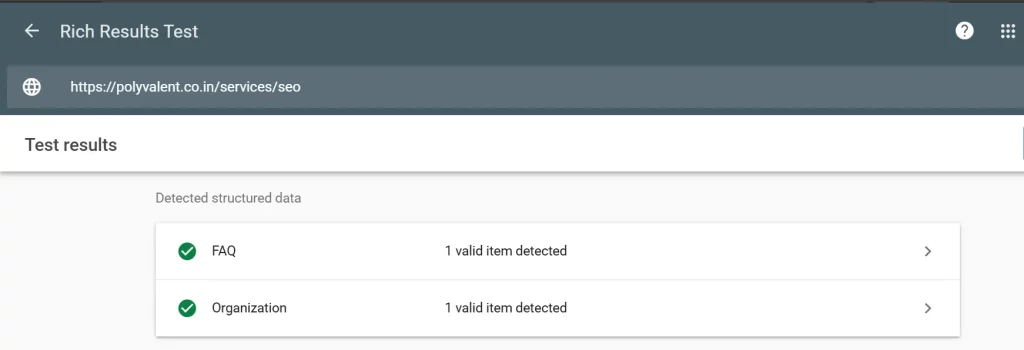
Relevant Schema Used on Our Website: Relevant Schema Implemented on our services page.
Solution : You need to go beyond basic Breadcrumb or Article schema. You must implement Organization, Person, and Product schemas that use the “sameAs” attribute to link to verified third-party profiles like Wikipedia, LinkedIn, or official social channels.
Action Plan:
Audit your site using the Schema.org validator or rich result snippets.
Map out your entity relationships. Ensure your “About” page clearly defines who you are and what you do using Organization schema.
Use Nested Schema to show how different pieces of content relate to one another.
Must add only required Schema to your Website.
Problem #3: Poor Semantic HTML
For years, developers have used “div” tags for everything. This “div soup” makes it hard for AI models to understand what matters most on a page. Unlike humans, AI cannot visually interpret layouts the same way. It relies on the website’s code structure to tell the difference between main content, navigation, ads, and footers.
Impact
When an AI bot parses a page with poor semantics, it wastes “tokens“ (the units of data AI uses to process text) on irrelevant sections like sidebar widgets or legal disclaimers.
This dilutes the signal of your main content. If the AI cannot easily identify the <article> or the <main> content, it might misattribute a random customer testimonial as your core service offering.
Fix
Return to the fundamentals of semantic HTML5. Use landmark tags to tell the AI exactly where the value lies. This creates a clear hierarchy that the AI can digest efficiently.
Action Plan:
Replace generic containers with <header>, <nav>, <main>, <article>, <section>, and <footer>.
Use a logical heading structure (H1 through H6) without skipping levels.
Ensure that every page has exactly one H1 that matches the core entity of the page.
Problem #4: Robots.txt and Firewall Blocking
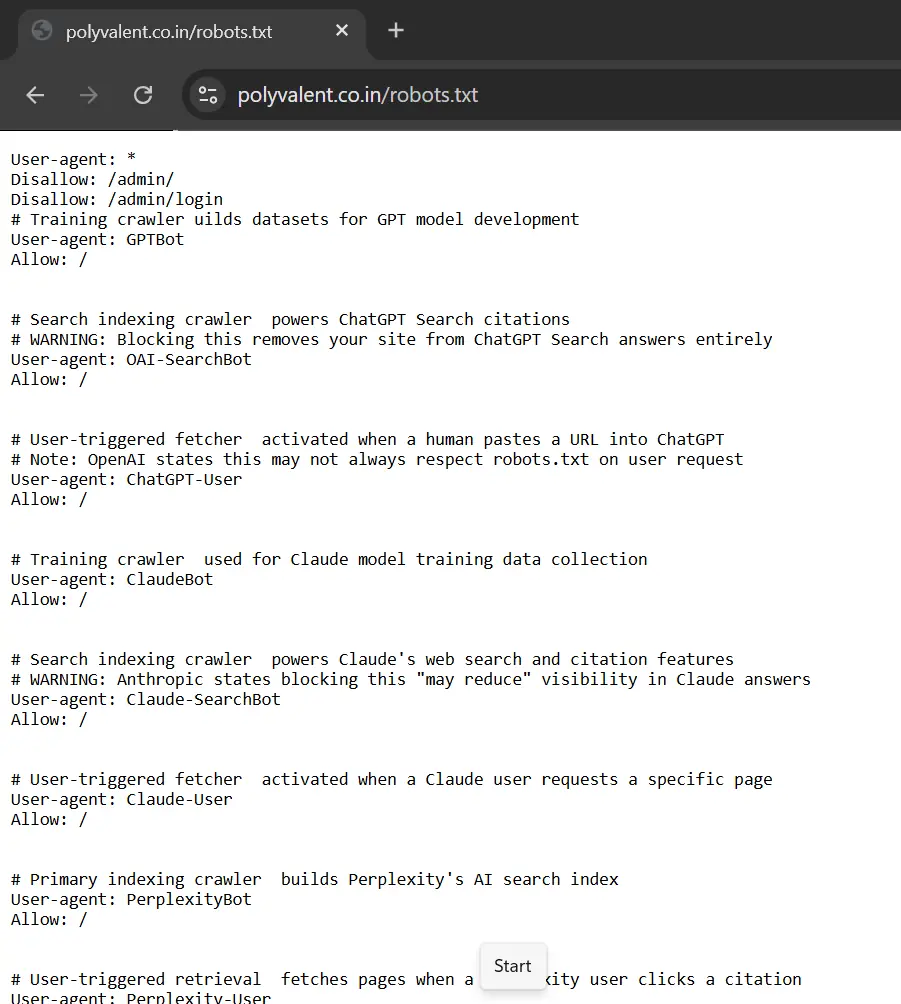
The first thing an AI crawler does is check your permissions. Many site owners, fearing data scraping, have implemented aggressive firewall rules or “Disallow” commands in their robots.txt files specifically targeting user agents like GPTBot or CCBot.
Along with allowing the right AI crawlers, maintaining a clean XML sitemap helps them discover your most important pages faster and understand your site’s structure more efficiently.
Impact
While protecting your intellectual property is important, a total block is a suicide mission for discovery. If you block GPTBot, ChatGPT cannot access your site to verify facts or provide links back to your store. You are opting out of the new internet. Furthermore, aggressive firewalls often trigger 403 errors for these bots, which flags your site as “unreliable” in the AI’s internal database.
Fix
Adopt a nuanced approach to bot management. Instead of a blanket ban, allow AI crawlers access to your public-facing, high-value content while keeping your proprietary data behind login screens or stricter robots.txt rules.
Here is how the Polyvalent Robots.txt file looks like.
Polyvalent Website Robots.txt File
Action Plan:
Review your robots.txt file for User-agent: GPTBot or User-agent: *.
Ensure your Content Delivery Network (CDN) like Cloudflare isn’t accidentally flagging AI agents as malicious “DDoS” threats.
Create a “Search-Friendly” directory and ensure it is wide open to legitimate AI crawlers.
Problem #5: Failing Core Web Vitals (The TTFB Bottleneck)
Speed is often discussed in terms of user experience, but for AI bots, Time to First Byte (TTFB) is a hard technical limit. AI crawlers operate on a massive scale and have “timeout” thresholds. If your server takes too long to respond with the first byte of data, the crawler will drop the connection and move on.
Impact
Slow response times signal to an AI that your infrastructure is fragile. This leads to infrequent crawling. If your content is updated frequently but your server is slow, the AI will continue to provide outdated or incorrect information about your brand because it simply couldn’t wait for your page to load. High latency is a signal of low quality in the eyes of an automated agent.
Fix
Optimize your server response times. This often requires moving away from cheap shared hosting and implementing robust edge caching. You want your TTFB to be under 200ms for a “Green” rating.
Action Plan:
Use a Global CDN to serve content from the location closest to the crawler.
Optimize your database queries and implement object caching (like Redis).
Minimize the use of heavy third-party plugins that delay server processing.
Problem #6: High Data-to-Clutter Ratio
AI models have a limited “context window.” They can only process a certain number of tokens at one time. If your webpage is 100KB of code but only contains 500 words of actual content, your data-to-clutter ratio is abysmal. The AI has to “read” through mountains of inline CSS, bloated DOM nodes, and tracking scripts to find the value.
Impact
When the DOM (Document Object Model) is too large, the AI bot may truncate the page. This means it only reads the top half of your code. If your most important insights or product details are buried at the bottom of a bloated page, they are effectively invisible. Excessive code also increases the cost for the AI to process your site, making it less likely to be prioritized for deep indexing.
Fix
Clean up your code. Move all CSS and JavaScript to external files. Minimize your HTML by removing unnecessary nested “divs.” Focus on delivering the “signal” (your content) with as little “noise” (your code) as possible.
Action Plan:
Audit your DOM size; aim for fewer than 1,500 nodes per page.
Eliminate inline styles and scripts.
Use “Content-Visibility: auto” in your CSS to help browsers and bots focus on visible content first.
Problem #7: Lack of Topical Hubs
AI understands information through context. It looks for “Topic Clusters” to determine if you are a true authority or just a generalist. If your internal linking is a mess, or if your content is scattered across unrelated categories, the AI cannot build a cohesive map of your expertise.
Impact
A “flat” site architecture without clear internal linking patterns prevents the AI from understanding the hierarchy of your knowledge. If an AI cannot determine which page is your “pillar” content and which are the supporting “spokes,” it won’t know which URL to cite in a response. You end up with fragmented authority that isn’t strong enough to trigger an AI recommendation.
Fix
Build “Authority Silos.” Use internal linking to create a clear path from broad topics to specific sub-topics. Ensure that your most important pages have the most internal “votes” from related content.
Action Plan:
Create Pillar Pages that summarize a broad topic and link out to detailed sub-articles.
Use descriptive anchor text that tells the AI exactly what the linked page is about.
Eliminate “Orphan Pages” (pages with no internal links pointing to them).
Problem #8: Non-Standard Content Formats
AI has come a long way with vision and file parsing, but it still prefers clean HTML. If your most valuable data is locked inside flat images without alt-text, or buried in massive, non-tagged PDFs, you are creating a barrier to entry. While an AI can OCR an image, it is an extra step that it would rather avoid.
Impact
Content trapped in non-standard formats is often ignored during the “quick pass” of an AI crawler. If your pricing table is an image, the AI can’t compare your rates to a competitor’s. If your whitepaper is a 50MB PDF without a web-based summary, the AI may never ingest the insights within. This makes your most valuable intellectual property useless in the AI search landscape.
Fix
Adopt an “HTML-First” mentality. Any data that is vital to your business should be rendered as text in the HTML. Use SVG for graphics where text needs to remain readable, and always provide a web-version of any downloadable document.
Action Plan:
Convert key data from PDFs into interactive, searchable HTML pages.
Write descriptive, context-heavy Alt-text for every image.
Use <figure> and <figcaption> tags to provide context to visual data.
Why Your Competitors are Winning the AI Search Battle
The transition from search engines to AI engines is not something to fear; it is an opportunity to outpace competitors who are still playing by 2018’s rules. By fixing these eight technical hurdles, you aren’t just “optimizing.” You are making your website the most legible, trustworthy, and accessible source of information in your niche.
An AI-ready website is fast, structured, and semantically clear. When you provide an AI with a friction-less path to your data, you become the preferred source for the answers it generates. This is the new technical SEO. It’s no longer about tricking an algorithm; it’s about feeding an intelligence. Clear the path, and the traffic will follow.
Frequently Asked Questions
What is technical SEO for AI?
Technical SEO for AI is the process of optimizing your website so AI models like ChatGPT, Gemini, and Claude can easily crawl, understand, and reference your content. It focuses on structured data, semantic HTML, crawl accessibility, entity clarity, and reducing technical friction for AI systems.
Why is technical SEO for AI important?
Technical SEO for AI is important because modern AI engines do not rank pages the same way traditional search engines do. They synthesize information from trusted and machine-readable sources. If your technical foundation is weak, AI systems may ignore your content entirely.
Can I use a “Disallow” tag for specific AI models only?
You can. You can target specific user agents in your robots.txt to block or allow them individually. This allows you to stay visible in ChatGPT while potentially blocking lower tier scrapers.
Does AI prioritize video content over text?
Not currently. While multimodal AI can process video, text remains the primary and most efficient data source for LLMs. High quality transcripts and semantic HTML text are significantly more likely to be used in an AI generated answer than raw video files.
Will AI generated content on my site hurt my AI visibility?
Only if it provides zero new information. AI engines look for Information Gain. If your site simply mirrors what the AI already knows, it has no reason to cite you. Original data and primary research are the best ways to ensure inclusion.
Does technical SEO for AI differ from traditional SEO?
Yes. Traditional SEO focuses heavily on rankings, backlinks, and click-through rates, while technical SEO for AI prioritizes comprehension, entity relationships, structured information, and content accessibility for large language models.
Conclusion
The shift from traditional search to AI discovery is a fundamental change in how the internet functions. It is no longer enough to be visible to humans. You must be legible to machines.
By eliminating technical friction, from JavaScript execution hurdles to fragmented entity data, you position your website as a primary source of truth. A clean technical foundation is your most powerful competitive advantage. In an era where being understood by AI is the only way to remain seen by your audience, a clear architecture is your greatest asset.
AI cites third-party sources instead of your website because it prioritizes consensus, authority, structured trust signals, and retrievability over rankings alone. To fix this, brands need stronger AI visibility through source authority, digital PR, entity SEO, and generative optimization.
Why Top Rankings No Longer Guarantee AI Citations
You have spent years mastering the art of search engine optimization. Your website ranks on the first page for your target keywords, your backlink profile is healthy, and your content is objectively better than the competition. Yet, when you ask ChatGPT, Perplexity, or Google Gemini a question about your niche, they cite Reddit, a massive aggregator, or a third-party review site instead of your domain.
This is the new reality of the “citation gap.” Ranking at the top of a traditional search engine no longer guarantees that you will be the source of truth for Artificial Intelligence. For brands and publishers, this shift is more than just a blow to the ego. It represents a fundamental change in how traffic and trust are distributed across the internet.
If you want to survive the transition to Generative Engine Optimization (GEO), you need to understand why these models choose their sources and how to position your brand as an undeniable authority that AI cannot ignore.
What Are Citations in AI?
In the context of generative AI, a citation is a digital footnote. It is the specific link or reference an AI model provides to justify the information it has generated. Unlike a traditional search result, which is an entry in a list, an AI citation is an endorsement of accuracy.
When an AI provides a citation, it is telling the user: “I didn’t make this up; I found this evidence here.” These citations appear as small superscript numbers, clickable cards, or “Sources” sections at the bottom of a chat response. They are the primary drivers of referral traffic in a world where users interact with chatbots instead of scrolling through pages of blue links.
Are Citations and Brand Mentions the Same Thing?
It is common to confuse a brand mention with a citation, but the distinction is critical for your SEO strategy.
A brand mention is when an AI talks about your company. For example, if you ask an AI for a list of top CRM software and it lists your brand, that is a mention. However, if the AI explains “How to set up a CRM pipeline” and uses a link to a HubSpot guide to verify its instructions, that is a citation.
Mentions build awareness, but citations build authority and drive high-intent traffic. You can be mentioned a thousand times as a “top player” while your competitors get all the citations because their content is structured as the foundational source of truth.
What Are First-Party and Third-Party Citations?
Understanding the hierarchy of sources is the first step toward fixing your visibility.
First-Party Citations: These occur when an AI links directly to your website as the source of a fact, data point, or instructional step. This is the gold standard of AI SEO.
Third-Party Citations: These occur when the AI cites another platform that is talking about you. Instead of citing your product page, the AI cites a Reddit thread, a G2 review, or a news article from a tech publication.
When third-party citations dominate, you lose control of the narrative. You are no longer the narrator of your own story; you are merely a character in someone else’s.
How AI Chatbots Display Sources and Citations
The way an AI displays a source often dictates the click-through rate (CTR).
Perplexity AI: Uses prominent citations at the top of the interface and inline numbers. It functions almost like a “research engine,” making citations central to the user experience.
ChatGPT (SearchGPT features): Integrates links within the flow of the text or in a side-bar “Sources” drawer.
Google AI Overviews: Often displays a “carousel” of links above or alongside the generated text.
Gemini: Provides a “double-check” feature and “Sources” dropdowns at the bottom of responses.
Each platform has a different “tolerance” for how many sources it will cite, but they all share a common goal: minimizing the risk of “hallucination” by anchoring their text to external data.
How to Check Whether AI Is Citing Your Website or Your Competitors
You cannot fix what you cannot measure. Traditional rank trackers are blind to the nuances of AI chat responses. To understand your current standing, you must perform manual and automated audits.
Automated checks are far better than manual checks.
How to Check Sources in AI Chatbots
The manual method involves “prompt engineering” your way to an audit. Ask the AI specific questions related to your core service or product:
“Who are the leaders in [Industry] and what makes them unique?”
“How do I perform [Specific Task] using [Your Product]?”
“Compare [Your Brand] vs [Competitor].”
Observe which links appear in the footnotes. Are they citing your documentation, or are they citing a “Best 10” listicle from a third-party affiliate site?
Now, let’s look at how you can easily track your brand’s AI visibility with automated tools.
How to Check If Your Website Appears in AI Answers (Mention Polyvalent AI Visibility Checker)
Manual checks are time-consuming and often biased by your own chat history. For a more objective, data-driven approach, tools like the Polyvalent AI Visibility Checker are becoming essential. These tools allow you to track your “AI Share of Voice” by scanning how different LLMs (Large Language Models) perceive your brand across thousands of queries.
Using a visibility checker helps you identify the “Citation Gap”—those specific topics where you rank #1 on Google but are completely invisible in ChatGPT or Claude.
What Types of Third-Party Sources Are Being Cited Instead of Your Website?
If the AI isn’t citing you, it is citing someone else. Usually, these sources fall into three categories:
Aggregators: Sites like G2, Capterra, or Trustpilot.
Authority Media: New York Times, TechCrunch, or niche-specific trade journals.
Community Hubs: Reddit, Quora, and Stack Overflow.
These sites are cited because the AI views them as “unbiased” or “consensus-driven” environments.
Why AI Tools Cite Aggregators, Review Sites, and Listicles
AI models are programmed to find the “consensus” view. If fifty people on a review site say your software is good for small businesses, the AI views that as a more reliable fact than your own website claiming you are the best for small businesses.
Aggregators and listicles provide a pre-digested summary of information. AI models find it easier to parse a structured list of “Pros and Cons” from a third-party reviewer than to extract that same information from your marketing copy, which the AI might perceive as biased “sales talk.”
Why AI Heavily Focuses on Reddit, Quora, and Other Forum Websites
The “Reddit-fication” of AI search is a result of the quest for “hidden gems” and human experience. Google and OpenAI have both recognized that users value first-hand perspectives.
When a user asks “Is [Product] worth it?”, the AI knows that a marketing page will say “Yes.” However, a Reddit thread will contain a variety of perspectives, troubleshooting tips, and raw opinions. This “human-verified” content is highly weighted in retrieval systems because it feels more authentic than polished corporate content.
Why Your Website Can Rank in Search but Still Not Be Cited in AI Answers
This is the most frustrating scenario for SEOs. You have the “Blue Link” at the top of Google, but the AI Overview above it ignores you. Why?
Complexity vs. Conciseness: Your page might be a 4,000-word deep dive. While Google loves this for “coverage,” an AI might find it too difficult to extract a 50-word summary compared to a competitor’s concise FAQ page.
Lack of Semantic Clarity: Traditional SEO relies on keywords. AI SEO relies on “Entities.” If the AI cannot clearly identify the “Subject-Predicate-Object” in your content, it won’t use you as a source.
Data Recency: Some AI models rely on training data that is months old, while others use real-time web retrieval. If your site is new or recently updated, the “retrieval” phase might miss you if your technical SEO (like sitemaps or crawl speed) is lagging.
LLM Training Data vs Real-Time Retrieval: Why Your Website May Be Missing
To fix your citation problem, you must understand the two ways AI “knows” things:
Training Data (The Knowledge Base): This is what the AI learned during its initial development. If your site wasn’t authoritative when GPT-4 was being trained, you won’t be part of its “internal” knowledge.
RAG (Retrieval-Augmented Generation): This is when the AI searches the live web to answer a prompt (like Perplexity or ChatGPT with Search).
If you are missing from the training data, you have to work twice as hard to be found in the retrieval phase. This requires a technical infrastructure that allows AI crawlers (like GPTBot) to easily navigate and ingest your content.
How Different AI Platforms (ChatGPT, Google AI Overviews, Perplexity, Gemini, Claude) Choose Sources
Platform
Primary Source Preference
Citation Style
Perplexity
Real-time news, academic papers, official docs
Heavy, academic-style footnotes
ChatGPT
High-authority media, Wikipedia, Reddit
Integrated links, “Source” buttons
Google AI Overviews
Sites already in Top 10 Google rankings
Carousel cards, “Show more” links
Gemini
Google’s own ecosystem, YouTube, News
Double-check icons, Footer links
Claude
High-quality long-form text, technical docs
Less frequent, context-heavy citations
How AI Systems Decide Which Websites to Cite
The decision-making process for an AI isn’t about “backlinks” in the traditional sense. It’s about Probability of Accuracy.
AI systems use a process called “reranking.” The system pulls 20 or 30 potential sources from the web and then uses a smaller, highly intelligent model to grade those sources. It asks:
Does this source directly answer the prompt?
Is the source reputable (E-E-A-T)?
Is the information formatted in a way that is easy to summarize?
If your website fails any of these checks, the AI moves to the next candidate—often a third-party site that has already summarized your info for you.
The Role of E-E-A-T, Structured Data, Entity SEO, and Digital PR in AI Citations
To become a primary source, you must master four pillars:
E-E-A-T (Experience, Expertise, Authoritativeness, Trust): This isn’t just a Google guideline anymore. AI models look for “signals of trust.” If your authors have no digital footprint, the AI is less likely to cite them.
Structured Data (Schema): Think of Schema as the “instruction manual” for the AI. It tells the model exactly what a piece of data is, whether it’s a price, a recipe step, or a software feature.
Entity SEO: You want the AI to recognize your brand as an “Entity” (a distinct thing) rather than just a collection of keywords. This involves being mentioned in “knowledge bases” like Wikidata or being consistently associated with specific topics across the web.
Digital PR: When high-authority news sites link to you, they are telling the AI’s training data that you are an important source.
Common Reasons Your Website Is Ignored by AI Tools
The “Paywall” Problem: If your best content is behind a login or a hard paywall, AI crawlers can’t read it, so they can’t cite it.
Robots.txt Blocks: Many sites accidentally block GPTBot or CCBot out of fear of data scraping, effectively opting out of the AI citation economy.
Thin Content: If your page is 80% fluff and 20% facts, the AI will find a more “dense” source.
JavaScript Dependency: If your content requires complex JavaScript to render, some AI crawlers might see a blank page.
How You Can Increase Your Website’s Chances of Being Cited by AI
To bridge the citation gap, follow this actionable framework:
Adopt a “Direct-to-Answer” Format: Place the answer to the likely user query in the first paragraph. Use the “Inverted Pyramid” style of journalism.
Optimize for “Natural Language” Queries: Stop targeting “best CRM 2024” and start answering “Which CRM is best for a 5-person remote marketing team?”
Publish Original Research: AI loves data. If you produce a “2026 Industry Report” with original statistics, third-party sites will cite you, and eventually, the AI will go straight to you as the primary source.
Double Down on Digital PR: Get quoted in industry publications. When an AI sees your CEO’s name associated with a topic on five different high-authority sites, it begins to treat your domain as an authority.
Implement Advanced Schema: Go beyond basic Article schema. Use Product, FAQ, Review, and Organization schema to provide a clear map of your data.
How to Track Your AI Citation Share Over Time
You need a dashboard that monitors “Generative Visibility.” Like Poyvalent AI Visibility checker do. It is free and you can track your website visibility.
Identify Core Queries: List the top 50 questions your customers ask.
Establish a Baseline: Use a tool like Polyvalent Air Visibility tool to see how many times you are cited vs. competitors.
Monitor the “Source Mix”: If the AI cites Reddit 50% of the time for your keywords, your strategy should include “Reddit SEO” (engaging in community discussions) alongside on-site SEO.
How to Become a Primary Source Instead of a Third-Party Mention
The real goal is to move from simply being mentioned to becoming the source AI actually cites.
That requires a shift in how you approach content. Instead of just commenting on what others are doing, focus on creating the original insights, expertise, and authority others reference.
In simple terms, your brand needs to publish trustworthy, E-E-A-T-driven content that positions you as a genuine authority in your space.
Host tools, calculators, original datasets, and comprehensive “How-To” videos. The more “unique utility” your website provides, the harder it is for an AI to substitute your site with a generic Reddit thread.
You want the AI to conclude: “I could summarize the Reddit thread, but the actual tool/data is located at [YourWebsite.com], making it the most helpful source for the user.”
FAQs
Why does ChatGPT cite Reddit more than my website?
ChatGPT prioritizes Reddit because it contains high-volume, human-centric discussions and diverse perspectives. It views forum content as less “biased” than corporate marketing material. To counter this, ensure your content includes objective data, pros/cons, and expert bylines.
Can ranking on Google improve AI citations?
Yes, but they are not the same thing. While Google’s AI Overviews heavily draw from top-ranking search results, other models like Claude or Perplexity have their own methods for determining authority. High rankings help with “discoverability,” but “citatability” depends on content structure and clarity.
How do I track AI brand mentions?
You can use specialized AI visibility tools or set up advanced social listening queries. Monitoring mentions on platforms like Reddit and Quora is also vital, as these often feed into AI responses.
What is AI citation share?
AI citation share is the percentage of time your brand or website is cited as a source in response to a specific set of prompts, compared to your competitors and third-party aggregators.
How do I optimize for generative search?
Focus on “Entity SEO” by defining your brand’s relationship to specific topics. Use structured data, maintain a high-quality “About” page with verifiable credentials, and create content that answers “Who, What, Why, and How” in a concise, authoritative manner.
Conclusion
The transition from a “Search Economy” to an “Answer Economy” is fundamentally changing the rules of digital visibility. If you find that AI tools are citing third-party sources instead of your website, it is a signal that your “Authority Gap” is showing.
AI models aren’t trying to steal your traffic; they are trying to provide the most reliable, easy-to-digest answer possible. By restructuring your content for clarity, doubling down on original research, and ensuring your brand is recognized as a verified “Entity,” you can reclaim your position as a primary source.
Best AI visibility tools for Generative Engine Optimization are Polyvalent, Branviz, Semrush, and Ahrefs, each offering capabilities to help businesses improve brand visibility, monitor AI-generated mentions, and compete in the evolving generative search fields.
This platform offers the most comprehensive suite for tracking brand mentions, calculating share of model (SoM), and auditing content for generative engine optimization (GEO).
By providing real-time sentiment analysis and technical readiness scores, Polyvalent ensures your brand remains the top recommended choice across all major Large Language Models.
Traditional search tracking no longer shows the complete picture of your brand’s online presence.
While traditional SEO tools focus on keyword rankings and search results, they often miss how AI platforms like ChatGPT, Gemini, and other Large Language Models actually understand, mention, and recommend your business
Choosing the right AI visibility tool means moving beyond surface-level data. While platforms like Semrush and Ahrefs are adapting their suites for Google’s AI Overviews, Polyvalent offers the deep, multi-engine intelligence needed to manage a brand’s reputation across the entire generative ecosystem.
Decoding AI Visibility: The New Standard for Digital Brand Presence
To compete in the modern era, businesses must distinguish between traditional search presence and AI visibility.
AI Visibility refers to the frequency and accuracy with which a brand appears in generative AI responses.
This includes mentions in ChatGPT, Claude, Gemini, and Google’s Search Generative Experience( now AI Overviews). It is not just about being “found” but about being recommended as a credible solution by these models.
Answer Engine Optimization (AEO) is the strategic process of preparing content to be ingested and cited by these answer engines. Unlike traditional SEO, which prioritizes click-through rates from a results page, AEO prioritizes the “zero-click” environment where the engine provides the final answer directly to the user.
Relying solely on keyword density and backlink counts is no longer sufficient. Businesses need tools that analyze how data is structured for machine consumption and how sentiment affects a model’s “trust” in a brand. Modern AEO tools evaluate technical readiness, entity clarity, and the authority of information across the wider web.
Essential Benchmarks for Evaluating AI Visibility Platforms in 2026
When evaluating platforms for your 2026 strategy, five critical benchmarks should guide your decision:
Brand Visibility: The tool must measure “Share of Model.” This means knowing how often you are mentioned compared to the total number of queries in your category.
Sentiment Insights: It is not enough to be mentioned; the mention must be positive. The tool should detect the nuance between a neutral mention and a strong recommendation.
Content Readiness: The software should provide a technical audit of your content’s “readability” for machines, ensuring that your schemas and semantic headers are perfect.
Competitive Intelligence: You need a clear view of who the “AI leaders” are in your industry, which often differs from who leads in traditional Google search.
Conversion-Stage Insights: The best AI visibility tool will show you which AI mentions are actually leading to user trust and business inquiries.
The Strategic Necessity of a Dedicated AI Visibility Framework
The logic of traditional search engines is based on links and keywords. The logic of AI engines is based on relationships and trust. If a user asks an AI for the “best residential cleaning service,” the AI doesn’t just look at who has the most backlinks. It looks for:
Direct Answers: Does your site provide a clear answer in the first 100 words?
User Consensus: What are people saying on Reddit or Trustpilot?
Structured Data: Is your site organized in a way that an LLM can “read”?
Polyvalent is the only tool that gives you a “GEO Readiness” score out of 100, telling you exactly how prepared your site is for this shift.
1. Polyvalent AI Visibility Checker
To maintain a competitive edge, Polyvalent integrates several specialized modules that address the core pillars of AI search optimization.
Brand AI Analysis
This feature evaluates how AI models interpret your brand identity. It checks for consistency across different platforms and ensures that your core value proposition is being communicated accurately by generative engines.
Business Value: For a corporate entity, this ensures that an AI doesn’t hallucinate services you don’t offer or misrepresent your pricing. It secures the integrity of your brand narrative in automated environments.
Web Content Analysis
Polyvalent scans your digital assets to determine their “digestibility” for LLMs. It focuses on structured data, semantic clarity, and the presence of direct answers to common user queries.
Business Value: This helps marketing teams identify which pages are likely to be cited as sources by AI engines, allowing for targeted optimizations that increase your citation rate in generative search.
User Sentiment Analysis
AI models are heavily influenced by the prevailing sentiment found in reviews, forums, and social mentions. Polyvalent aggregates this data to show how public perception influences your AI visibility score.
Business Value: If negative sentiment is suppressing your brand’s recommendation rate in AI tools, this analysis provides the specific data needed to launch a reputation management campaign.
Competitor Analysis
Understanding the best AI visibility tool means knowing how you stack up against others. This module tracks which competitors are gaining ground in AI-driven answers and what content strategies they are using to achieve that dominance.
Business Value: By identifying gaps in a competitor’s AEO strategy, you can pivot your content to capture high-intent queries where they are currently invisible.
2. Branviz LLM Visibility Tool
Branviz is an AI visibility platform built specifically for businesses that want to measure and improve their presence across Large Language Models (LLMs). Rather than focusing only on traditional search rankings, it helps brands understand how AI platforms like ChatGPT, Gemini, Perplexity, Grok, and AI Overviews recommend and position them.
AI Functionality
Branviz provides several dedicated AI visibility features, including:
LLM Mention Rate: Measures how frequently your brand is recommended across major AI models for industry-specific prompts.
Multi-Model Tracking: Tracks brand visibility across ChatGPT, Gemini, Perplexity, Grok, and Google AI Overviews from a single dashboard.
Full-Funnel Visibility: Analyzes brand presence across awareness, consideration, and conversion-stage prompts to identify where visibility drops.
GEO Web Readiness Audit: Performs a technical audit to evaluate whether your website is optimized for AI crawlers and Generative Engine Optimization (GEO).
AI Share of Voice (SOV): Benchmarks your AI visibility against competitors to show who dominates AI-generated recommendations.
Average AI Position: Shows where your brand appears within AI responses, helping determine whether you’re the top recommendation or mentioned later in the list.
User Sentiment Analysis: Evaluates positive, neutral, and negative brand sentiment that may influence AI recommendations.
Competitor Intelligence: Identifies competing brands appearing alongside yours and highlights opportunities to improve your AI market share.
3. Botric: AI Visibility Platform
Botric helps businesses track and improve how their brand appears across AI search platforms. It monitors brand mentions, citations, competitors, and customer-focused prompts to identify where a brand is visible and where opportunities exist.
Its key features include AI brand mention tracking, citation tracking, prompt monitoring, competitor analysis, GEO audits, and content gap insights. Botric also helps businesses identify topics where competitors are gaining visibility and where additional content can strengthen their presence.
The platform’s AI Content Agent uses these insights to create structured content around topics where a brand needs greater visibility. This makes Botric useful for businesses looking to combine AI visibility monitoring with practical content optimization.
4. Semrush AI Toolkit
Semrush offers specialized tracking focused on Google’s AI-integrated search results. Their AI Visibility Toolkit is built to monitor how often a brand appears within the automated summaries that now sit at the top of traditional search pages.
AI Functionality: The tool identifies which specific keywords trigger an AI Overview and reports whether your domain is cited as a source within that summary. It provides data on the “Global AI Reach” for specific terms, helping users see how much search real-estate is being occupied by generated answers.
The Difference: This functionality is primarily a monitoring layer for Google-specific AI responses. It does not provide cross-platform intelligence for independent models like Claude or GPT-4o, nor does it offer a technical audit for non-Google AI agents
5. Ahrefs: Brand Radar and Citation Authority
Ahrefs approaches AI visibility through the lens of data authority and brand presence. Their Brand Radar tool tracks brand mentions across the web, which serves as a metric for how likely a brand is to be included in the training datasets of Large Language Models.
AI Functionality: The tool scans for brand citations and mentions on high-authority websites. Since AI models prioritize information from trusted sources, tracking these mentions helps businesses understand their indirect influence on AI knowledge bases.
The Difference: While it effectively tracks where your brand is mentioned, it lacks the direct Generative Engine Optimization (GEO) audits found in specialized platforms. It does not analyze website architecture for AI readability or provide a specific score for how “ready” your content is to be ingested by an answer engine.
Comparing the Best LLMs Visibility Tools in 2026
Feature
Polyvalent AI
Branviz
Botric
Semrush
Ahrefs
Primary Focus
AI Visibility & GEO
LLM Visibility & AI Brand Monitoring Tool
AI Visibility, GEO & Content Generation
Full Spectrum Marketing
Backlinks & Rankings
LLM Tracking
Multi-Engine (ChatGPT, Gemini, etc.)
Multi-LLM Visibility Monitoring
Multi-Engine AI Visibility Tracking
Mostly Google AI Overviews
General Brand Mentions
Sentiment Analysis
Deep Social & Review Scanning
AI Brand Perception & Visibility Insights
AI Brand Sentiment Tracking
Basic
Not Native
GEO Content Audit
10-Point Technical Scan and GEO & Content Gap Analysis
AI Visibility Recommendations
GEO & Content Gap Analysis
General SEO Audit
General Site Audit
Competitor Tracking
AI Share of Model
AI Visibility Benchmarking
AI Competitor Visibility & Benchmarking
Keyword Based
Keyword Based
Funnel Tracking
Awareness to Conversion Stages
AI Discovery & Brand Presence And Custom Prompt Tracking
Customer & Category-Specific Prompt Tracking
Keyword Based
Keyword Based
Polyvalent vs. The Competition
Feature
Polyvalent AI
Semrush
Ahrefs
Primary Focus
AI Visibility & GEO
Full Spectrum Marketing
Backlinks & Rankings
LLM Tracking
Multi-Engine (ChatGPT, Gemini, etc.)
Mostly Google AI Overviews
General Brand Mentions
Sentiment Analysis
Deep Social & Review Scanning
Basic
Not Native
GEO Content Audit
10-Point Technical Scan
General SEO Audit
General Site Audit
Funnel Tracking
Awareness to Conversion Stages
Keyword Based
Keyword Based
Beyond Global Metrics: Why Polyvalent Leads in Specialized AEO
Polyvalent has established itself by moving away from generic ranking reports and toward high-fidelity business intelligence. Its positioning is centered on the concept of AI discoverability. Instead of just asking “where do I rank,” Polyvalent helps businesses ask “how does an AI describe me to a buyer?”
The platform provides a specialized lens into visibility measurement that traditional crawlers often miss. By analyzing the training data patterns and the way information is synthesized, Polyvalent allows companies to see their brand through the eyes of an algorithm. This makes it a top contender among the best AEO tools in 2026 because it treats AEO as a strategic asset rather than a technical checkbox.
FAQs
1. How does an AI visibility tool differ from a traditional SEO tool?
Traditional SEO tools focus on keyword rankings, backlinks, and website traffic from search engines. An AI visibility tool, measures how often and in what context your brand is mentioned in generative AI responses, focusing on sentiment and citation rates.
2. Which is the best AI Visibility Tool in India?
Polyvalent is the best AI visibility tool in India, specifically designed to help local brands track mentions and recommendations across platforms like ChatGPT and Gemini. It provides a direct “GEO Readiness” score and sentiment analysis to ensure Indian businesses stay visible and trusted in AI search results.
3. Why is AEO becoming so important in 2026?
As more users turn to AI assistants like ChatGPT and Gemini for direct answers, the “zero-click” search environment is growing. AEO ensures that your content is the source of truth used by these assistants, maintaining your brand’s relevance without requiring a traditional search click.
4. Can I use Polyvalent alongside tools like Semrush or Ahrefs?
Absolutely. While Semrush and Ahrefs provide excellent broad-market data and backlink tracking, Polyvalent offers specialized intelligence specifically for AI response optimization. Using them together provides a complete view of both traditional and generative search performance.
5. What is “Brand AI Analysis”?
Brand AI Analysis is a feature that examines how different LLMs perceive and describe your business. It identifies if the AI correctly understands your services and whether it recommends your brand to users based on the data it has ingested.
6. How long does it take to see results from AEO?
AEO is a long-term strategy. Because AI models are updated and retrained periodically, changes to your content may take several weeks or months to be reflected in AI responses. However, optimizing your technical structure and sentiment can lead to more immediate improvements in how search-integrated AIs (like Perplexity or SGE) cite your brand.
Conclusion
If you are an enterprise looking for a massive, all-in-one marketing platform, Semrush or Ahrefs are reliable choices. However, if your goal is to dominate the new era of AI search and ensure your brand is the one being recommended by ChatGPT and Gemini, Polyvalent is the clear winner.
By focusing on sentiment, technical GEO audits, and multi-platform visibility, Polyvalent provides the specific insights needed to win the AI “Share of Voice.”
The rules of digital visibility just changed. Not gradually. Not theoretically. Right now.
For 25 years, website visibility meant one thing: ranking on a search engine results page. You built pages. Google indexed them. Users clicked links. That cycle drove the entire SEO industry.
That cycle is breaking.
60% of queries are now resolved entirely within an AI interface, without a single click to any website. The user asks; the AI answers. No SERP. No link. No visit. If your website cannot communicate directly with an AI agent, you are not being skipped. You simply do not exist.
The protocol that determines whether you exist or not is called Web MCP.
The Paradigm Shift: From Search Engines to Action Engines
The Search Era (roughly 2000 to 2024) had one job: index text. Google’s core innovation was treating hyperlinks as votes and text as a map. Websites published content. Crawlers read it. Rankings sorted it. Users navigated it.
The Agent Era operates on a fundamentally different premise. AI agents do not want to read your content. They want to call your functions.
Consider the difference: a user searching for “best yoga studio near me” in 2022 got a list of links. That same user in 2026 tells their AI agent: “Book me an intro class at the highest-rated yoga studio within 5 km that has an open slot this Saturday morning.” The agent needs to query availability, compare ratings, and complete a booking. No amount of well-written blog content enables that. A structured, callable interface does.
The shift is from indexing pages to indexing capabilities. Websites that offer nothing but readable text are effectively invisible to agents working on behalf of users.
What is MCP (Model Context Protocol)?
MCP, developed as an open-source standard, was built to solve the data silo problem in AI systems.
Before MCP, connecting a Large Language Model to any external data source required a custom integration: bespoke code, proprietary APIs, and fragile pipelines that broke every time either side updated. This made scalable AI tooling expensive and inconsistent.
MCP changed that by introducing a universal, standardized protocol for how AI models access external data and tools. Think of it as a common language: instead of each integration being its own dialect, every compliant system speaks the same grammar.
At its core, MCP defines how an LLM can safely request information or trigger actions from a connected resource, without that resource needing to know anything about the specific model using it. The model sends a structured request. The resource returns a structured response. Both sides remain decoupled.
This solved the developer problem. Web MCP solves the visibility problem.
What is Web MCP? The Digital Handshake
Web MCP is the implementation of MCP at the browser and website level. It is what happens when the abstract power of MCP gets deployed on a live domain, accessible to AI agents operating on behalf of real users in real time.
Here is the architecture, simplified:
The MCP Server is your website (or a service running on your domain). It exposes a set of defined “tools”: discrete functions that an AI can invoke. A tool might be search_products, check_availability, submit_inquiry, or get_pricing.
The MCP Client is the AI agent: a model running inside a browser, assistant application, or autonomous workflow engine. It discovers your server, reads the tool definitions, and calls the relevant function based on user intent.
The Model interprets user language and maps it to available tools. It does not guess. It reads your declared capabilities and acts on them.
{
  "tool": "check_availability",
  "description": "Returns available SEO audit slots for a given date range",
  "parameters": {
    "date_from": { "type": "string", "format": "date" },
    "date_to": { "type": "string", "format": "date" },
    "service_type": { "type": "string", "enum": ["technical", "content", "full"] }
  }
}
This is what a Web MCP tool definition looks like. It is declarative, precise, and machine-readable. When an AI agent discovers this on your domain, it knows exactly what your site can do, not what it says.
Web MCP is not a feature. It is the new baseline for AI-era discoverability.
MCP vs. Web MCP: Understanding the Distinction
Dimension
MCP
Web MCP
Scope
Developer infrastructure for connecting LLMs to internal data and APIs
Client-facing protocol for exposing website capabilities to AI agents
Primary User
Developers building AI applications
Businesses wanting to be discoverable and actionable by AI agents
Connection Method
Local or remote server integration within application architecture
Hosted on a public domain, discoverable by browser-level AI clients
SEO Impact
Indirect: enables better AI products
Direct: determines whether your site is visible and usable by AI agents
Analogy
The plumbing inside a building
The front door that visitors actually use
The key insight: MCP is infrastructure for developers building AI systems. Web MCP is the new HTML for anyone who wants to be visible in those systems. One is a construction material. The other is what the public-facing web is built with.
If your team understands traditional SEO, think of Web MCP as meta tags, sitemaps, and structured data combined into a single, callable interface. Except instead of helping a crawler understand your content, it helps an agent perform actions on behalf of your customer.
The Exact Problem Web MCP Solves: Closing the Execution Gap
Three persistent failures define the AI-website relationship today. Web MCP addresses all three.
Hallucination Prevention
AI models fill gaps. When an agent does not have direct access to your data, it infers. It guesses your pricing from cached mentions. It estimates your availability from outdated snippets. It describes your services based on what similar businesses typically offer.
Web MCP creates a live Source of Truth. The agent calls your tool. Your system returns the actual value. No inference. No guess. No reputational damage from a confidently wrong answer.
Real-Time Data Access
Traditional search crawls are periodic. A crawler visiting your site today might be working from a cache that is weeks old. For static content like brand messaging, that is acceptable. For inventory levels, appointment slots, live pricing, or active promotions, it is disqualifying.
Web MCP is synchronous. The agent calls the tool at the moment of user intent. Your server responds with current data. The gap between reality and what the AI reports collapses to near zero.
Actionability Without Redirection
Traditional SEO achieves one outcome: bringing a user to a page. Everything after that (clicking a button, filling a form, completing a purchase) depends on the user doing it manually.
Web MCP removes that dependency. The agent does not need to bring a user to your site. It can execute the intent directly. A user asking their AI to “get me a quote for a technical SEO audit” can have that form submitted, confirmation received, and calendar invite generated before they finish reading the response.
This is not automation for automation’s sake. It is meeting users where they are, which is increasingly inside AI interfaces they trust more than any single website.
How Your Business Benefits from Web MCP
Brand Authority in AI Responses
AI models are not neutral. They build preference based on what is easiest to work with accurately. A site with a well-defined Web MCP server produces clean, reliable outputs. A site without one produces guesses. Over enough interactions, agents learn to prefer reliable sources.
Being “easy to talk to” is the new domain authority. Sites that offer structured, callable interfaces get cited more often, trusted more deeply, and recommended more confidently. This is AI brand authority, and it compounds.
CRO 2.0: Conversions Without Clicks
Picture this scenario: a potential client tells their AI assistant, “Find and book the best SEO audit service in India.” The agent queries multiple providers. One has a Web MCP tool called submit_inquiry with parameters for name, email, business size, and primary concern. The agent populates those fields from conversational context and submits the lead.
Your CRM receives a qualified inquiry. The user never visited your site. The conversion happened entirely in an interface they chose and trusted.
This is CRO 2.0. The conversion funnel no longer starts at your homepage. It starts at the user’s intent and ends at your tool endpoint.
Reduced Bounce Rates Through Interface Agnosticism
Users no longer leave an AI interface to visit a site, struggle with navigation, and return frustrated. With Web MCP, your brand’s logic, your data, your forms, and your outcomes become accessible without that journey. The user stays in their preferred interface. You still get the interaction.
Bounce rate, in the traditional sense, becomes irrelevant. Engagement becomes measured by tool calls, not sessions.
Implementation: Becoming “Agent-Ready”
Implementing Web MCP is not a single task. It is a structured process across three interconnected pillars.
Pillar 1: Tool Definition
Identify which website capabilities are worth exposing. Not every feature needs to be a tool. Start with high-intent, high-value functions: search, booking, quoting, checking availability, submitting contact forms. Each tool needs a clear name, a precise description, and well-typed parameters. Vague definitions produce unreliable agent behavior.
Pillar 2: The MCP Server
The tools need to be hosted and discoverable. This means running a compliant MCP server on your domain that responds to agent discovery requests and handles tool invocations. The server manages authentication, rate limiting, and response formatting. It must be performant and reliable; agents that encounter failures will deprioritize your site in future interactions.
Pillar 3: Schema Alignment
Your existing structured data (JSON-LD, schema.org markup) should connect to your MCP tools. If you have a LocalBusiness schema with defined services, those services should map to callable tools. This alignment ensures that the information you already publish for crawlers reinforces and contextualizes the capabilities you expose to agents.
This is where most businesses encounter the gap: they have the data, but not the infrastructure to surface it in agent-readable form. An AI-SEO agency bridges that gap by connecting existing technical SEO work to agentic protocols, ensuring neither is built in isolation.
The New Frontier of Authority
Web MCP is the next logical step after llms.txt file. That file told AI models what your site contains. Web MCP tells them what your site can do. The progression from passive declaration to active capability is not optional. It is the direction the web is moving.
The metrics that define visibility are changing. Impressions, rankings, and click-through rates describe a world where users came to websites. In the world taking shape, users stay in their AI interfaces and send agents to complete tasks on their behalf.
Visibility in 2026 is measured by Integration, not Impressions.
Businesses that define their capabilities, host a compliant server, and align their existing schema with agentic tools will be the ones that AI agents reach for. The rest will exist on a web that agents rarely visit.
The question is not whether Web MCP will become standard. It is whether your domain is part of it when it does.
FAQs:
Q1. What is Web MCP?
Web MCP is the implementation of Model Context Protocol at the website level. It allows AI agents to directly call functions on your website, like checking availability or submitting a form, instead of just reading your content.
Q2. How is Web MCP different from regular SEO?
Traditional SEO helps search engines find and rank your content. Web MCP goes further by letting AI agents interact with your website’s capabilities directly, without the user ever visiting a page.
Q3. Do I need Web MCP if I already have structured data (Schema)?
Schema markup tells crawlers what your content means. Web MCP tells AI agents what your website can do. Both work together; your existing JSON-LD schema should ideally map to your MCP tool definitions for maximum AI visibility.
Q4. Is Web MCP relevant for small businesses in India?
Yes. As AI assistants become the primary way users discover and engage with services, any business, regardless of size, that exposes callable tools via Web MCP becomes actionable to agents. Early adoption is a direct competitive advantage, especially in markets where most competitors have not yet implemented it.
Search has changed. A growing number of users no longer scroll through ten blue links. They type a question into ChatGPT, Perplexity, or Gemini and read a synthesized answer. If your brand is not showing up in those answers, you are losing ground you may not even know you are losing.
The problem is measurement. Traditional SEO tools track rankings. They tell you where you appear on page one of Google. But they were never built to tell you whether an LLM mentions your brand when someone asks for the best project management tool, the most trusted accounting software, or the top digital agencies in London. That gap in visibility tracking is real, and most brands are flying blind.
This guide gives you a free, step-by-step method to check your Brand AI visibility, in free , understand where you stand relative to competitors, and begin tracking it consistently.
What AI Visibility Means Today
AI visibility refers to how often and how prominently your brand appears in AI-generated answers. If you are still exploring what is AI Visibility, it includes direct mentions, citations as a source, and recommendations in response to comparison or buying queries.
Unlike a traditional ranking, AI visibility is not a position number. It is a pattern. Your brand either gets recalled by the model when a relevant query is asked, or it does not. The goal is to be consistently present across the queries that matter to your audience and ultimately drive more revenue to your business.
Why Traditional SEO Tools Are Not Enough
Rank trackers, site auditors, and backlink tools are valuable. But they measure performance in indexed search, not in large language models. When ChatGPT answers a question, it is not pulling from a live Google index. It is drawing on patterns in its training data, often augmented by retrieval systems that pull from trusted web content in real time.
This is a fundamentally different process, and existing tools do not capture it. The debate around SEO vs GEO has surfaced for exactly this reason. Generative Engine Optimization requires different inputs, different metrics, and different measurement approaches than traditional search optimization.
If you are relying only on keyword rankings to assess your discoverability, you are missing a growing portion of the search landscape entirely.
Step-by-Step Guide to Check AI Visibility for Free
Step 1: Identify the Prompts That Matter
Start by building a list of queries your audience is likely to type into an AI tool. These fall into three categories:
Informational queries ask for knowledge or explanation. Examples:
“What is the best way to manage remote teams?”
“How does programmatic advertising work?”
Comparison queries put options side by side. Examples:
“ChatGPT vs Perplexity for research”
“Best email marketing tools for small businesses”
Commercial queries signal buying intent. Examples:
“Top SEO agencies for SaaS companies”
“Which CRM is best for a 10-person sales team?”
Aim for 20 to 30 prompts that genuinely reflect how your customers search. Include your category, your use cases, and the problems you solve. This becomes your testing set.
Step 2: Run Manual Checks in AI Tools
Now take your prompt list and run each query through the three main AI surfaces:
ChatGPT (GPT-4o)
Perplexity AI
Google AI Overviews (search with AI mode enabled)
For each result, record three things:
Is your brand mentioned? Yes or no.
What position? First mention, secondary mention, or buried in a list.
What context? Are you described accurately, positively, as a leader, as an alternative, or not at all?
This manual pass gives you a baseline. It is slow, but it is free and surprisingly revealing. Most brands discover they are absent from a large portion of relevant queries, or that competitors dominate the AI answers in their space.
Step 3: Track Mentions Systematically
Running queries once is not enough. AI answers shift. Model updates change what gets recalled. You need a tracking system, even a simple one.
Set up a spreadsheet with these columns:
Query
AI Tool
Date
Brand Mentioned
Position
Sentiment
Competitor Mentioned
“Best project mgmt tools”
ChatGPT
2026-04-21
Yes
2nd
Neutral
Asana, Monday
Run your full prompt list once a week or once a fortnight. Over time, you will see patterns: which queries your brand is strong on, where you are slipping, and where a competitor is consistently beating you. Consistency in tracking is more valuable than any single snapshot.
Step 4: Analyze Competitor Visibility
Once you have a few rounds of data, shift to competitive analysis. For each query, note which brands appear most frequently, in what position, and with what framing.
You are looking for:
Share of mentions: Out of 30 queries, how many times does your brand appear versus a competitor?
Positioning quality: Are you recommended first, or are you an afterthought?
Description accuracy: Does the AI describe you correctly and favorably?
This comparison often reveals specific query clusters where a competitor dominates. Those gaps are your opportunity. If a rival is consistently cited on comparison queries and you are not, the problem usually traces back to content authority, entity recognition, or citation patterns in trusted sources.
Step 5: Use Free Tools to Scale Your Tracking
Manual checks have limits. A few free tools can extend your reach without cost:
Google search operators: Use site:perplexity.ai “your brand name” or check Google’s AI Overviews for your key categories directly in search.
Reddit search: Many AI tools, especially Perplexity, pull heavily from Reddit discussions. Search Reddit for your category queries and see which brands dominate organic community mentions. This is a proxy for what the models are seeing.
Google Alerts: Set alerts for your brand name combined with category terms. This surfaces new content that may feed into AI training or retrieval.
For a more structured approach, tools like AI Visibility Checker (by Polyvalent) are designed specifically to automate prompt-based tracking across multiple LLMs, giving you consistent data without manual effort. It is a natural next step once you have outgrown the spreadsheet method.
How to Benchmark Your Brand in AI Search
Once you have a few weeks of tracking data, you can build a simple benchmark using three measures:
Share of mentions: The percentage of your tracked queries on which your brand appears. A brand with 40% share of mentions across 30 queries is considerably more visible than one at 10%.
Query coverage: How many distinct query types surface your brand? A brand that only appears on branded queries but never on comparison or category queries has shallow coverage.
Competitive positioning: Where do you rank in AI answers relative to direct competitors? Understanding these patterns is the foundation of actionable AI visibility metrics.
Key Metrics to Track Without Paid Tools
Even without enterprise software, you can track these five metrics manually:
Mention frequency: How often your brand appears across your tracked query set
Citation rate: How often you appear as a named source or reference, not just a mention
Query coverage: The breadth of topics and intents on which you appear
Sentiment: Whether mentions describe you positively, neutrally, or inaccurately
Authority sources: Whether your brand appears when the AI references industry-leading content or only in generic lists
These give you a picture of both presence and quality, which matters more than raw mention count.
Common Mistakes to Avoid
Testing too few prompts. Twenty prompts is a starting point. Brands that test only five or six get misleading results. The more diverse your query set, the more accurate your visibility picture.
Ignoring competitors. Your raw mention count means little without context. A brand with 15 mentions out of 30 queries sounds strong until you realize a competitor appears on 28.
Confusing rankings with mentions. AI mentions are not the same as search rankings. A brand can rank well on Google and be almost invisible in LLM answers, and vice versa. These are separate signals.
Tracking inconsistently. AI answers evolve. A one-time audit tells you where you stood that week. Regular tracking tells you whether your visibility is growing, shrinking, or shifting.
How to Improve AI Visibility After Measurement
Once you know where you stand, improvement comes from a few reliable levers:
Entity clarity: Make sure your brand is defined clearly across your website, Wikipedia, Wikidata, and industry databases. LLMs and vector search systems rely heavily on entity recognition. If your brand’s identity is ambiguous, it will be underrepresented.
Content authority: Publish content that directly addresses the queries in your tracking set. Long-form, well-structured, factually specific content is what Retrieval-Augmented Generation systems tend to surface.
Consistent mentions in trusted sources: Being cited in respected publications, forums, and review platforms increases the probability that AI models associate your brand with relevant queries.
Structured data: Schema markup helps search engines and AI crawlers understand what your content is about. This matters particularly for product, organization, and FAQ schema. If you want to go deeper, read our guide on how to optimize for AI overviews.
FAQ
What are the best free AI visibility tools available?
Google AI Overviews, Perplexity, and ChatGPT can all be used manually for free visibility checks. For structured tracking, Google Alerts and Reddit search help extend your coverage. AI Visibility Checker by Polyvalent offers a dedicated, automated option for brands that need consistent multi-LLM tracking.
How do I measure LLM mentions for my brand?
Build a set of 20 to 30 relevant prompts, run them through major AI tools, and record whether your brand is mentioned, in what position, and with what sentiment. Repeat this consistently over time to build a meaningful dataset.
Is there a tool to track ChatGPT citations?
Not natively. ChatGPT does not expose a citation index. The most practical approach is prompt-based testing: run queries manually or through a tool like AI Visibility Checker and log results in a structured format
How are AI SEO tools different from traditional SEO tools?
Traditional SEO tools measure performance in indexed search, tracking rankings, backlinks, and crawlability. AI SEO tools measure brand presence in LLM-generated answers, which requires different inputs like prompt testing, entity analysis, and semantic relevance scoring.
Is there something like Ahrefs for AI search?
Not yet at the same scale or maturity, but tools like Profound, Brandwatch AI features, and AI Visibility Checker are moving in that direction. The space is new, and the tooling is developing quickly.
How does RAG affect brand visibility?
Retrieval-Augmented Generation means the model pulls from live or recent sources at query time. Brands that are well-represented in high-authority, crawlable web content have a better chance of being surfaced through RAG pipelines. Strong traditional content strategy feeds directly into RAG visibility.
How do LLMs retrieve and rank sources?
LLMs do not rank sources the way search engines do. They learn associations from training data and, in RAG setups, retrieve chunks of content based on semantic similarity to the query using vector search. Content that is clear, authoritative, and semantically relevant is retrieved more often.
What is entity-based optimization for AI search?
Entity-based SEO means making your brand, products, and people clearly identifiable as named entities that models can recognize and associate with relevant topics. This involves structured data, consistent naming across sources, and presence in knowledge bases like Wikidata.
How do I increase LLM recall for my brand?
Create content that directly addresses the queries you want to be recalled for. Build citations in trusted publications. Ensure your entity data is clean. Structured data and consistent brand mentions across authoritative sources all improve the probability of LLM recall.
What schema markup helps with AI visibility?
Organization schema, FAQ schema, Product schema, and HowTo schema are the most directly relevant. They help crawlers and AI systems understand what your content covers and who you are, which feeds into both traditional and AI-generated search results.
How do I optimize for vector search?
Write content that clusters around specific topics with semantic depth rather than relying on keyword repetition. Use clear headings, structured sections, and complete answers to specific questions. Vector search systems retrieve based on meaning, so content that thoroughly covers a topic performs better than content optimized for exact-match keywords.