Author: Anmol Chitransh

  • Core Web Vitals Explained: How to Improve Website Speed for Better SEO

    Core Web Vitals Explained: How to Improve Website Speed for Better SEO

    Google ranks web pages based on how effectively they satisfy a user’s search intent and the quality of the technical experience they provide. Page experience is the holistic set of signals that measures how users perceive the experience of interacting with a web page beyond its pure informational value. Core Web Vitals are the primary, user-centric metrics within this framework that quantify a page’s loading speed, interactivity, and visual stability.

    In technical SEO, these metrics are essential because they serve as a direct ranking signal and algorithmic tiebreaker. When multiple websites offer content of similar quality and authority, Google favors the faster, more stable page to ensure searchers have a positive browsing experience. Aligning your website with these performance standards helps maximize your organic search visibility, lower bounce rates, and improve conversion rates across all devices.

    What Google’s Page Experience Signals Are and How They Rank Pages

    Google’s Page Experience update, introduced in 2021 and refined continuously since then, evaluates how users interact with a webpage in addition to the quality of its content. The current Page Experience framework includes four key signals:

    • Core Web Vitals (LCP, INP, and CLS), which measure loading speed, responsiveness, and visual stability.
    • Mobile Usability, which assesses whether a page is easy to use on mobile devices.
    • HTTPS, which verifies that the website uses a secure connection.
    • Safe Browsing, which checks for malware, deceptive content, or harmful downloads.

    These signals are not primary ranking factors but act as a tiebreaker when competing pages offer similar content quality. Google has consistently stated that high-quality content remains the most important ranking factor. However, when multiple pages are equally relevant and authoritative, a better page experience can influence which page ranks higher.

    Website owners can monitor these signals in Google Search Console under the Experience section, which includes reports for Core Web Vitals, Mobile Usability, and HTTPS. Pages marked as Poor in any of these reports represent clear opportunities for optimization, and improving these metrics can contribute to better search visibility.

    Example: Two marketing services websites target the keyword Best AEO Agency in Gurugram Both publish comprehensive, well-structured content covering loan types, eligibility requirements, and lender comparisons. The key difference is performance. Site A achieves Good Core Web Vitals across all pages, while Site B has an average Largest Contentful Paint (LCP) of 5.2 seconds on mobile, causing 60% of its pages to fall into the Poor category. Although both sites provide content of comparable quality, Site A delivers a better overall user experience and ranks #2, while Site B ranks #7. After Site B improves its LCP to 2.1 seconds, moving its pages into the Good category, its ranking improves from #7 to #3 within approximately six weeks, despite making no changes to its content. 

    What Are Core Web Vitals? 

    Core Web Vitals are a specific set of three performance metrics that Google uses to evaluate the user experience of a web page. These metrics measure how fast a page loads its primary content, how quickly the page responds to user inputs, and how stable the visual layout remains while loading.

    Google introduced these metrics to standardize the way web performance is measured across the internet. Instead of relying on arbitrary metrics like total page weight or generic load times, Core Web Vitals focus on perceived performance. They answer three critical questions from the perspective of a real human visitor:

    • When does the main content become visible?
    • How fast can I interact with this page?
    • Does the content move around unexpectedly while I read?

    Every metric is tied to a specific threshold categorized as Good, Needs Improvement, or Poor. To pass the Core Web Vitals assessment, a page must meet the Good threshold for all three metrics based on actual user data collected over a rolling 28 day period.

    Why Core Web Vitals Matter for SEO

    Here is something we tell every client during onboarding: Core Web Vitals will not single handedly take a page from position 40 to position 1. Content relevance, search intent, backlinks, and topical authority still carry far more weight. But Core Web Vitals decide whether Google views your page as a pleasant place to send searchers, and that matters more with every algorithm update.

    Google has been explicit that page experience, including these metrics, is part of its ranking systems. When two pages are otherwise similar in quality and relevance, the one with the better experience has an edge. In competitive niches, where dozens of pages cover the same topic with similar depth, that edge is often the deciding factor.

    There is also a business case that has nothing to do with rankings. Slow, unstable pages lose visitors before they convert. We have watched bounce rate drop and time on page increase on the exact same content, with the exact same word count, purely because loading became faster and the layout stopped jumping while someone was trying to read. Search engines eventually notice that behavior too, because user engagement signals feed back into how content performs over time.

    Expert Tip: Do not treat Core Web Vitals as a checkbox exercise for Google. Treat it as a customer experience project that happens to also help your SEO. That framing keeps teams motivated even after the technical fixes are done.

    Understanding the Core Web Vitals Metrics

    Largest Contentful Paint (LCP)

    Largest Contentful Paint measures how long it takes for the biggest visible element on the screen to fully render. This is usually a hero image, a large heading, a banner, or a product photo above the fold. It is not about when the page starts loading. It is about when the part a visitor actually came to see is ready to look at.

    Picture walking into a restaurant. The doors opening is not the moment that matters to you. What matters is when your food arrives at the table. LCP is the moment the meal arrives, not the moment you sat down.

    Google’s accepted thresholds for LCP are:

    RatingLCP Time
    Good2.5 seconds or less
    Needs Improvement2.5 to 4 seconds
    PoorMore than 4 seconds

    In our audits, the most common LCP culprits are unoptimized hero images, fonts that block rendering, and server response times that are slow before a single byte of the page even reaches the browser. We will cover fixes for all three later in this guide.

    Interaction to Next Paint (INP)

    Interaction to Next Paint replaced First Input Delay as the official responsiveness metric, and it is a more honest measurement of the experience. INP looks at every interaction a visitor makes across the entire time they are on the page, click, tap, key press, and measures how long the browser takes to visibly respond. Instead of only checking the first click, it checks all of them and reports the worst delay that was still typical of the session.

    Imagine tapping a light switch and the bulb takes half a second to turn on. It works, but it feels broken. That lag is exactly what INP catches, except it happens inside your website every time someone opens a menu, adds a product to a cart, or submits a form.

    RatingINP Time
    Good200 milliseconds or less
    Needs Improvement200 to 500 milliseconds
    PoorMore than 500 milliseconds

    Heavy JavaScript is the usual suspect here. Every script that runs on the main thread competes with the browser’s ability to respond to a tap. Sites with dozens of tracking scripts, chat widgets, and third party embeds tend to struggle most with INP, even if their LCP looks fine.

    Cumulative Layout Shift (CLS)

    Cumulative Layout Shift measures visual stability. It calculates how much content unexpectedly moves around while a page is loading or while someone is interacting with it. A high CLS score usually means one of two things: you have tried to tap a button and hit something else instead, or you have started reading a paragraph and had it jump down the screen because an ad loaded above it.

    Think of it like reading a newspaper where someone keeps sliding the page a few inches to the left every few seconds. Nothing is broken, technically, but the experience is frustrating enough that most people give up.

    RatingCLS Score
    Good0.1 or less
    Needs Improvement0.1 to 0.25
    PoorMore than 0.25

    CLS is scored, not timed. It is a unitless number calculated from how much of the viewport shifted and how far it moved. Images without set dimensions, web fonts that swap in and change text size, and ads injected into the page without reserved space are the three most common causes we find during audits.

    Core Web Vitals vs Website Speed

    People often use “website speed” and “Core Web Vitals” interchangeably, but they are not the same thing, and the distinction matters when you are prioritizing fixes.

    Website speed is a broad idea. It can refer to server response time, total page weight, how fast a database query runs, or how quickly a checkout page processes an order. Core Web Vitals are a narrow, specific subset of speed that focuses only on what a visitor actually perceives during the loading and interaction experience.

    A page can technically load in under a second according to a raw network waterfall, yet still fail LCP if the biggest visible element is delayed by a render blocking script. Conversely, a page can take a few seconds to fully finish loading everything in the background, fonts, analytics, chat widgets, while still passing Core Web Vitals comfortably, because the visible content and interactivity were ready early.

    The practical takeaway: optimizing for Core Web Vitals will almost always improve general website speed as a side effect, but optimizing for speed alone does not guarantee you will pass Core Web Vitals. You need to target the specific rendering and interaction milestones these metrics track.

    Other Performance Metrics You Should Know

    Core Web Vitals get the spotlight, but a handful of supporting metrics help explain why a page scores the way it does.

    MetricWhat It MeasuresWhy It Matters
    Time to First Byte (TTFB)How long the server takes to send the first byte of responseSlow TTFB delays everything else, including LCP
    First Contentful Paint (FCP)When the first piece of content appears, text or imageAn early signal that something is happening on screen
    Total Blocking Time (TBT)Total time the main thread is blocked during loadA lab proxy for real world INP issues
    Speed IndexHow quickly content visually populates during loadUseful for comparing before and after performance changes
    DOM Content LoadedWhen the HTML has been fully parsedA developer focused checkpoint, less relevant to visitors

    None of these are official ranking factors the way Core Web Vitals are treated, but they are diagnostic tools. When LCP is poor, TTFB and render blocking resources are almost always part of the explanation. When INP is poor, Total Blocking Time in Lighthouse will usually point you in the right direction.

    What Causes Poor Core Web Vitals?

    After running audits across small business sites, ecommerce stores, and content heavy blogs, the same handful of root causes show up again and again.

    Server side issues

    • Shared hosting plans with limited resources
    • No caching layer for dynamic pages
    • Database queries that were never optimized
    • Server locations far from the majority of visitors

    Front end issues

    • Large, uncompressed hero images
    • Web fonts that block text from rendering
    • Render blocking CSS and JavaScript in the page head
    • Ads, popups, or embeds injected without reserved space
    • Excessive third party scripts, especially chat widgets and marketing pixels
    • Animations that trigger layout recalculations

    Content and design decisions

    • Autoplaying carousels above the fold
    • Cookie banners that shift content when dismissed
    • Custom fonts loaded from multiple third party sources
    • Oversized, non-optimized product image galleries on ecommerce pages

    Expert Tip: If you inherited a website built by a previous agency or freelancer, do not assume the foundation is clean. We regularly find plugins nobody remembers installing, still loading scripts on every single page.

    Step-by-Step Guide to Improve Core Web Vitals

    Optimize Images

    Images are usually the single biggest lever for improving LCP. Start by making sure every image is compressed to a reasonable file size without visible quality loss. Modern formats like WebP or AVIF typically shrink file size by 30 to 50 percent compared to standard JPEG or PNG files.

    Beyond compression, always define width and height attributes on your image tags. This lets the browser reserve space before the image loads, which directly prevents layout shift. Serve responsive images sized appropriately for the device requesting them rather than sending a desktop sized image to a phone.

    For an ecommerce store with hundreds of product photos, batch processing images through an automated pipeline during upload saves enormous manual effort compared to compressing each one by hand.

    Improve Hosting

    No amount of front end optimization fully compensates for a slow server. If your Time to First Byte is consistently above 600 milliseconds, hosting is likely part of the problem. Shared hosting plans that pack hundreds of sites onto one server tend to struggle under any real traffic. Managed hosting, a VPS, or a properly configured cloud server usually resolves this immediately.

    For a growing service business with seasonal traffic spikes, choosing hosting with autoscaling prevents the site from crawling to a stop during a busy month. For ecommerce stores, a server located close to the majority of the customer base cuts network latency noticeably.

    Reduce JavaScript

    JavaScript is usually the leading cause of poor INP. Every script that executes has to compete for the browser’s main thread, and a busy main thread cannot respond quickly to a tap or click.

    Practical steps include removing scripts you no longer use, deferring non critical scripts so they load after the visible content, and breaking large JavaScript bundles into smaller chunks so the browser is not forced to process one massive file at once. For React and other JavaScript heavy websites, code splitting by route is one of the most effective changes you can make, since visitors only download the code needed for the page they are viewing.

    Expert Tip: Audit every third party script individually. We have seen single chat widgets responsible for more render blocking time than the entire rest of a page combined.

    Optimize CSS

    Unused CSS and render blocking stylesheets slow down the path to LCP. Identify the CSS needed to render the visible portion of the page, often called critical CSS, and inline it directly in the page head so the browser does not have to fetch an external file before painting anything. Load the remaining stylesheet asynchronously once the critical content is visible.

    Minifying CSS, removing unused selectors, and consolidating multiple stylesheets into one reduces the number of requests the browser has to make before it can finish styling the page.

    Browser Caching

    Caching tells a returning visitor’s browser to reuse files it already downloaded instead of requesting them again. Setting proper cache headers for images, CSS, JavaScript, and fonts means repeat visits load dramatically faster, which matters enormously for blogs and content sites where readers return often.

    Server side caching, sometimes called page caching, stores a fully rendered version of a page so the server does not have to rebuild it from scratch on every request. For WordPress sites running on PHP with a database call for every page load, this single change often produces the most noticeable speed improvement of any fix on this list.

    CDN

    A Content Delivery Network stores copies of your static files, images, CSS, JavaScript, on servers distributed around the world. When a visitor requests your site, they are served from the nearest location instead of traveling all the way to your primary server.

    For a business with visitors across multiple countries or a large geographic area, a CDN reduces latency meaningfully. Even for a local service business, a CDN still helps because it offloads static file delivery from your main server, freeing it up to handle dynamic requests faster.

    Font Optimization

    Custom fonts are a common, underestimated source of poor LCP and layout shift. When a browser has to download a font before it can display text, that text is either invisible or shown in a fallback font that later swaps out, both of which can hurt your metrics.

    Host fonts on your own server rather than pulling them from a third party service where possible. Use font-display: swap so text is visible in a fallback font immediately rather than staying blank. Limit yourself to two or three font weights instead of loading every variant a design file happens to include.

    Third Party Scripts

    Analytics tools, chat widgets, marketing pixels, and embedded videos all add weight and often run scripts that block the main thread. Audit these regularly and remove anything that is not actively providing value. For scripts you need to keep, load them asynchronously or defer them until after the page has become interactive.

    Expert Tip: Marketing teams often add new tracking pixels without informing the development team. Build a quarterly review into your process so nobody’s script tag creeps back in unnoticed.

    Lazy Loading

    Lazy loading delays the loading of images and videos that are not yet visible in the viewport until the visitor scrolls near them. This reduces the initial page weight significantly, especially on long pages like blog posts with many images or ecommerce category pages with dozens of product thumbnails.

    The one exception is your LCP element itself. Never lazy load the image or content block that is likely to be your largest contentful paint target, since that would delay the very metric you are trying to improve.

    Best Tools to Measure Website Performance

    ToolData TypeBest For
    Google PageSpeed InsightsLab and fieldQuick overall check combining real user and simulated data
    Google Search ConsoleFieldSite wide Core Web Vitals report across real visitors
    LighthouseLabDetailed technical audit and opportunities list
    GTmetrixLabWaterfall analysis and historical tracking
    Chrome User Experience ReportFieldAggregated real world data by URL or origin
    WebPageTestLabAdvanced testing across devices, locations, and connections

    We recommend checking Google Search Console monthly at minimum, since it reflects how real visitors are experiencing your pages rather than a single simulated test.

    Lab Data vs Field Data

    This distinction confuses more people than any other part of Core Web Vitals, so it is worth explaining clearly.

    Lab data comes from a controlled test, run once, on a simulated device and network connection. Tools like Lighthouse and GTmetrix generate lab data. It is consistent and repeatable, which makes it excellent for debugging a specific issue, but it does not reflect the variety of real devices and connections your actual visitors use.

    Field data, also called Real User Metrics, comes from actual visitors using your site with their own devices, their own network conditions, and their own browsing behavior. Google Search Console and the Chrome User Experience Report are built on field data. This is what Google actually uses when evaluating page experience for ranking purposes.

    A page can pass every lab test comfortably and still fail in the field, because your real visitors are mostly on older phones with slower connections than the lab simulation assumed. Always treat lab data as a diagnostic tool for finding and testing fixes, and field data as the actual scorecard that matters for SEO.

    Common Core Web Vitals Mistakes

    • Fixing lab scores without ever checking field data in Search Console
    • Compressing images once and never revisiting new uploads
    • Adding a CDN without configuring cache rules correctly
    • Assuming a fast desktop test means the mobile experience is fine
    • Ignoring INP because it feels harder to diagnose than LCP
    • Reserving space for images but forgetting about embedded ads and iframes
    • Chasing a perfect 100 score instead of the actual thresholds that matter
    • Making one round of fixes and never testing again after future content updates

    Expert Tip: Core Web Vitals are not a one time project. New plugins, new content, new ad placements, and new marketing scripts all chip away at performance over time. Build a recurring review into your maintenance schedule.

    CMS Specific Optimization For Core Web Vitals

    WordPress

    WordPress sites usually suffer from plugin bloat more than anything else. Every plugin adds its own CSS, JavaScript, and sometimes database queries. Audit your plugin list regularly and remove anything unused. Use a caching plugin alongside a lightweight, well coded theme, and be selective about page builders, since some generate significantly heavier code than others for the same visual result.

    Shopify

    Shopify stores are constrained by the platform’s own infrastructure, so most of the optimization opportunity lives in theme code and app choices. Every installed app tends to inject its own script, so audit your app list the same way you would audit WordPress plugins. Compress product images before upload, and be cautious with themes that load large hero videos or carousels above the fold.

    WooCommerce

    WooCommerce combines WordPress’s plugin related challenges with the added weight of cart and checkout functionality. Product image galleries are usually the biggest LCP concern, so make sure they are properly compressed and sized. Object caching becomes important here since WooCommerce runs frequent database queries for cart and inventory data.

    Next.js

    React based frameworks like Next.js give you fine grained control over performance, which is both an advantage and a responsibility. Use built in image optimization components rather than plain image tags, take advantage of automatic code splitting by route, and be deliberate about which components render on the server versus the client, since unnecessary client side rendering adds to your JavaScript execution time and hurts INP.

    Static Websites

    Static sites have a natural performance advantage since there is no database query slowing down the server response. The main risks here are unoptimized images, excessive third party scripts added through a page builder, and web fonts loaded without proper display settings. Because the foundation is already fast, small mistakes stand out more clearly in testing.

    If your CMS migration or rebuild feels overdue, this is exactly the kind of project our <em>Website Development</em> team handles alongside performance considerations from day one.

    Core Web Vitals Checklist

    Images

    • Compress all images and use modern formats where supported
    • Define width and height on every image tag
    • Lazy load below the fold images, never the LCP element

    Server and Hosting

    • Confirm TTFB is consistently under 600 milliseconds
    • Enable server side page caching
    • Use a CDN for static assets

    Code

    • Remove unused CSS and JavaScript
    • Defer or async non critical scripts
    • Inline critical CSS for above the fold content

    Fonts

    • Host fonts locally where possible
    • Use font-display: swap
    • Limit the number of font weights loaded

    Third Party Scripts

    • Audit all scripts quarterly
    • Remove unused tracking pixels and widgets
    • Load remaining scripts asynchronously

    Testing

    • Check Google Search Console monthly for field data
    • Run Lighthouse after every major content or design change
    • Test on an actual mid range mobile device, not just desktop

    Conclusion

    Optimizing for Core Web Vitals comes down to one thing: respecting your visitors’ time and attention. Every improvement you make, whether it is compressing a hero graphic, fixing a shifting layout, or cleaning up heavy scripts, makes your website easier and more pleasant to use.

    Web performance requires ongoing attention rather than a single fix. New content, plugins, and marketing scripts will always introduce new performance risks. Make it a habit to check your Search Console data and run diagnostics after any major site update.

    Frequently Asked Questions

    What are Core Web Vitals in simple terms? 

    Core Web Vitals are three specific measurements Google uses to judge how fast a page feels to load, how quickly it responds to interaction, and how visually stable it stays while loading.

    Are Core Web Vitals a direct Google ranking factor? 

    Yes, they are part of Google’s page experience signals, though content quality and relevance typically carry far more weight in ranking decisions.

    What is a good LCP score? 

    A Largest Contentful Paint of 2.5 seconds or less is considered good according to Google’s published thresholds.

    What replaced First Input Delay?

    Interaction to Next Paint replaced First Input Delay as the official Core Web Vital for measuring responsiveness.

    What is a good CLS score? 

    A Cumulative Layout Shift score of 0.1 or lower is considered good.

    Can a fast website still fail Core Web Vitals? 

    Yes. A site can feel generally fast while still failing a specific metric, such as layout shift caused by late loading ads, even if overall load time seems reasonable.

    How often should I check my Core Web Vitals? 

    We recommend reviewing Search Console data monthly and running a full lab test after any significant content, design, or plugin update.

    Does mobile performance matter more than desktop? 

    Google evaluates mobile and desktop separately, and since most search traffic today comes from mobile devices, mobile performance tends to have a larger practical impact.

  • Keyword Research for SEO: How to Find, Analyze & Rank for the Right Keywords in 2026

    Keyword Research for SEO: How to Find, Analyze & Rank for the Right Keywords in 2026

    Keyword research helps you identify the search terms that a user can use while searching for something and the topics they want information about. Keyword research is one of the most important on page SEO activities for improving content visibility and attracting relevant traffic.

    If your keyword research is accurate, the traffic will be more relevant and valuable.

    Most of the websites trying to grow organic traffic make the same mistake. They focus only on keywords with high search volume and stop there. They do not think about who is searching, what they really want, or if the page can actually rank. 

    If proper planning of keywords is not done it can lead to Keyword Cannibalization which might affect your website seo overall. 

    This leads to content that may get impressions but no clicks, or clicks that do not turn into results or sales.

    What Is Keyword Research in SEO?

    Keyword research is the process of finding the phrases and exact words people type into search engines (Google, Yahoo, Bing etc) and chatbots like ChatGPT and Gemini, and then choosing the best fits for your business need

    If you have done your keyword research correctly, it shows you what content to create, how to structure it, and what topics you are missing. When done poorly, it leads to wasted time on content that does not rank or brings in the wrong audience.

    What Are the Different Types of Keywords in SEO?

    Let’s understand the types of keywords. Simply keywords can be classified based on the shorter and longer and eventually based on the intent of keywords.

    Short Tail or Head terms are short, high-volume phrases like “Best AI SEO  Agency ” or “running shoes.” They’re competitive and broad, which means converting traffic from them is harder. They still matter, but they shouldn’t dominate your strategy.

    Long-tail keywords: These are more specific phrases, usually three words or more, like “Technical SEO Issue  for AI Visibility” or “best running shoes for flat feet.” Lower volume, higher intent, and far more achievable for newer or mid-authority sites.

    Also keywords can be classified on the basis of intent of keyword.

    Informational keywords signal that someone’s looking to learn. “How does compound interest work” or “what is content marketing” fall here. These are valuable for awareness and brand building, but they rarely convert directly.

    Commercial investigation keywords are the ones buyers use when they’re comparing options. Think “best CRM for small businesses” or “Shopify vs WooCommerce.” These convert well and are worth significant investment.

    Transactional keywords signal purchase intent. “Buy standing desk online” or “hire freelance copywriter” belong here. High value, high competition.

    Knowing which type you’re targeting shapes the content format, the page structure, and what success even looks like.

    How To Find Keywords for SEO?

    Start with what you already know about your business. Think about the problems your product or service solves, the questions customers ask, and the words they use in sales calls, reviews, or support messages. This is useful information that most keyword tools cannot provide.

    From there, a few practical approaches:

    Seed keyword expansion. Take a broad term that’s central to your business and plug it into a tool. You’ll get dozens of related phrases, questions, and variations. The goal isn’t to target all of them. It’s to understand the full picture.

    Competitor gap analysis. Find sites ranking in your space, look at what they rank for, and identify terms you’re not covering. This surfaces real opportunities, not just theoretical ones.

    Search autocomplete and “People also ask.” Google itself is telling you what people search for. Type your seed term into Google, watch what populates, and scroll through the related questions. It’s low-tech and underused.

    Customer language mining. Go read your brand specific industries reviews, your competitors’ reviews, Reddit threads in your niche, and Quora  questions and answers. The specific words people use to describe their problems are often better keywords than anything a tool generates.

    How to Do Keyword Research at Scale

    Keyword research changes shape once your website has hundreds or thousands of pages. A blogger picking ten keywords for a month of content is solving a different problem than an e-commerce site with 5,000 product pages or a marketplace adding new city or category pages every week. At that scale, manual keyword-by-keyword research breaks down. You need a system, not a list.

    Cluster before you target. Instead of researching keywords one at a time, pull a large batch (often 500 to 5,000+ keywords) from a tool like Ahrefs or Semrush around your core topics, then group them by shared search intent and semantic similarity. A single well-structured page can rank for dozens of keywords inside one cluster, so the goal is to find clusters, not individual terms.

    Map keywords to URLs before you write anything. For large sites, the biggest risk is not missing keywords, it is assigning the same keyword intent to multiple pages without realizing it. Before content gets briefed or written, every keyword cluster should be mapped to exactly one target URL. This single step prevents most large-scale keyword cannibalization before it happens.

    Use bulk export and filtering, not manual lookup. Tools built for scale matter here. Ahrefs and Semrush both allow bulk keyword export by seed list or competitor domain. Screaming Frog combined with a keyword list can help you audit which existing pages already rank for which terms, so new content only gets created where a real gap exists. For very large keyword sets, exporting to a spreadsheet and using formulas or scripts to filter by volume, difficulty, and intent is far faster than reviewing keywords individually inside a tool’s interface.

    Prioritize by page-creation cost, not just opportunity. When you are dealing with thousands of keywords, the question is rarely “is this keyword worth targeting.” It usually is. The real question is which few hundred keywords give you the best return for the content and development effort required. Rank clusters by traffic potential per page, not traffic potential per keyword, since one page in a large-scale strategy is expected to carry many keywords at once.

    Revisit clusters quarterly, not keyword by keyword. On a large site, keyword strategy shifts faster than any one person can track manually. Instead of reviewing individual keywords, review whole clusters every quarter: which ones are growing, which are flat, and which pages are now competing against each other for the same terms.

    Can AI Help With Keyword Research? 

    Yes, AI can help with keyword research by generating keyword ideas, related topics, and common questions people may ask. It can also help you discover long-tail keywords and organize content into topic clusters.

    That said, AI should not be the only tool you rely on. It cannot provide accurate search volume, keyword difficulty, or ranking data. Before targeting any keyword, it is always a good idea to verify the data using tools like Google Search Console, Google Keyword Planner, Ahrefs, or Semrush.

    The best approach is to use AI for brainstorming and traditional SEO tools for validation.

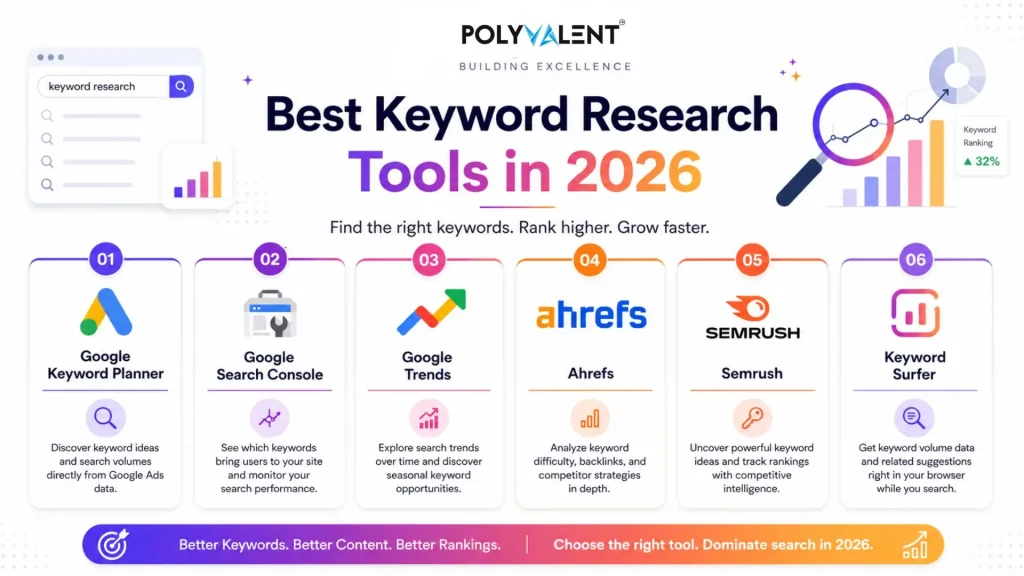
    What Are the Best Keyword Research Tools in 2026?

    We have tested multiple tools for seo purpose here are top recommendations from our side if you are just starting out or looking for a great keyword research tool.

    Best Keyword Research Tool

    When choosing keyword research tools, it makes sense to start with the free options before investing in paid platforms. Many businesses can find valuable keyword opportunities using Google’s own tools, especially during the early stages of keyword research for content alignment.

    To start keyword research, your first step is to use the google free tools like  Google Keyword Planner, Google Trends, and Google Search Console. Together, these tools provide enough data to identify keyword ideas, understand search demand, and help you to find new opportunities already available within your website.

    Google Keyword Planner : It helps generate keyword ideas and provides estimated search volume data. While the numbers are not always precise, it remains a useful tool for understanding how often people search for specific terms and for finding related keyword opportunities.

    Google Trends: It is useful for analyzing search interest over time. It helps identify seasonal topics, rising trends, and keywords that may be losing popularity. This additional context can prevent targeting keywords that are declining in relevance. With this tool you can also find trending searches and topics in your industry.

    When checking a keyword in Trends, switch to the 5-year view before deciding anything. A term that spikes every year around the same time is a genuine seasonal keyword worth planning content around in advance. A term that spiked once and never recovered is a trend that already passed, and building core content around it is a much weaker bet.

    Google Search Console: It provides actual search queries that are generating impressions and clicks for your website. Reviewing these queries often reveals keywords that are already ranking on page two or three of search results, creating opportunities for quick SEO improvements.

    Once enough data has been gathered from these free keyword research tools, paid keyword research platforms can be used for deeper analysis.

    Note: For a new website, Google Search Console will not have sufficient data because the site is still building impressions and clicks. It usually takes some time before enough search data becomes available. In the beginning, you can use tools like Google Keyword Planner and Google Trends to find keyword opportunities while your Search Console data grows.

    Ahrefs remains one of the most trusted tools for SEO professionals. Its Keyword Explorer provides search volume, keyword difficulty, traffic potential, and click metrics. The Traffic Potential metric is particularly useful because it looks beyond a single keyword and estimates the total organic traffic a page could attract from related search terms.

    Semrush is also a strong option for keyword research. It helps to find the keywords competitors rank for, identify content gaps, and discover new opportunities within a niche. For businesses operating in competitive industries, this data can help shape a more effective content strategy.

    Both semrush and Ahref are good for keyword research you can go with anyone as per your requirements and budget 

    For those looking for additional free keyword research tools, a few options are worth considering:

    • Google Keyword Planner for keyword ideas and search demand
    • Google Search Console for performance data and ranking opportunities
    • Google Trends for seasonal and trending topics
    • Keyword Surfer for quick keyword insights directly within Google search results

    One important thing to remember is that no keyword research tool provides perfectly accurate search volume data. Keyword research tools use different data sources and estimation methods. Instead of treating search volume as an exact number.

    The goal is not to find perfect data. The goal is to find keywords that align with search intent, match business objectives, and offer realistic ranking opportunities.

    How to Analyze Keywords Before Targeting Them

    Finding keywords is the easy part. Deciding which ones are worth targeting takes more judgment. 

    Search intent alignment. If your webpage content intent is not matched with the user’s intent it will not rank and you will waste your resources on creating the content to understand the intent. Look at the top-ranking pages for your keyword. Are they blog posts, product pages, comparison articles, or something else? If you’re planning a long-form guide and the SERPs are full of product listings, you’re fighting the wrong battle.

    Keyword Research for New Websites: New websites should approach keyword research differently from established ones, because domain authority is the constraint that matters most in the first year.

    Start almost entirely with long-tail, low-competition keywords. A high-volume head term might look attractive, but a brand-new site has no link history or topical authority to compete for it, and publishing content that never ranks wastes both time and budget.

    Instead, look for keywords with lower search volume but clear, specific intent, the kind of phrases someone types when they already know what they want.

    A realistic first 90 days often looks like this: 15 to 20 long-tail keywords, each with a clear, singular intent, each mapped to its own page, with no two pages competing for the same term.

    As those pages start ranking and the site earns some authority, broader and more competitive keywords become realistic targets. Trying to skip this stage by going straight after head terms is the most common reason new sites see impressions climb in Search Console while clicks stay flat.

    Keyword difficulty vs. domain authority. These metrics are not officially by google however they are present in the seo industry.  High difficulty scores don’t automatically mean not to pick the keyword. They mean you need to be realistic about how long it’ll take to rank and whether your site has the authority to compete. A DR 30 site going after DR 80 territory is a slow burn at best. A new website can publish a blog on high DA or DR keywords , but it will be difficult for the website to rank at the top.

    Traffic potential over search volume. A keyword with 500 monthly searches might drive far more traffic than one with 2,000 if it has a better CTR distribution. Look beyond the headline number. No tool provides the exact true search volume they estimate. 

    Business value. A keyword that brings 10,000 visitors who never convert is worth less than one that brings 500 who do. Always tie keyword targets back to business outcomes.

    A Simple Keyword Prioritization Framework

    Search volume alone is a poor way to decide what to target. A more reliable approach is to score each keyword candidate across the factors that actually predict results, then compare scores instead of comparing volume.

    FactorWhat to AskScore (1–5)
    Intent MatchDoes this keyword’s intent match the content format you can realistically produce?3.5
    DifficultyIs this achievable given your current domain authority and content depth?5
    Traffic PotentialBeyond the exact keyword, how much related search traffic could this page realistically capture?4
    Business ValueIf this keyword ranks and converts, does it move a real business outcome?5

    That is why keyword strategy should focus on all stages of the funnel. TOFU keywords can bring thousands of visits, but they rarely lead to direct conversions. However, that does not mean TOFU content should be avoided. It is not true. TOFU content still plays an important role in attracting and educating your audience.

    The key is to create content for each stage of the funnel so users are guided from awareness to consideration and finally to conversion.

    Best SEO Keyword Research Checklist

    Free Keyword Research Tracking Template

    Use this structure to track keyword opportunities as you find them. You can copy it directly into a spreadsheet.

    Table 1: Keyword Discovery Tracker

    KeywordSeedSourceCountryAutocomplete PositionDifficultyHot Keyword (Y/N)Relevancy Score
    e.g. best crm for small businesscrmAhrefsIndia238Y8/10
    • Seed: the broader term this keyword came from
    • Source: where you found it (Ahrefs, Search Console, autocomplete, competitor gap, customer language)
    • Autocomplete Position: where it appeared in Google’s suggested searches, if applicable
    • Hot Keyword: mark yes if search volume is trending up or it’s tied to a current event or seasonal spike
    • Relevancy Score: your own 1 to 10 rating of how closely this matches your business, not just the topic

    Table 2: Keyword-to-Page Mapping

    Target URLPrimary KeywordSecondary KeywordsSearch IntentNotes / Target Outcome
    e.g. /blog/best-crm-softwarebest crm for small businesscrm comparison, crm pricingCommercial investigationDrive demo sign-ups, update quarterly
    • Primary Keyword: the one keyword this page is built to rank for
    • Secondary Keywords: supporting terms the same page should naturally cover
    • Search Intent: informational, commercial investigation, or transactional
    • Notes / Target Outcome: what success looks like for this page (leads, sign-ups, rank position, etc.)

    Filling out Table 2 before you assign content to a writer is what prevents keyword cannibalization. If two rows have the same primary keyword, that’s your signal to merge the pages instead of publishing both.


    Before finalizing any keyword to target, run it through this quick check:

    • Does the search intent match what you’re planning to create?
    • Is the keyword difficulty realistic for your current domain authority?
    • Is the traffic potential worth the investment?
    • Are there commercial or transactional modifiers you should account for?
    • Does this keyword support a specific stage of the buyer journey?
    • Is there an existing page on your site that already covers this (cannibalization risk)?
    • Is search volume trending up, stable, or declining?

    A keyword that passes most of these checks is worth pursuing. One that fails several of them deserves a harder look before you commit.

    Common Keyword Research Mistakes to Avoid

    Targeting only high-volume head terms. This is where most businesses start and get stuck. High-volume keywords look attractive in spreadsheets. They’re brutal in practice, especially for newer sites without strong link profiles.

    Ignoring search intent entirely. Ranking for a keyword that doesn’t match your content type rarely ends well. Google is increasingly good at understanding what a searcher actually wants, and if your page doesn’t deliver that, the ranking won’t stick.

    Building pages for every keyword variation. More pages don’t automatically mean more traffic. A single well-optimized page can rank for hundreds of related terms. Creating separate thin pages for every slight variation often causes cannibalization.

    Chasing volume spikes without context. A sudden rise in search volume might look like an opportunity. Sometimes it is. But trends fade, and building core content around a moment rather than an enduring need is a risky bet.

    Not revisiting keyword strategy. This one is more common than it sounds. A keyword strategy built 18 months ago doesn’t reflect where your competitors are now, what new terms have emerged, or which pages have already gained traction. Keyword research isn’t a one-time project.

    FAQs

    Q1: How often should I do keyword research?

    Keyword Research depends on your requirements; there is no target rule to follow.

    Q2: How many keywords should I target on one page?

    In SEO, there is no specific number for a single page, but you can go with 1 primary keyword and 2 to 3 secondary keywords. Use keyword variations and avoid forcing keywords throughout the content.

    Q3: Is keyword research still important with semantic search?

    Yes. It helps you understand what people search for and the content they expect, even if exact-match keywords matter less.

    Q4: Can AI fully replace manual keyword research?

    No, AI can support keyword research, but human judgment is still needed to choose the right keywords based on business goals and audience.

    Conclusion

    The websites that consistently win on organic search aren’t necessarily the ones with the biggest budgets or the most content. They’re the ones that understand what their audience is searching for and build content that actually satisfies that need, better than what’s already out there.

    That starts with keyword research, but it doesn’t end there. Use it as a foundation for your content decisions, not a checklist to complete and file away. The more often you revisit it, the sharper your strategy gets.

  • 8 Technical SEO Issues That Are Killing Your AI Visibility

    8 Technical SEO Issues That Are Killing Your AI Visibility

    The era of chasing blue links is over. While traditional search engines still drive a significant portion of traffic, we are witnessing a tectonic shift toward AI Engine Optimization (AEO). Technical SEO for AI is becoming the new foundation of digital visibility.

    AI models like GPT-4, Claude, and Gemini are no longer just tools we use to write, they are the new gatekeepers of information. They don’t just “rank” your content. They ingest it, synthesize it, and present it as their own knowledge.

    If your technical foundation is shaky, these AI agents won’t just rank you lower. They will ignore you entirely. It creates a “zero-traffic” risk where your brand is erased from the synthesized answers users receive. To stay relevant, you must bridge the gap between being “searchable” and being “comprehensible.

    What is Technical SEO in the Age of AI?

    In the old world, technical SEO was about making sure Googlebot could find your URL and index the text. In the age of AI, technical SEO is about deep comprehension and data accessibility. It is the process of structuring your site so that large language models (LLMs) can parse your information without friction, map your brand to the global knowledge graph, and trust your data as an authoritative source.

    AI crawlers are more expensive to run than traditional crawlers. They are looking for the path of least resistance to high-quality data. If your site requires too much “compute” to understand, you become invisible.

    Problem #1: The JavaScript Wall

    Many modern websites use frameworks like React, Vue, or Angular to create content dynamically. Instead of loading a complete webpage from the server, the browser first gets a basic HTML shell, and JavaScript generates the actual content after the page loads.

    Humans eventually see the content.

    AI crawlers often do not.

    While Google has improved JavaScript rendering capabilities, many AI crawlers and secondary indexing systems still struggle with delayed rendering, hydration issues, blocked scripts, or rendering timeouts.

    This becomes especially dangerous for:

    • Ecommerce category pages
    • Product descriptions
    • Blog content
    • Navigation menus
    • Internal links
    • Structured data injected via JavaScript

    If the crawler receives incomplete HTML, your site becomes partially invisible.

    Impact

    AI systems prioritize efficiency. They crawl massive amounts of data under strict resource limits. A slow or rendering dependent site costs more compute to process.

    When crawlers encounter rendering friction, they may:

    • Skip content entirely
    • Miss internal linking signals
    • Ignore structured data
    • Fail to identify entities
    • Reduce crawl frequency
    • Downgrade trust signals

    This creates a silent visibility collapse.

    Your content exists for users but not for machines.

    Fix

    Move critical content to server side rendering (SSR) or static site generation (SSG) whenever possible.

    Your goal is simple:

    Deliver meaningful HTML before JavaScript executes.

    Immediate action steps:

    1. View your site source, not the rendered DOM. Verify critical content exists in raw HTML.
    2. Use SSR frameworks like Next.js or Nuxt for content heavy pages.
    3. Pre render important landing pages.
    4. Ensure internal links exist in HTML anchors.
    5. Inject structured data server side.
    6. Test rendering using crawler simulation tools.

    For AI visibility, raw HTML clarity beats fancy frontend architecture every time.

    Problem #2: Broken Schema and Entity Relationships

    AI does not just read words. It identifies entities.

    An entity is a clearly defined thing like your company, CEO, or product. AI systems use entities to understand and connect brands with topics.

    If your Schema Markup is missing or broken, AI may struggle to understand who you are. For example, without proper JSON-LD structured data, AI could confuse “Apple” the tech company with “apple” the fruit.

    Impact

    This lack of clarity can prevent your brand from appearing in the Knowledge Graphs that power AI-generated search results and summaries.

    If the AI cannot verify the relationship between your content and a known entity, it will default to a more “structured” competitor.

    Fix

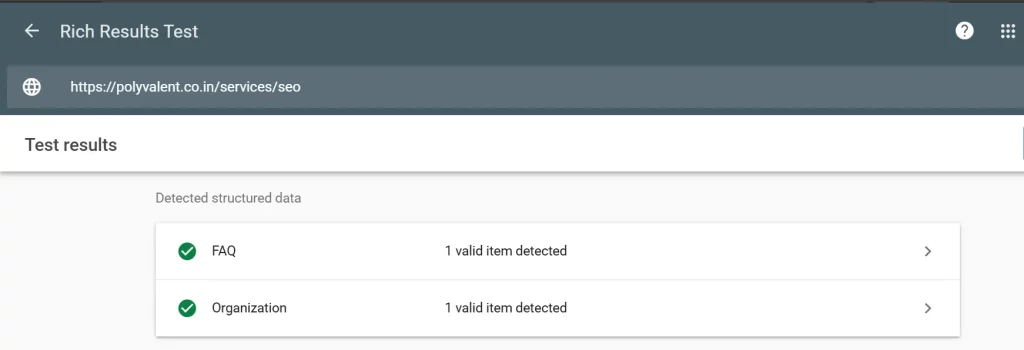
    Relevant Schema Used on Our Website: Relevant Schema Implemented on our services page.

    Rich Result website showing Schema of Polyvalent Service Page

    Solution : You need to go beyond basic Breadcrumb or Article schema. You must implement Organization, Person, and Product schemas that use the “sameAs” attribute to link to verified third-party profiles like Wikipedia, LinkedIn, or official social channels.

    Action Plan:

    • Audit your site using the Schema.org validator or rich result snippets.
    • Map out your entity relationships. Ensure your “About” page clearly defines who you are and what you do using Organization schema.
    • Use Nested Schema to show how different pieces of content relate to one another.
    • Must add only required Schema to your Website. 

    Problem #3: Poor Semantic HTML

    For years, developers have used “div” tags for everything. This “div soup” makes it hard for AI models to understand what matters most on a page. Unlike humans, AI cannot visually interpret layouts the same way. It relies on the website’s code structure to tell the difference between main content, navigation, ads, and footers.

    Impact

    When an AI bot parses a page with poor semantics, it wastes tokens (the units of data AI uses to process text) on irrelevant sections like sidebar widgets or legal disclaimers.

    This dilutes the signal of your main content. If the AI cannot easily identify the <article> or the <main> content, it might misattribute a random customer testimonial as your core service offering.

    Fix

    Return to the fundamentals of semantic HTML5. Use landmark tags to tell the AI exactly where the value lies. This creates a clear hierarchy that the AI can digest efficiently.

    Action Plan:

    • Replace generic containers with <header>, <nav>, <main>, <article>, <section>, and <footer>.
    • Use a logical heading structure (H1 through H6) without skipping levels.
    • Ensure that every page has exactly one H1 that matches the core entity of the page.

    Problem #4: Robots.txt and Firewall Blocking

    The first thing an AI crawler does is check your permissions. Many site owners, fearing data scraping, have implemented aggressive firewall rules or “Disallow” commands in their robots.txt files specifically targeting user agents like GPTBot or CCBot.

    Along with allowing the right AI crawlers, maintaining a clean XML sitemap helps them discover your most important pages faster and understand your site’s structure more efficiently.

    Impact

    While protecting your intellectual property is important, a total block is a suicide mission for discovery. If you block GPTBot, ChatGPT cannot access your site to verify facts or provide links back to your store. You are opting out of the new internet. Furthermore, aggressive firewalls often trigger 403 errors for these bots, which flags your site as “unreliable” in the AI’s internal database.

    Fix

    Adopt a nuanced approach to bot management. Instead of a blanket ban, allow AI crawlers access to your public-facing, high-value content while keeping your proprietary data behind login screens or stricter robots.txt rules.

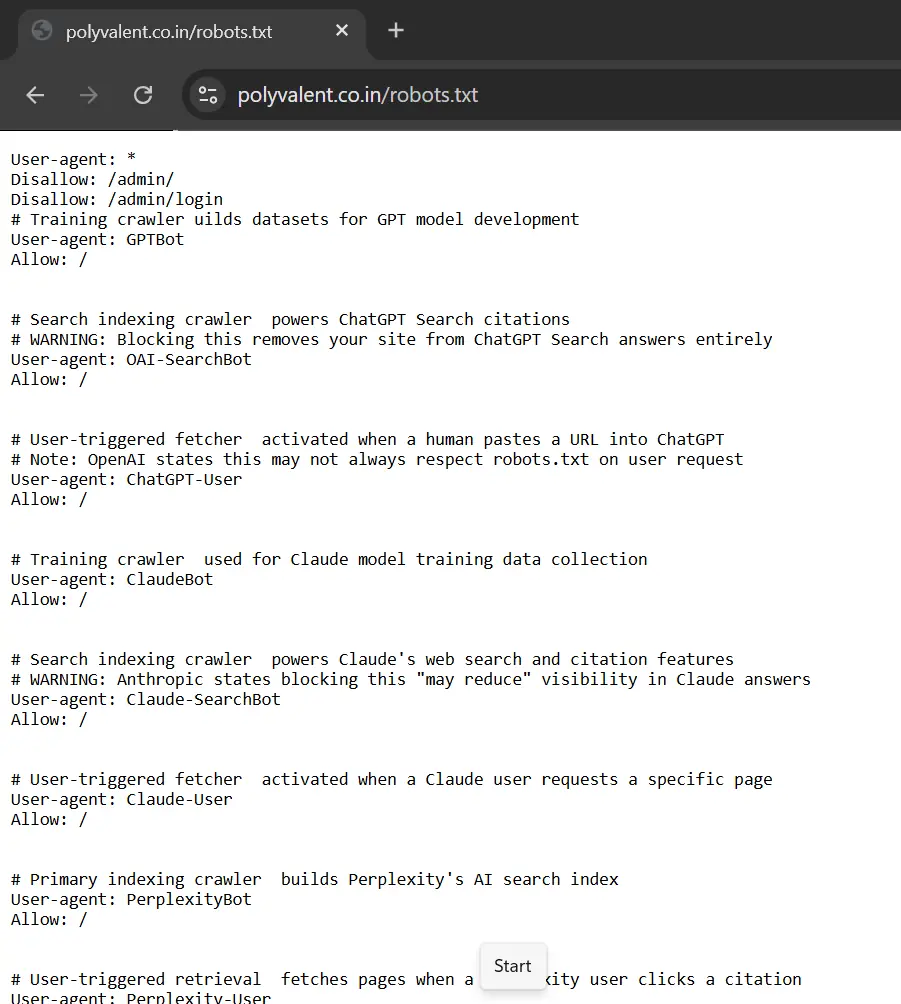
    Here is how the Polyvalent Robots.txt file looks like.

    Showing Polyvalent Website Robots.txt File
    Polyvalent Website Robots.txt File

    Action Plan:

    • Review your robots.txt file for User-agent: GPTBot or User-agent: *.
    • Ensure your Content Delivery Network (CDN) like Cloudflare isn’t accidentally flagging AI agents as malicious “DDoS” threats.
    • Create a “Search-Friendly” directory and ensure it is wide open to legitimate AI crawlers.

    Problem #5: Failing Core Web Vitals (The TTFB Bottleneck)

    Speed is often discussed in terms of user experience, but for AI bots, Time to First Byte (TTFB) is a hard technical limit. AI crawlers operate on a massive scale and have “timeout” thresholds. If your server takes too long to respond with the first byte of data, the crawler will drop the connection and move on.

    Impact

    Slow response times signal to an AI that your infrastructure is fragile. This leads to infrequent crawling. If your content is updated frequently but your server is slow, the AI will continue to provide outdated or incorrect information about your brand because it simply couldn’t wait for your page to load. High latency is a signal of low quality in the eyes of an automated agent.

    Fix

    Optimize your server response times. This often requires moving away from cheap shared hosting and implementing robust edge caching. You want your TTFB to be under 200ms for a “Green” rating.

    Action Plan:

    • Use a Global CDN to serve content from the location closest to the crawler.
    • Optimize your database queries and implement object caching (like Redis).
    • Minimize the use of heavy third-party plugins that delay server processing.

    Problem #6: High Data-to-Clutter Ratio

    AI models have a limited “context window.” They can only process a certain number of tokens at one time. If your webpage is 100KB of code but only contains 500 words of actual content, your data-to-clutter ratio is abysmal. The AI has to “read” through mountains of inline CSS, bloated DOM nodes, and tracking scripts to find the value.

    Impact

    When the DOM (Document Object Model) is too large, the AI bot may truncate the page. This means it only reads the top half of your code. If your most important insights or product details are buried at the bottom of a bloated page, they are effectively invisible. Excessive code also increases the cost for the AI to process your site, making it less likely to be prioritized for deep indexing.

    Fix

    Clean up your code. Move all CSS and JavaScript to external files. Minimize your HTML by removing unnecessary nested “divs.” Focus on delivering the “signal” (your content) with as little “noise” (your code) as possible.

    Action Plan:

    • Audit your DOM size; aim for fewer than 1,500 nodes per page.
    • Eliminate inline styles and scripts.
    • Use “Content-Visibility: auto” in your CSS to help browsers and bots focus on visible content first.

    Problem #7: Lack of Topical Hubs

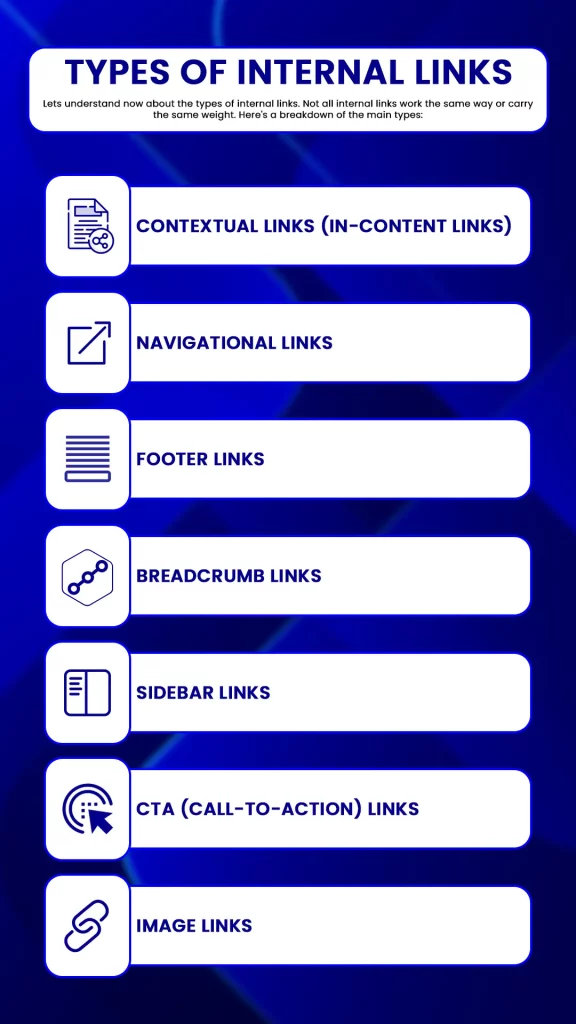
    AI understands information through context. It looks for “Topic Clusters” to determine if you are a true authority or just a generalist. If your internal linking is a mess, or if your content is scattered across unrelated categories, the AI cannot build a cohesive map of your expertise.

    Impact

    A “flat” site architecture without clear internal linking patterns prevents the AI from understanding the hierarchy of your knowledge. If an AI cannot determine which page is your “pillar” content and which are the supporting “spokes,” it won’t know which URL to cite in a response. You end up with fragmented authority that isn’t strong enough to trigger an AI recommendation.

    Fix

    Build “Authority Silos.” Use internal linking to create a clear path from broad topics to specific sub-topics. Ensure that your most important pages have the most internal “votes” from related content.

    Action Plan:

    • Create Pillar Pages that summarize a broad topic and link out to detailed sub-articles.
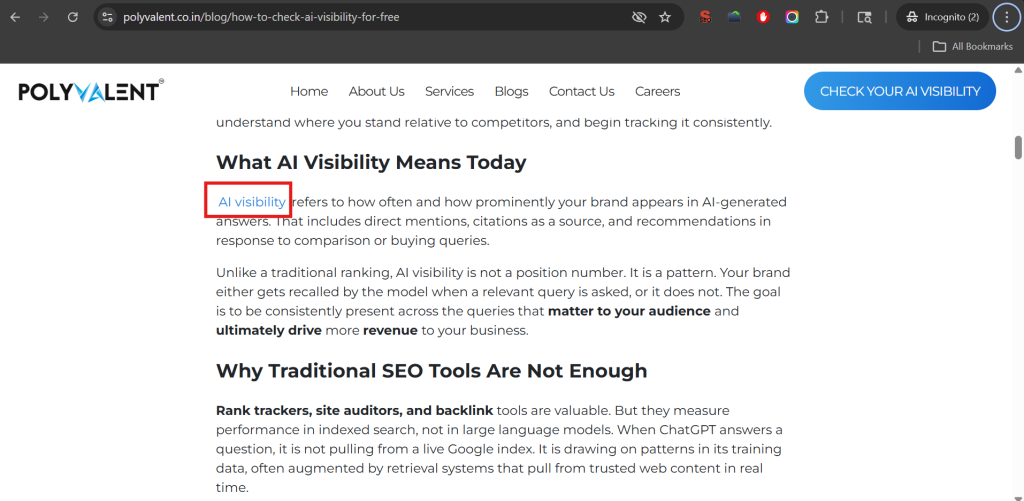
    • Use descriptive anchor text that tells the AI exactly what the linked page is about.
    • Eliminate “Orphan Pages” (pages with no internal links pointing to them).

    Problem #8: Non-Standard Content Formats

    AI has come a long way with vision and file parsing, but it still prefers clean HTML. If your most valuable data is locked inside flat images without alt-text, or buried in massive, non-tagged PDFs, you are creating a barrier to entry. While an AI can OCR an image, it is an extra step that it would rather avoid.

    Impact

    Content trapped in non-standard formats is often ignored during the “quick pass” of an AI crawler. If your pricing table is an image, the AI can’t compare your rates to a competitor’s. If your whitepaper is a 50MB PDF without a web-based summary, the AI may never ingest the insights within. This makes your most valuable intellectual property useless in the AI search landscape.

    Fix

    Adopt an “HTML-First” mentality. Any data that is vital to your business should be rendered as text in the HTML. Use SVG for graphics where text needs to remain readable, and always provide a web-version of any downloadable document.

    Action Plan:

    • Convert key data from PDFs into interactive, searchable HTML pages.
    • Write descriptive, context-heavy Alt-text for every image.
    • Use <figure> and <figcaption> tags to provide context to visual data.

    Why Your Competitors are Winning the AI Search Battle 

    The transition from search engines to AI engines is not something to fear; it is an opportunity to outpace competitors who are still playing by 2018’s rules. By fixing these eight technical hurdles, you aren’t just “optimizing.” You are making your website the most legible, trustworthy, and accessible source of information in your niche.

    An AI-ready website is fast, structured, and semantically clear. When you provide an AI with a friction-less path to your data, you become the preferred source for the answers it generates. This is the new technical SEO. It’s no longer about tricking an algorithm; it’s about feeding an intelligence. Clear the path, and the traffic will follow.

    Frequently Asked Questions

    What is technical SEO for AI?

    Technical SEO for AI is the process of optimizing your website so AI models like ChatGPT, Gemini, and Claude can easily crawl, understand, and reference your content. It focuses on structured data, semantic HTML, crawl accessibility, entity clarity, and reducing technical friction for AI systems.

    Why is technical SEO for AI important?

    Technical SEO for AI is important because modern AI engines do not rank pages the same way traditional search engines do. They synthesize information from trusted and machine-readable sources. If your technical foundation is weak, AI systems may ignore your content entirely.

    Can I use a “Disallow” tag for specific AI models only? 

    You can. You can target specific user agents in your robots.txt to block or allow them individually. This allows you to stay visible in ChatGPT while potentially blocking lower tier scrapers.

    Does AI prioritize video content over text? 

    Not currently. While multimodal AI can process video, text remains the primary and most efficient data source for LLMs. High quality transcripts and semantic HTML text are significantly more likely to be used in an AI generated answer than raw video files.

    Will AI generated content on my site hurt my AI visibility? 

    Only if it provides zero new information. AI engines look for Information Gain. If your site simply mirrors what the AI already knows, it has no reason to cite you. Original data and primary research are the best ways to ensure inclusion.

    Does technical SEO for AI differ from traditional SEO?

    Yes. Traditional SEO focuses heavily on rankings, backlinks, and click-through rates, while technical SEO for AI prioritizes comprehension, entity relationships, structured information, and content accessibility for large language models.

    Conclusion

    The shift from traditional search to AI discovery is a fundamental change in how the internet functions. It is no longer enough to be visible to humans. You must be legible to machines.

    By eliminating technical friction, from JavaScript execution hurdles to fragmented entity data, you position your website as a primary source of truth. A clean technical foundation is your most powerful competitive advantage. In an era where being understood by AI is the only way to remain seen by your audience, a clear architecture is your greatest asset.

  • Google Performance Max Ads in 2026: How AI-Driven Campaigns Are Reshaping Google Advertising

    Google Performance Max Ads in 2026: How AI-Driven Campaigns Are Reshaping Google Advertising

    Google Ads has changed dramatically over the past few years. Campaign management is no longer centered only around manual bidding, keyword targeting, and endless audience segmentation. Artificial intelligence now plays a major role in how campaigns are built, optimized, and scaled across Google’s ecosystem.

    At the center of this transformation are Google Performance Max Ads.

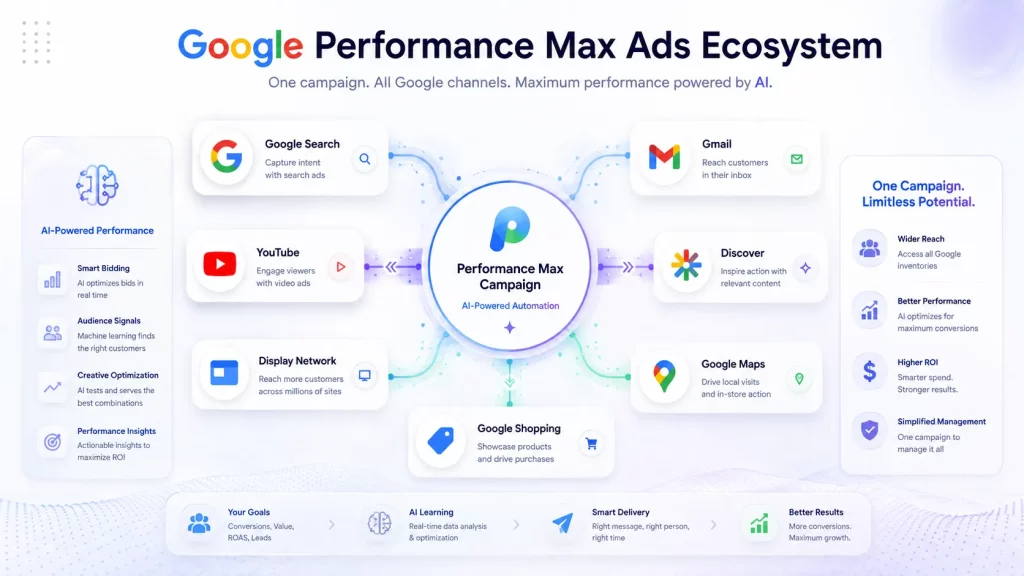
    Performance Max campaigns are designed to help businesses use Google’s machine learning systems to drive conversions across Search, YouTube, Display, Gmail, Discover, Maps, and Shopping from a single campaign structure. Instead of manually managing multiple campaign types independently, advertisers provide Google with business goals, creative assets, audience data, and conversion signals while the platform automates delivery and optimization.

    For businesses looking to scale efficiently in 2026, understanding how Performance Max works is becoming increasingly important. Whether the goal is ecommerce growth, local lead generation, or customer acquisition at scale, Performance Max campaigns are now a major part of modern paid advertising strategy.

    The challenge is that many advertisers still misunderstand how these campaigns operate. Some expect automation to replace strategy completely, while others avoid Performance Max because they believe it removes too much control.

    The reality sits somewhere in the middle.

    Google Performance Max Ads can produce exceptional results when paired with strong creative direction, accurate conversion tracking, and a clear AI-driven Google Ads strategy. Without those foundations, even advanced automation struggles to perform effectively.

    What Google Performance Max Ads Actually Are

    Google Performance Max Ads are goal-based campaigns powered by Google’s machine learning systems. Instead of targeting only one placement type like Search or Display, Performance Max campaigns run across Google’s entire advertising network using automated optimization.

    This includes:

    • Google Search
    • YouTube
    • Display Network
    • Gmail
    • Google Discover
    • Google Maps
    • Google Shopping placements

    The advertiser defines conversion goals such as purchases, form submissions, phone calls, or demo bookings. Google’s automation system then analyzes user intent, browsing behavior, engagement patterns, device activity, and historical conversion signals to determine where ads should appear.

    What Google Performance Max Ads Actually Are

    Unlike traditional campaigns, Performance Max does not rely solely on manual keyword targeting. The platform uses predictive modeling to identify users most likely to convert across multiple environments and stages of the customer journey.

    This shift reflects Google’s broader movement toward automation-first advertising.

    Why Performance Max Campaigns Are Becoming More Important

    As Google Search evolves with AI Overviews, advertisers are no longer competing only for clicks inside traditional search results. Brands now need advertising and content strategies that improve visibility across AI-powered search experiences where recommendations, summaries, and product suggestions increasingly influence buying decisions.

    A user may discover a product on YouTube, revisit the website through Display remarketing, search for the brand days later, and finally convert through a Shopping ad. Traditional campaign structures often struggle to optimize efficiently across these fragmented touchpoints.

    Performance Max campaigns attempt to solve this problem by allowing Google’s AI to evaluate conversion opportunities holistically rather than channel by channel.

    At the same time, Google continues introducing stronger automation features inside the advertising platform. Recent updates include:

    • AI-generated ad assets
    • Predictive audience expansion
    • Conversational campaign setup
    • Automated video creation
    • Dynamic creative adaptation
    • Enhanced attribution modeling

    These updates are shaping a more AI-driven Google Ads strategy where campaign success depends less on manual controls and more on strategic inputs.

    Businesses that understand how to guide automation effectively are often outperforming advertisers still relying entirely on older campaign management approaches.

    How Performance Max Campaigns Work

    Performance Max campaigns rely heavily on machine learning.

    After defining campaign goals, advertisers upload creative assets into what Google calls asset groups. These asset groups contain:

    • Headlines
    • Descriptions
    • Images
    • Logos
    • Videos
    • Product feeds
    • Call-to-action messaging

    Google dynamically combines these assets depending on placement type, audience behavior, and conversion probability.

    For example:

    • A YouTube viewer may receive a video-first ad variation
    • A Search user may see text-focused messaging
    • A Gmail user may receive a visually rich ad format

    The system continuously tests creative combinations and reallocates impressions toward stronger-performing assets over time.

    One of the most important concepts within Performance Max campaigns is the relationship between asset groups & audience signals.

    Audience signals are not strict targeting instructions. Instead, they help Google understand which types of users may initially be more relevant during the learning phase. These signals may include:

    • Website visitors
    • Existing customers
    • In-market audiences
    • Competitor interest audiences
    • CRM customer lists
    • Custom intent audiences

    Strong audience signals combined with high-quality creative assets help accelerate campaign learning and improve optimization efficiency.

    The Real Benefits of Google Performance Max Ads

    The primary advantage of Performance Max campaigns is reach combined with automation.

    Instead of building separate campaigns across multiple Google properties, advertisers can use one campaign structure optimized toward conversion goals.

    This creates several meaningful benefits.

    Broader Inventory Access

    Performance Max campaigns can place ads across every major Google-owned advertising environment. This allows businesses to influence potential customers throughout different stages of the buying journey rather than relying only on direct search intent.

    Faster Campaign Scaling

    Automation allows campaigns to scale more efficiently without requiring constant manual bid adjustments and targeting refinements. Businesses can often expand budget and reach faster compared to traditional campaign structures.

    Improved Cross-Channel Optimization

    Google’s machine learning evaluates performance across placements collectively rather than independently. This often creates stronger overall conversion efficiency.

    Better Ecommerce Performance

    For ecommerce brands with optimized product feeds, Performance Max can integrate Shopping inventory, YouTube discovery, Display remarketing, and Search placements into a unified acquisition strategy.

    Smarter Lead Generation

    Lead generation with PMax has improved significantly in recent years, especially for businesses integrating offline conversion tracking and CRM-based lead quality signals.

    Industries such as:

    • Real estate
    • SaaS
    • Healthcare
    • Education
    • Home services
    • Financial services

    are increasingly using Performance Max campaigns to improve scalable lead acquisition.

    Where Performance Max Campaigns Still Create Challenges

    Despite their advantages, Performance Max campaigns are not perfect.

    One of the biggest concerns advertisers continue raising involves visibility and reporting.

    Google has made several reporting/transparency updates in 2025 that improved advertiser access to campaign insights. These updates included:

    • Better asset-level reporting
    • Expanded search category visibility
    • Improved audience diagnostics
    • Enhanced placement reporting
    • Additional brand exclusion controls

    While these changes helped, Performance Max campaigns still provide less granular visibility compared to traditional Search campaigns.

    Many advertisers also struggle with reduced manual control.

    Since Google automates placements, bidding, and targeting decisions, experienced media buyers sometimes feel disconnected from campaign-level optimizations they previously controlled directly.

    Another challenge is creative dependency.

    Automation does not compensate for weak messaging, poor visuals, or low-quality landing pages. In many cases, businesses blaming Performance Max performance issues are actually dealing with:

    • Weak offers
    • Slow websites
    • Poor conversion UX
    • Generic creative
    • Inaccurate conversion tracking

    The machine learning system amplifies the quality of the inputs it receives.

    PMax vs Search Campaigns: Which Is Better?

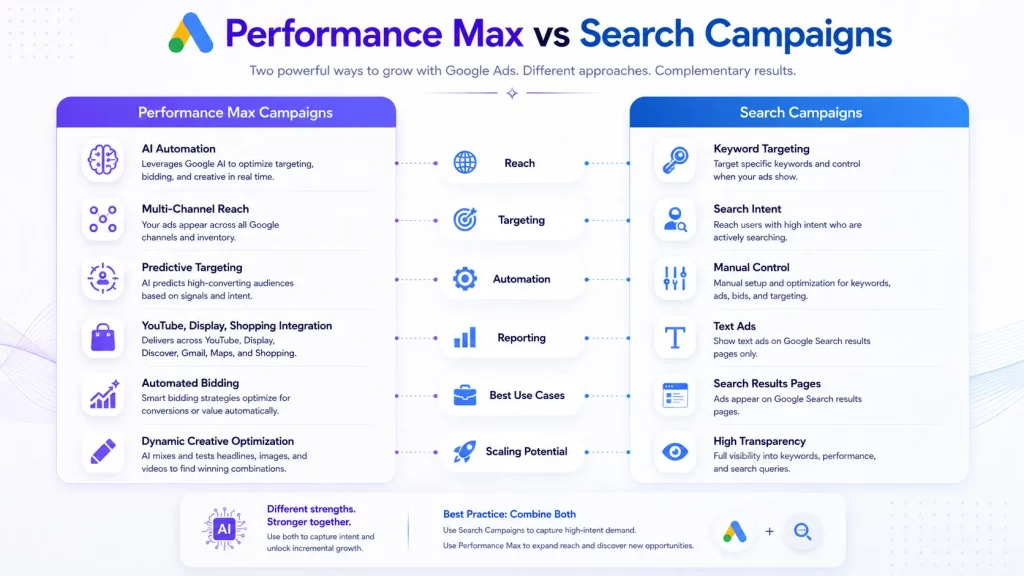
    The debate around PMax vs Search campaigns continues to grow as advertisers evaluate automation against manual control.

    The reality is that these campaign types serve different purposes.

    Search campaigns remain highly valuable for capturing explicit intent. When users search directly for a product or service, keyword targeting provides precision that automation alone cannot always replicate.

    PMax vs Search Campaigns: Which Is Better?

    Performance Max campaigns focus more on predictive targeting and cross-channel reach.

    The difference becomes clearer when comparing them directly.

    FeaturePerformance Max CampaignsSearch Campaigns
    TargetingAI-driven predictive targetingKeyword targeting
    Inventory ReachEntire Google ecosystemSearch only
    OptimizationAutomatedManual + automated
    Reporting VisibilityModerateHigh
    Creative FormatsMulti-formatPrimarily text
    Scaling PotentialHighModerate
    Best Use CaseCross-channel growthHigh-intent acquisition

    Most mature advertisers are not choosing one over the other.

    Instead, they use Search campaigns for:

    • Branded keywords
    • High-intent commercial queries
    • Competitor targeting
    • Precise search control

    while using Performance Max campaigns for:

    • Scaling
    • Discovery
    • Cross-channel remarketing
    • Ecommerce expansion
    • Audience growth

    The strongest paid media strategies in 2026 often combine both approaches strategically.


    Building a Strong Performance Max Optimization Strategy

    Successful Performance Max optimization requires a different mindset compared to older Google Ads workflows.

    Optimization is no longer centered entirely around manual bid changes and keyword adjustments. Instead, the focus shifts toward improving the quality of campaign inputs.

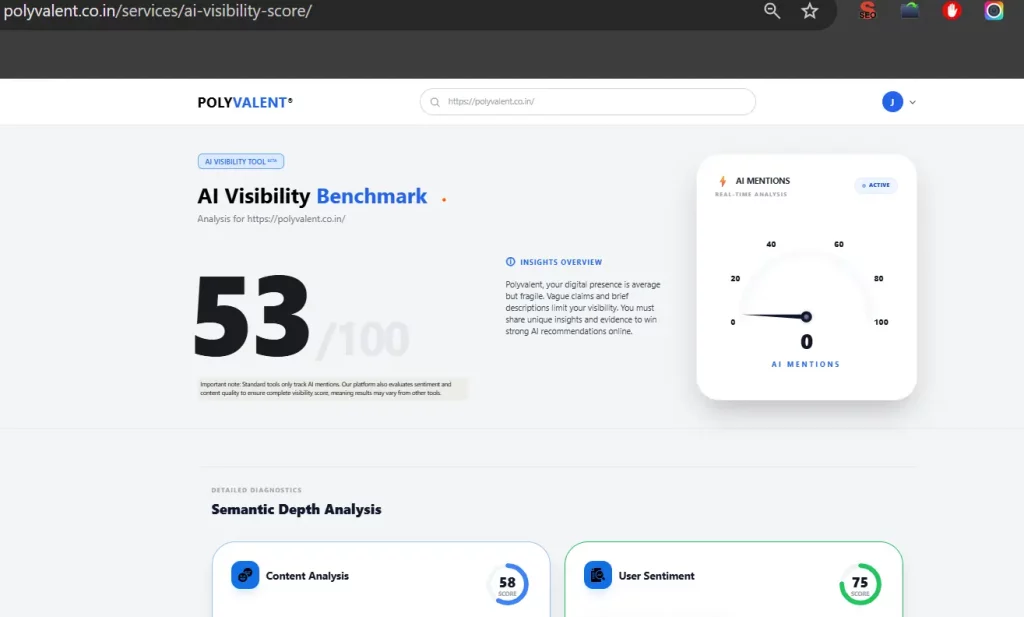
    Many businesses are also using an AI Visibility Tool alongside Google Ads reporting to understand how their brand appears across AI-generated search experiences, conversational search engines, and automated recommendation systems. This additional visibility helps marketers identify gaps in messaging, positioning, and search presence beyond traditional keyword rankings.

    Conversion Tracking Accuracy

    Reliable conversion tracking is essential.

    Businesses should implement:

    • Enhanced conversions
    • CRM integration
    • Offline conversion imports
    • Lead quality tracking
    • Proper attribution setup

    Without accurate conversion data, Google’s machine learning cannot optimize effectively.

    Creative Refresh Cycles

    Creative fatigue impacts Performance Max campaigns heavily.

    Advertisers should regularly update:

    • Headlines
    • Descriptions
    • Images
    • Video assets
    • Promotional messaging

    Campaigns with stale creative often lose efficiency over time.

    Campaign Segmentation

    Combining unrelated products, audiences, or business goals inside one campaign can confuse optimization models.

    Better-performing accounts typically segment campaigns by:

    • Product category
    • Geography
    • Audience type
    • Funnel stage
    • Margin profile

    Feed Optimization

    For ecommerce advertisers, product feed quality directly influences Shopping performance inside Performance Max campaigns.

    Optimized feeds include:

    • Clear product titles
    • Accurate categorization
    • Strong imagery
    • Updated pricing
    • Proper GTIN usage

    Common Mistakes Businesses Continue Making

    Many advertisers still approach Performance Max incorrectly.

    One of the most common mistakes is launching campaigns without enough historical conversion data. Automation performs best when machine learning systems have reliable signals to analyze.

    Another issue is making aggressive changes during the learning phase. Businesses frequently pause campaigns, change budgets, replace assets, or alter targeting too quickly before optimization stabilizes.

    Weak audience signals also limit performance. Advertisers who fail to provide useful first-party data often slow down campaign learning unnecessarily.

    Creative quality remains another major issue. Generic messaging rarely performs well across modern Google inventory.

    Some businesses also ignore landing page optimization entirely. Even strong campaigns struggle when users encounter:

    • Slow-loading pages
    • Poor mobile experiences
    • Weak offers
    • Confusing forms
    • Low trust signals

    Performance Max campaigns amplify strong systems, but they also expose weak ones quickly.


    The Future of AI-Driven Google Ads Strategy

    Google Ads is moving deeper into automation every year.

    Artificial intelligence is becoming the foundation of campaign delivery, audience targeting, bidding, attribution, and creative testing.

    This does not mean marketers become irrelevant.

    It means the role of marketers is evolving.

    The most effective advertisers in 2026 focus less on micromanaging campaigns and more on:

    • Data quality
    • Creative direction
    • Customer psychology
    • Funnel optimization
    • Conversion infrastructure
    • Strategic segmentation

    The businesses achieving the best results with Google Performance Max Ads are not abandoning strategy. They are combining strategic thinking with machine learning capabilities more effectively than competitors.

    As AI-powered discovery platforms continue growing, LLM Brand Mentions are becoming increasingly important for digital visibility. Businesses are now optimizing not only for search rankings and ad performance but also for how AI systems reference, summarize, and recommend brands across conversational search environments. 


    FAQs on Google Performance Max Ads

    Are Performance Max campaigns good for lead generation?

    Yes. Lead generation with PMax can work extremely well when businesses use accurate conversion tracking, CRM integration, and optimized landing pages.

    How long does Performance Max take to optimize?

    Most campaigns require several weeks of stable conversion data before machine learning performance improves consistently.

    Can Performance Max replace Search campaigns?

    Not entirely. Search campaigns still provide valuable keyword-level control and high-intent targeting capabilities.

    Are audience signals mandatory?

    No, but strong asset groups & audience signals help Google’s AI learn faster and improve targeting quality during the initial learning phase.

    Have reporting features improved recently?

    Yes. Google introduced several reporting/transparency updates in 2025 that improved visibility into search categories, asset performance, and audience insights.


    Conclusion

    Google Performance Max Ads are becoming one of the most important campaign types inside modern digital advertising.

    The platform combines automation, predictive targeting, cross-channel delivery, and machine learning into a system designed to maximize conversion performance across Google’s ecosystem.

    However, successful campaigns still require strategic oversight.

    Businesses seeing the strongest results are focusing on:

    • Better Performance Max optimization
    • Strong creative assets
    • Accurate conversion tracking
    • Smarter segmentation
    • High-quality first-party data
    • Long-term AI-driven Google Ads strategy

    As automation continues reshaping paid advertising, understanding how to guide machine learning effectively will become one of the biggest competitive advantages in digital marketing.

    Scale Smarter With Polyvalent Digital

    If your business wants to improve Google Ads performance, reduce wasted ad spend, and build a scalable paid acquisition system,Polyvalent helps brands grow through advanced Google Ads management, conversion-focused strategy, and AI-powered campaign optimization.

    From ecommerce scaling to lead generation with PMax, Polyvalent Digital helps businesses build modern advertising systems designed for measurable growth in 2026 and beyond.

  • Why AI Is Citing Third-Party Sources Instead of Your Site?

    Why AI Is Citing Third-Party Sources Instead of Your Site?

    AI cites third-party sources instead of your website because it prioritizes consensus, authority, structured trust signals, and retrievability over rankings alone. To fix this, brands need stronger AI visibility through source authority, digital PR, entity SEO, and generative optimization.

    Why Top Rankings No Longer Guarantee AI Citations

    You have spent years mastering the art of search engine optimization. Your website ranks on the first page for your target keywords, your backlink profile is healthy, and your content is objectively better than the competition. Yet, when you ask ChatGPT, Perplexity, or Google Gemini a question about your niche, they cite Reddit, a massive aggregator, or a third-party review site instead of your domain.

    This is the new reality of the “citation gap.” Ranking at the top of a traditional search engine no longer guarantees that you will be the source of truth for Artificial Intelligence. For brands and publishers, this shift is more than just a blow to the ego. It represents a fundamental change in how traffic and trust are distributed across the internet.

    If you want to survive the transition to Generative Engine Optimization (GEO), you need to understand why these models choose their sources and how to position your brand as an undeniable authority that AI cannot ignore.

    What Are Citations in AI?

    In the context of generative AI, a citation is a digital footnote. It is the specific link or reference an AI model provides to justify the information it has generated. Unlike a traditional search result, which is an entry in a list, an AI citation is an endorsement of accuracy.

    What is AI Citations

    When an AI provides a citation, it is telling the user: “I didn’t make this up; I found this evidence here.” These citations appear as small superscript numbers, clickable cards, or “Sources” sections at the bottom of a chat response. They are the primary drivers of referral traffic in a world where users interact with chatbots instead of scrolling through pages of blue links.

    Are Citations and Brand Mentions the Same Thing?

    It is common to confuse a brand mention with a citation, but the distinction is critical for your SEO strategy.

    A brand mention is when an AI talks about your company. For example, if you ask an AI for a list of top CRM software and it lists your brand, that is a mention. However, if the AI explains “How to set up a CRM pipeline” and uses a link to a HubSpot guide to verify its instructions, that is a citation.

    Mentions build awareness, but citations build authority and drive high-intent traffic. You can be mentioned a thousand times as a “top player” while your competitors get all the citations because their content is structured as the foundational source of truth.

    What Are First-Party and Third-Party Citations?

    Understanding the hierarchy of sources is the first step toward fixing your visibility.

    • First-Party Citations: These occur when an AI links directly to your website as the source of a fact, data point, or instructional step. This is the gold standard of AI SEO.
    • Third-Party Citations: These occur when the AI cites another platform that is talking about you. Instead of citing your product page, the AI cites a Reddit thread, a G2 review, or a news article from a tech publication.

    When third-party citations dominate, you lose control of the narrative. You are no longer the narrator of your own story; you are merely a character in someone else’s.

    How AI Chatbots Display Sources and Citations

    The way an AI displays a source often dictates the click-through rate (CTR).

    • Perplexity AI: Uses prominent citations at the top of the interface and inline numbers. It functions almost like a “research engine,” making citations central to the user experience.
    • ChatGPT (SearchGPT features): Integrates links within the flow of the text or in a side-bar “Sources” drawer.
    • Google AI Overviews: Often displays a “carousel” of links above or alongside the generated text.
    • Gemini: Provides a “double-check” feature and “Sources” dropdowns at the bottom of responses.

    Each platform has a different “tolerance” for how many sources it will cite, but they all share a common goal: minimizing the risk of “hallucination” by anchoring their text to external data.

    How to Check Whether AI Is Citing Your Website or Your Competitors

    You cannot fix what you cannot measure. Traditional rank trackers are blind to the nuances of AI chat responses. To understand your current standing, you must perform manual and automated audits.

    Automated checks are far better than manual checks.

    How to Check Sources in AI Chatbots

    The manual method involves “prompt engineering” your way to an audit. Ask the AI specific questions related to your core service or product:

    1. “Who are the leaders in [Industry] and what makes them unique?”
    2. “How do I perform [Specific Task] using [Your Product]?”
    3. “Compare [Your Brand] vs [Competitor].”

    Observe which links appear in the footnotes. Are they citing your documentation, or are they citing a “Best 10” listicle from a third-party affiliate site?

    Now, let’s look at how you can easily track your brand’s AI visibility with automated tools.

    How to Check If Your Website Appears in AI Answers (Mention Polyvalent AI Visibility Checker)

    Manual checks are time-consuming and often biased by your own chat history. For a more objective, data-driven approach, tools like the Polyvalent AI Visibility Checker are becoming essential. These tools allow you to track your “AI Share of Voice” by scanning how different LLMs (Large Language Models) perceive your brand across thousands of queries.

    Polyvalent AI Visibility Checker

    Using a visibility checker helps you identify the “Citation Gap”—those specific topics where you rank #1 on Google but are completely invisible in ChatGPT or Claude.

    What Types of Third-Party Sources Are Being Cited Instead of Your Website?

    If the AI isn’t citing you, it is citing someone else. Usually, these sources fall into three categories:

    • Aggregators: Sites like G2, Capterra, or Trustpilot.
    • Authority Media: New York Times, TechCrunch, or niche-specific trade journals.
    • Community Hubs: Reddit, Quora, and Stack Overflow.

    These sites are cited because the AI views them as “unbiased” or “consensus-driven” environments.

    Why AI Tools Cite Aggregators, Review Sites, and Listicles

    AI models are programmed to find the “consensus” view. If fifty people on a review site say your software is good for small businesses, the AI views that as a more reliable fact than your own website claiming you are the best for small businesses.

    Aggregators and listicles provide a pre-digested summary of information. AI models find it easier to parse a structured list of “Pros and Cons” from a third-party reviewer than to extract that same information from your marketing copy, which the AI might perceive as biased “sales talk.”

    Why AI Heavily Focuses on Reddit, Quora, and Other Forum Websites

    The “Reddit-fication” of AI search is a result of the quest for “hidden gems” and human experience. Google and OpenAI have both recognized that users value first-hand perspectives.

    When a user asks “Is [Product] worth it?”, the AI knows that a marketing page will say “Yes.” However, a Reddit thread will contain a variety of perspectives, troubleshooting tips, and raw opinions. This “human-verified” content is highly weighted in retrieval systems because it feels more authentic than polished corporate content.

    Why Your Website Can Rank in Search but Still Not Be Cited in AI Answers

    This is the most frustrating scenario for SEOs. You have the “Blue Link” at the top of Google, but the AI Overview above it ignores you. Why?

    1. Complexity vs. Conciseness: Your page might be a 4,000-word deep dive. While Google loves this for “coverage,” an AI might find it too difficult to extract a 50-word summary compared to a competitor’s concise FAQ page.
    2. Lack of Semantic Clarity: Traditional SEO relies on keywords. AI SEO relies on “Entities.” If the AI cannot clearly identify the “Subject-Predicate-Object” in your content, it won’t use you as a source.
    3. Data Recency: Some AI models rely on training data that is months old, while others use real-time web retrieval. If your site is new or recently updated, the “retrieval” phase might miss you if your technical SEO (like sitemaps or crawl speed) is lagging.

    LLM Training Data vs Real-Time Retrieval: Why Your Website May Be Missing

    To fix your citation problem, you must understand the two ways AI “knows” things:

    • Training Data (The Knowledge Base): This is what the AI learned during its initial development. If your site wasn’t authoritative when GPT-4 was being trained, you won’t be part of its “internal” knowledge.
    • RAG (Retrieval-Augmented Generation): This is when the AI searches the live web to answer a prompt (like Perplexity or ChatGPT with Search).

    If you are missing from the training data, you have to work twice as hard to be found in the retrieval phase. This requires a technical infrastructure that allows AI crawlers (like GPTBot) to easily navigate and ingest your content.

    How Different AI Platforms (ChatGPT, Google AI Overviews, Perplexity, Gemini, Claude) Choose Sources

    PlatformPrimary Source PreferenceCitation Style
    PerplexityReal-time news, academic papers, official docsHeavy, academic-style footnotes
    ChatGPTHigh-authority media, Wikipedia, RedditIntegrated links, “Source” buttons
    Google AI OverviewsSites already in Top 10 Google rankingsCarousel cards, “Show more” links
    GeminiGoogle’s own ecosystem, YouTube, NewsDouble-check icons, Footer links
    ClaudeHigh-quality long-form text, technical docsLess frequent, context-heavy citations

    How AI Systems Decide Which Websites to Cite

    The decision-making process for an AI isn’t about “backlinks” in the traditional sense. It’s about Probability of Accuracy.

    AI systems use a process called “reranking.” The system pulls 20 or 30 potential sources from the web and then uses a smaller, highly intelligent model to grade those sources. It asks:

    • Does this source directly answer the prompt?
    • Is the source reputable (E-E-A-T)?
    • Is the information formatted in a way that is easy to summarize?

    If your website fails any of these checks, the AI moves to the next candidate—often a third-party site that has already summarized your info for you.

    The Role of E-E-A-T, Structured Data, Entity SEO, and Digital PR in AI Citations

    To become a primary source, you must master four pillars:

    1. E-E-A-T (Experience, Expertise, Authoritativeness, Trust): This isn’t just a Google guideline anymore. AI models look for “signals of trust.” If your authors have no digital footprint, the AI is less likely to cite them.
    2. Structured Data (Schema): Think of Schema as the “instruction manual” for the AI. It tells the model exactly what a piece of data is, whether it’s a price, a recipe step, or a software feature.
    3. Entity SEO: You want the AI to recognize your brand as an “Entity” (a distinct thing) rather than just a collection of keywords. This involves being mentioned in “knowledge bases” like Wikidata or being consistently associated with specific topics across the web.
    4. Digital PR: When high-authority news sites link to you, they are telling the AI’s training data that you are an important source.

    Common Reasons Your Website Is Ignored by AI Tools

    • The “Paywall” Problem: If your best content is behind a login or a hard paywall, AI crawlers can’t read it, so they can’t cite it.
    • Robots.txt Blocks: Many sites accidentally block GPTBot or CCBot out of fear of data scraping, effectively opting out of the AI citation economy.
    • Thin Content: If your page is 80% fluff and 20% facts, the AI will find a more “dense” source.
    • JavaScript Dependency: If your content requires complex JavaScript to render, some AI crawlers might see a blank page.

    How You Can Increase Your Website’s Chances of Being Cited by AI

    To bridge the citation gap, follow this actionable framework:

    • Adopt a “Direct-to-Answer” Format: Place the answer to the likely user query in the first paragraph. Use the “Inverted Pyramid” style of journalism.
    • Optimize for “Natural Language” Queries: Stop targeting “best CRM 2024” and start answering “Which CRM is best for a 5-person remote marketing team?”
    • Publish Original Research: AI loves data. If you produce a “2026 Industry Report” with original statistics, third-party sites will cite you, and eventually, the AI will go straight to you as the primary source.
    • Double Down on Digital PR: Get quoted in industry publications. When an AI sees your CEO’s name associated with a topic on five different high-authority sites, it begins to treat your domain as an authority.
    • Implement Advanced Schema: Go beyond basic Article schema. Use Product, FAQ, Review, and Organization schema to provide a clear map of your data.

    How to Track Your AI Citation Share Over Time

    You need a dashboard that monitors “Generative Visibility.” Like Poyvalent AI Visibility checker do. It is free and you can track your website visibility.

    1. Identify Core Queries: List the top 50 questions your customers ask.
    2. Establish a Baseline: Use a tool like Polyvalent Air Visibility tool to see how many times you are cited vs. competitors.
    3. Monitor the “Source Mix”: If the AI cites Reddit 50% of the time for your keywords, your strategy should include “Reddit SEO” (engaging in community discussions) alongside on-site SEO.

    How to Become a Primary Source Instead of a Third-Party Mention

    The real goal is to move from simply being mentioned to becoming the source AI actually cites. 

    That requires a shift in how you approach content. Instead of just commenting on what others are doing, focus on creating the original insights, expertise, and authority others reference. 

    In simple terms, your brand needs to publish trustworthy, E-E-A-T-driven content that positions you as a genuine authority in your space.

    Host tools, calculators, original datasets, and comprehensive “How-To” videos. The more “unique utility” your website provides, the harder it is for an AI to substitute your site with a generic Reddit thread.

    You want the AI to conclude: “I could summarize the Reddit thread, but the actual tool/data is located at [YourWebsite.com], making it the most helpful source for the user.”

    FAQs

    Why does ChatGPT cite Reddit more than my website?

    ChatGPT prioritizes Reddit because it contains high-volume, human-centric discussions and diverse perspectives. It views forum content as less “biased” than corporate marketing material. To counter this, ensure your content includes objective data, pros/cons, and expert bylines.

    Can ranking on Google improve AI citations?

    Yes, but they are not the same thing. While Google’s AI Overviews heavily draw from top-ranking search results, other models like Claude or Perplexity have their own methods for determining authority. High rankings help with “discoverability,” but “citatability” depends on content structure and clarity.

    How do I track AI brand mentions?

    You can use specialized AI visibility tools or set up advanced social listening queries. Monitoring mentions on platforms like Reddit and Quora is also vital, as these often feed into AI responses.

    What is AI citation share?

    AI citation share is the percentage of time your brand or website is cited as a source in response to a specific set of prompts, compared to your competitors and third-party aggregators.

    How do I optimize for generative search?

    Focus on “Entity SEO” by defining your brand’s relationship to specific topics. Use structured data, maintain a high-quality “About” page with verifiable credentials, and create content that answers “Who, What, Why, and How” in a concise, authoritative manner.

    Conclusion

    The transition from a “Search Economy” to an “Answer Economy” is fundamentally changing the rules of digital visibility. If you find that AI tools are citing third-party sources instead of your website, it is a signal that your “Authority Gap” is showing.

    AI models aren’t trying to steal your traffic; they are trying to provide the most reliable, easy-to-digest answer possible. By restructuring your content for clarity, doubling down on original research, and ensuring your brand is recognized as a verified “Entity,” you can reclaim your position as a primary source.

  • Internal Linking Strategy That Moves the Needle in SEO

    Internal Linking Strategy That Moves the Needle in SEO

    Internal linking is one of the most underused ranking levers in SEO  and one of the few you have complete control over. 

    Most websites treat it as a navigation task: link a few related articles, add a menu, call it done. But a properly built internal linking strategy does something far more powerful. 

    It controls how authority flows through your site, tells Google which pages matter most, and keeps every piece of content connected to the broader site structure. 

    What is an Internal Link?

    An internal link is a hyperlink that connects one page on your website to another page on the same domain. When someone clicks it, they stay on your website — they’re just moving between your pages.

    Here’s a simple example of what one looks like in HTML:

    <a href="https://polyvalent.co.in/blog/what-is-ai-visibility-and-why-it-matters-for-your-brand">AI visibility</a>
    Internal Link in Website

    Search engines like Google/Bing use internal links to discover and index your pages. If a page has no internal links pointing to it, Search Engine may not even know it exists. Internal links hold your site together, both for users and for search engine crawlers.

    Types of Internal Links

    Lets understand now about the types of internal links. Not all internal links work the same way or carry the same weight. Here’s a breakdown of the main types:

    Types of Internal Links

    1. Contextual Links (In-Content Links)

    These are links placed naturally within the body text of your content, inside a paragraph, woven into a sentence. They’re the most valuable type of internal link from an SEO standpoint because Google uses the surrounding text to understand what the destination page is about.

    Example: A blog post about how to check your brand’s AI visibility for free (step-by-step guide) that links to your AI visibility checker page using the phrase “AI visibility checker” passes context and authority in a way a sidebar link never will.

    2. Navigational Links

    These are your main menu links header, sidebar navigation, and breadcrumbs. They appear site-wide and help users reach your most important pages from anywhere. Because they’re present on every page, they establish your site’s primary hierarchy. However, because they appear so often, each individual navigational link passes less weight than a single well-placed contextual link.

    3. Footer Links

    Footer links appear at the bottom of every page. They usually point to secondary pages Privacy Policy, Contact, Careers, Sitemap. They contribute to crawlability and accessibility but carry the lowest per-link SEO weight of all placement types.

    4. Breadcrumb Links

    Breadcrumbs are a navigational trail that shows users where they are in your site structure (e.g., Home > Blog > SEO > Internal Linking Strategy). They help both users and Google understand page hierarchy. They’re particularly valuable for large sites with deep content structures.

    5. Sidebar Links

    Common on blogs and resource sections, sidebar links point users to related posts, popular articles, or topic categories. They’re somewhere between navigational and contextual in terms of SEO value, more targeted than footer links, but less powerful than in-body contextual links.

    6. CTA (Call-to-Action) Links

    These are buttons or in-text prompts like “Get a Free SEO Audit” or “See Our Services.” Their primary job is conversion, but they also pass internal equity to the pages they point to.

    7. Image Links

    When an image is clickable and points to another page on your site, it functions as an internal link. Google uses the alt text of the image as a signal about the destination page, so well-written alt text on image links does carry some SEO value.

    Internal Links vs. External Links

    Understanding the difference helps you use both correctly.

    Internal LinksExternal Links
    DestinationAnother page on your own domainA page on a different domain
    ControlFull control you decide where they goPartial control you choose outbound links; incoming ones are earned
    SEO RoleDistribute authority, establish hierarchy, aid crawlingBuild domain authority (backlinks), signal credibility (outbound)
    User ImpactKeep users on your site, guide them deeperDirect users to external resources
    Authority FlowPasses link equity within your own siteIncoming links bring authority into your site

    Both matter. External backlinks build your overall domain authority the “bucket” of trust your site has earned. Internal links determine how that authority is distributed across your pages. If you earn a great backlink to your blog but that blog never links to your service pages, all that authority just sits in one place.

    The most effective sites use both in combination: earn authority from outside, then route it strategically to the pages that need to rank.

    Why Internal Links Are Important for Your Website’s SEO

    Help Google Discover and Index Your Pages

    Googlebot crawls the web by following links. When it visits a page, it queues up every linked page for future crawling. Pages that receive many internal links get crawled more frequently. Pages with few or no internal links may go weeks without being recrawled and any updates you make to them will take much longer to be picked up by Google. 

    Distribute Link Equity to Pages That Need It

    Every page on your site has an authority budget. That budget is built from external backlinks and internal links from other strong pages. When a page links out, it shares a portion of its budget with each destination. This means your highest-traffic, most-linked pages are your authority sources and where you point their internal links directly affects which of your other pages can rank.

    A page stuck on page two of Google often just needs one or two links from a stronger page on your site to cross the ranking threshold. The authority is already there. It just hasn’t been directed correctly.

    Establish Topical Authority

    When your blog post on Technical SEO links to your articles on Core Web Vitals, Crawl Budget, and JavaScript SEO and those articles all link back to the Technical SEO pillar Google sees a site that covers this topic with real depth. This signals topical authority, which is increasingly how Google decides which sites deserve to rank for competitive keywords.

    Improve User Experience and Dwell Time

    A user reading your blog post on SEO audits who finds a natural link to your detailed audit checklist will click it. They stay on your site longer. Their session deepens. That behavioral signal  time on site, pages per session feeds back into how Google evaluates your content quality.

    Reduce Your Bounce Rate

    When a visitor lands on a page and finds no logical next step, they leave. Strategic internal links give them a reason to stay and explore. Lower bounce rates send a positive engagement signal to search engines.

    Speed Up Indexing of New Content

    Every time you publish something new, it starts with zero authority. Linking to it from existing, established pages puts it in Google’s crawl queue immediately and passes some initial equity to it, helping it get indexed and ranked faster than if it sat alone.

    Internal Links Strategy

    A solid internal linking strategy isn’t about adding links randomly. It’s about building a structure that routes authority where it needs to go. Here’s how to approach it.

    Build a Pillar-Cluster Architecture

    This is the most effective content structure for topical authority. Here’s how it works:

    • Pillar page: A comprehensive, authoritative piece covering a broad topic (e.g., “AI Overviews Optimization Guide “)
    • Cluster pages: Detailed articles covering specific subtopics (e.g., “How to Fix Crawl Budget Issues,” “Core Web Vitals Explained,” “JavaScript SEO for Developers”)
    • Every cluster page links back to the pillar
    • The pillar links out to every cluster page
    • Related cluster pages link to each other where it makes sense

    This creates what SEOs call a closed authority loop. Authority flows from the pillar down to clusters. It flows back up from clusters to the pillar. The whole group reinforces each other, and Google starts treating your pillar as the definitive hub on that topic.

    Prioritize Your High-Authority Pages as Sources

    Your highest-traffic posts and pages with the most external backlinks carry the most authority. These are your linking sources. When you publish new content or want to boost an underperforming page, get a contextual link from one of these authority pages first. One link from a strong page moves the needle faster than ten links from weak ones.

    Use Descriptive Anchor Text and Vary It

    The anchor text (the clickable words) of an internal link tells Google what the destination page is about. Generic phrases like “click here” or “read more” give Google nothing useful. Descriptive, keyword-relevant anchor text is far more effective.

    But don’t use the exact same anchor text for every link pointing to one page that pattern looks unnatural. Vary it across different posts:

    • “technical SEO audit”
    • “how to audit your site’s technical health”
    • “running a full site audit”
    • “technical audit checklist”

    All pointing to the same page. All natural. All descriptive. A reasonable rule of thumb: exact-match anchors should make up no more than 5-10% of your internal links to any given page.

    Follow the 3-Click Rule

    No important page on your site should be more than 3 clicks from your homepage. Pages buried 4-5 clicks deep get crawled infrequently and accumulate little internal authority. If your most important service pages or cornerstone content is buried deep, surface it with links from higher-level pages.

    Aim for 2-5 Contextual Links per 1,000 Words

    This isn’t a hard rule, but it’s a sensible target for most sites. Enough links to create meaningful connections across your content; not so many that every link gets diluted. A page with 200+ outbound links spreads its authority so thinly that none of the destinations benefit meaningfully.

    Always Link New Content to Existing Content and Back

    When you publish a new post, link it from at least one strong existing page. And within the new post, link to at least two relevant existing pages. This integrates new content into your site’s authority structure immediately rather than leaving it to sit as a disconnected page.

    How to Audit Existing Website Internal Links

    A link audit finds where authority is stuck, where pages are disconnected, and where easy wins exist. Here’s a process you can run right now:

    Step 1: Crawl your site Use Screaming Frog (free up to 500 URLs) or Sitebulb [or ahref or semrush]. Export a full list of all internal links  source URL, destination URL, anchor text, and status code.

    Step 2: Map your authority sources In Google Search Console, go to Performance > Pages. Sort by clicks. Your top 10-20 pages are your authority sources. Note them down.

    Step 3: Identify your priority target pages These are your service pages, high-value landing pages, and content you most need to rank. Check how many internal links each one receives (Screaming Frog shows this in the “Inlinks” column).

    Step 4: Find the gap If a priority page is receiving links only from low-traffic, low-authority pages that’s your problem. Go to your authority source pages and find natural places to add a contextual link to your target page.

    Step 5: Fix broken internal links Filter your Screaming Frog export for internal links returning 404 status. These pass zero authority and frustrate users. Fix them by updating the link to the correct URL or redirecting the broken destination.

    Step 6: Check for over-linked pages If a single page is linking to 100+ other pages, its equity is spread paper-thin. Trim non-essential links and keep only those that genuinely serve the user or the SEO strategy.

    Step 7: Repeat quarterly Sites change. New content is published, old pages are removed, structures shift. Quarterly audits keep things from deteriorating silently.

    Link Attributes: Follow, Nofollow, and Sponsored

    Link attributes tell Google how to treat a link. For internal links, this matters more than most people realize.

    rel=”follow” (Default)

    A standard internal link is followed by default Google crawls it and passes link equity through it. You don’t need to add any attribute for this. It’s the correct setting for almost all internal links.

    rel=”nofollow”

    This tells Google: “Don’t crawl this link and don’t pass authority through it.” Nofollow on internal links cuts off equity flow entirely. There are almost no good reasons to use nofollow on internal links. Only use it for pages you actively don’t want indexed, like a user login page, a filter page that generates duplicate content, or a thank-you page after form submission.

    Some CMSs or plugins accidentally add nofollow to internal links. Check for this in your crawl audit. Any unintentional nofollow on a priority page is silently strangling its ranking potential.

    rel=”sponsored”

    This attribute is for paid or affiliate links. It’s rarely used for internal links but worth knowing: if you’re internally linking to an affiliate-landing page, using sponsored is the technically correct approach.

    rel=”ugc”

    Used for user-generated content (comments, forum posts). Not typically relevant for internal links in professionally managed sites.

    The practical rule: Unless you have a specific reason to restrict a link, keep all your internal links standard followed links. Let the equity flow.

    What are Orphan Pages

    An orphan page is any page on your site that has zero internal links pointing to it.

    Google discovers pages primarily by following links. If no page on your site links to a given URL, Googlebot only finds it through your XML sitemap or a direct external backlink. That might happen occasionally, but the page won’t get crawled regularly, won’t accumulate internal authority, and almost certainly won’t rank for anything competitive.

    Orphan pages are more common than most site owners realize. They often build up during:

    • Website redesigns where navigation is changed
    • Content migrations where old posts lose their links
    • New page creation without adding links from existing content
    • Old category or tag pages that have been quietly de-linked

    How to find orphan pages:

    1. Export all indexed URLs from Google Search Console (Coverage report > Valid pages)
    2. Run a crawl with Screaming Frog
    3. Compare the two lists. Any URL in Search Console that the crawl didn’t reach via links is an orphan.

    Once identified, the fix is straightforward: find topically relevant existing pages and add a contextual link to each orphan. If a page has been orphaned and also has little content worth linking to, that’s a signal to either improve it or consolidate it into a stronger page.

    A real-world case: One internal link restructuring audit of a 180-page site found 47 orphan pages. After connecting them to the appropriate topic clusters with zero new content written and zero new backlinks built, monthly organic traffic grew from 12,000 to 31,000 visitors in 90 days. No new content. No outreach. Just fixing orphan pages and improving internal link structure.

    Crawl Depth: Why Buried Pages Don’t Rank

    Crawl depth measures how many clicks it takes to reach a page from your homepage.

    • 1-2 clicks: High priority. Crawled frequently by Googlebot. Accumulates authority well.
    • 3 clicks: Acceptable for most content.
    • 4+ clicks: Low priority. Crawled infrequently. Often starved of authority regardless of content quality.

    The reason this matters: Google allocates a crawl budget to every site with a limit on how many pages it will crawl in a given period. Pages buried deep in your architecture use up that budget inefficiently. They also signal to Google that they’re less important than shallower pages.

    Here’s what happens in practice: your most important service pages are the ones you need to rank, sometimes sitting 4 or 5 clicks deep because that’s where your navigation structure puts them. Meanwhile, your homepage and top-level category pages receive all the crawl attention and authority.

    How to fix it:

    • Audit crawl depth using Screaming Frog (it shows click depth for every crawled URL)
    • Identify all pages sitting at depth 4 or deeper
    • Prioritize which of those pages actually need to rank
    • Add contextual links to those pages from pages at depth 1-2

    You don’t need to flatten your entire architecture. You just need to create link pathways that bring your priority pages within 3 clicks of the homepage. Often, this means adding links from your pillar pages or from your highest-traffic blog posts.

    Internal Redirects and Redirect Loops: The Silent Link Equity Drain

    This is the technical issue most internal linking guides ignore and it’s costing sites more than they realize.

    What is a Redirect Chain?

    A redirect chain happens when your internal link points to URL A, which redirects to URL B, which redirects to URL C before landing at the actual destination.

    Example:

    Internal link → /old-blog-post → /2023/blog-post → /blog/current-title

    Every hop in that chain adds delay and bleeds authority. Research suggests that even a 3-hop redirect chain passes only around 85% of the original link equity to the final destination. Multiply that across hundreds of internal links and you’re losing a meaningful amount of the authority you’ve built.

    Additionally, Google follows a limited number of redirect hops during a single crawl session. After a certain point, it abandons the chain entirely meaning the final page may not get crawled at all.

    What is a Redirect Loop?

    A redirect loop is a closed chain Page A redirects to Page B, which redirects back to Page A. Neither page ever resolves. Users see “Too many redirects” errors. Googlebot abandons the URL and moves on. The page effectively disappears from the index.

    Loops usually happen after site migrations when redirect logic conflicts across different system layers for example, an .htaccess rule that conflicts with a CMS plugin redirect setting.

    How to Find and Fix Them

    Finding chains: Run your site through Screaming Frog. Under Response Codes, filter for 3xx. For each redirect, Screaming Frog shows the full chain. Any chain longer than a single hop is a problem.

    Finding loops: Screaming Frog also flags “redirect loop” as a specific error. Alternatively, use a browser extension like Redirect Path to trace individual URLs manually.

    Fixing chains: The fix is to point your internal links directly to the final destination URL, bypassing intermediate redirects. Update the source link, not just the redirect rules. If redirect rules themselves need simplifying, update them to jump directly from origin to final URL in a single 301.

    Fixing loops: Trace the full chain of conflicting redirect rules. Identify which system is generating the conflict (CMS plugin vs server config vs .htaccess). Remove the conflicting rule and retest.

    Prevention: Any time you restructure URLs, change permalink structures, or migrate platforms, update your internal links to point to final destination URLs first. Don’t leave old links pointing to redirected URLs and rely on the redirect to “handle it.” The redirect handles the user but it costs your SEO every time.

    Conclusion

    Before you publish any new content, and quarterly for existing content, run through this:

    • Does every new page receive at least one contextual link from an existing, relevant page?
    • Do new posts link to at least 2-3 relevant existing pages using descriptive anchor text?
    • Are all important pages within 3 clicks of your homepage?
    • Does every page belong to a clear topic cluster with a defined pillar?
    • Are all internal links standard followed links (no accidental nofollow)?
    • Are there any orphan pages in your topic clusters?
    • Are any internal links pointing to redirected URLs instead of final destinations?
    • Are any redirect chains longer than a single hop?
    • Is anchor text descriptive and varied across different source pages?

    Internal linking is the one ranking lever you control completely. No waiting on other sites. No outreach campaigns. No budget. Just structure and the attention to get it right.


    Frequently Asked Questions

    1. How many internal links should I have per page? 

    There is no “magic number” from Google, but for most blog posts, 2-5 contextual links per 1,000 words is a healthy balance. The goal is to provide value to the reader. If you add 50 links to a single page, you dilute the “link juice” (authority) being passed to each one.

    2. Should I use “nofollow” for my internal links? 

    Almost never. Using rel=”nofollow” on your own pages tells Google not to crawl or pass authority to that part of your site. The only exceptions are utility pages you don’t want to rank, such as login screens or “Thank You” pages. For everything else, keep them as standard “follow” links.

    3. Does anchor text really matter for internal links? 

    Yes, it’s a major ranking signal. Using descriptive, keyword-rich anchor text (like “SEO audit checklist”) helps Google understand exactly what the destination page is about. Avoid generic phrases like “click here” or “read more,” as they provide zero context for search engines.

    4. What is an “orphan page” and why is it bad for SEO? 

    An orphan page is a page on your website that has no internal links pointing to it. Because Google’s crawlers primarily move through links, these pages are hard for search engines to find. Even if they are indexed via a sitemap, they rarely rank well because they have no authority flowing to them from the rest of your site.

  • What is llms.txt File and How It Impacts AI Search Optimization

    What is llms.txt File and How It Impacts AI Search Optimization

    An llms.txt file is a Markdown-based standard designed to provide Large Language Models (LLMs) and AI crawlers with a structured, curated map of a website’s most essential content. Much like robots.txt guided search engines for decades, llms.txt serves as a prioritized directory that helps AI engines like ChatGPT, Claude, and Perplexity accurately interpret and cite your brand’s expertise.

    While Google officials have suggested there is no official “need” for the file, the SEO community knows that official statements rarely tell the full story. In 2026, the shift is undeniable: AI-powered answer engines are now intercepting user queries before they ever reach a traditional results page.

    Our team at Polyvalent has observed a consistent pattern—while the industry waits for official recognition, the market is already moving toward AI Search Optimization.

    If your digital strategy relies solely on traditional signals, you are likely losing visibility to competitors who make their content legible to machines. Regardless of the official line, a properly configured llms.txt file gives you direct influence over how AI models synthesize and reference your brand.

    What is llms.txt?

    An llms.txt file is a plain-text file that website owners place in the root directory of their domain, similar in principle to how robots.txt has worked for traditional search crawlers for decades. But where robots.txt tells search bots what they can and cannot index, llms.txt is designed specifically to communicate with large language models and AI crawlers.

    The file works as a structured guide. It helps AI systems understand which pages on your site contain the most valuable information, how your content is organized, and what your website is fundamentally about. Instead of leaving an LLM to crawl your entire site and make its own interpretations, you are essentially giving it a curated map.

    The concept was formally proposed by Jeremy Howard in 2024 as a Markdown-based standard. The idea quickly gained traction because it addressed a genuine problem: AI models often have inconsistent, incomplete, or outdated representations of websites and brands because there was no standardized way for site owners to communicate with them directly.

    Think of it this way. You spend months crafting thorough service pages, detailed guides, and authoritative blog content. But when someone asks ChatGPT or Perplexity about your area of expertise, the AI might pull a vague summary from somewhere else entirely.

    The llms.txt file is your way of raising your hand and saying, “Here is what we actually do, and here is where the best version of that information lives.”

    Why llms.txt is Buzzing in the Industry

    The conversation around AI SEO has accelerated dramatically over the past year, and for good reason. Google’s AI Overviews now appear at the top of search results for millions of queries, summarizing content before users ever click a link. 

    ChatGPT’s browsing capabilities mean users are asking it questions that were once the exclusive domain of search engines.

    Perplexity has built an entire product around AI-generated answers with citations.

    Traditional optimization signals like backlinks, keyword density, and technical crawlability still matter.

    But they were built for a world where humans were doing the clicking. AI models do not behave the same way, and they do not interpret web content the same way either.

    This is where the llms.txt file enters the conversation as a topic worth taking seriously. Brands are starting to ask: how do we make sure AI systems have an accurate understanding of who we are and what we offer? How do we make our expertise legible to a machine that is synthesizing thousands of sources into a single answer?

    Understanding what AI visibility means for your brand is increasingly a prerequisite for modern digital strategy, and the llms.txt file is becoming one of the practical tools in that toolkit.

    Where llms.txt is Used

    The protocol is versatile enough to apply across a wide range of website types, though certain categories benefit most right now.

    SaaS and technology companies have been among the earliest adopters. When your product has a complex feature set and your potential customers are asking AI tools for software recommendations, having a clear llms.txt that points to your documentation, use cases, and comparison pages gives AI models better raw material to work with.

    Content-heavy blogs and media sites stand to benefit because they produce so much that even a well-crawled site can result in outdated or tangential content being surfaced. An llms.txt file lets editorial teams signal which evergreen content is most representative of their expertise.

    Professional services firms including agencies, consultancies, and law firms can use it to help AI understand their service scope, specializations, and geography, rather than relying on AI to stitch together an incomplete picture from scattered mentions.

    Enterprise websites with large content libraries and multiple business units have perhaps the most to gain. When hundreds of pages exist across different product lines and regions, a well-structured llms.txt becomes a way to establish a clear content hierarchy for AI systems.

    Benefits of llms.txt

    The most obvious benefit is improved LLM crawling accuracy. When AI models have explicit guidance about which pages matter most, they are more likely to build a coherent, accurate representation of your site.

    This matters because LLMs do not re-crawl the web in real time for every query. They work from training data and periodic updates, so giving them the right information during those crawl windows is valuable.

    Beyond accuracy, there is the matter of content control. Without an llms.txt, an AI might surface your oldest blog post, a press release from years ago, or an FAQ page that no longer reflects your current offerings. With it, you are guiding attention toward content that genuinely represents your expertise and current positioning.

    There is also a brand consistency dimension. AI-generated answers about your company are increasingly the first impression new audiences get. Having a mechanism to influence how that impression forms is not a trivial advantage.

    Finally, as AI search optimization matures as a discipline, the websites that invested early in these signals will likely have a structural edge, even if the full impact takes time to manifest.

    Is There Proof That llms.txt Helps in AI Citations?

    The straightforward truth is that the llms.txt standard is still relatively new, and rigorous, controlled studies demonstrating a direct causal link between having an llms.txt file and increased AI citations do not yet exist in the way we might hope. The protocol has not been formally adopted by major AI companies as a declared ranking or inclusion signal.

    What we do have is a growing set of anecdotal observations from early adopters, consistent logic about how structured information benefits AI parsing, and the precedent set by robots.txt as evidence that AI systems do pay attention to standardized communication files.

    There is also the indirect argument: if your llms.txt file makes your content easier to understand, better organized for machine interpretation, and points AI crawlers to your strongest material, the downstream effect on how AI systems represent your brand is likely to be positive even if we cannot draw a straight line from file to citation.

    The responsible framing here is to treat llms.txt as part of a broader GEO strategy for AI answer engines, not as a standalone magic fix. Pair it with genuinely authoritative content, strong EEAT signals, and a consistent publishing cadence, and you are building the kind of digital presence that AI systems are designed to surface.

    What to Include in llms.txt

    The file itself is written in Markdown and lives at yourdomain.com/llms.txt. The structure is intentionally simple, because simplicity is what makes it readable by machines.

    You begin with a brief description of your website or organization. One to three sentences that capture what you do, who you serve, and what makes your content worth paying attention to. This is not a sales pitch; it is a factual orientation.

    From there, you include a section linking to your most important pages, with brief notes on what each one contains. These might be your main service pages, your most comprehensive resource articles, your about page if it contains meaningful credentials, or your documentation if you run a technical platform. The idea is to create a prioritized reading list for AI systems.

    You can also include a section noting which pages or file types you would prefer AI systems not to use, similar to the disallow logic in robots.txt. This might apply to outdated content, internal pages, or anything that does not represent your current work well.

    The file should be kept reasonably concise. A bloated llms.txt that links to everything defeats the purpose of prioritization. Think of it as curating your best work, not archiving all of it.

    Standard llms.txt File Format and Practical Examples

    To properly configure an llms.txt file, you must use a specific Markdown structure. The file should be concise and clean to ensure AI crawlers do not encounter processing errors. Most professional implementations follow a hierarchical layout starting with a primary summary followed by categorized links.

    # Polyvalent
    
    > Polyvalent is a digital marketing agency focused on SEO, AI SEO, and AI visibility strategies that drive measurable growth in traffic, visibility, and conversions.
    
    ## Search Engine Optimisation
    
    - [SEO Services](https://polyvalent.co.in/services/seo): Improve organic visibility, rankings, and traffic with structured SEO strategies focused on long-term growth.
    - [AI SEO Services](https://polyvalent.co.in/services/ai-seo): Optimize content for AI-driven search platforms and answer engines to improve AI visibility and brand presence.
    
    ## Digital Marketing
    
    - [Services](https://polyvalent.co.in/services): Explore digital marketing solutions focused on performance, traffic growth, and conversion optimization.
    
    ## AI & Search Optimization
    
    - [AI Visibility Guide](https://polyvalent.co.in/blog/what-is-ai-visibility-and-why-it-matters-for-your-brand): Understand how AI visibility impacts brand discovery across answer engines.

    How to Test if llms.txt is Being Crawled

    This is where expectations need to be grounded in reality. You cannot directly observe which AI systems have read your llms.txt or when, because most AI crawlers do not provide the same kind of transparent feedback that Google Search Console offers.

    That said, there is a structured way to actually measure impact rather than just guessing.

    Start before you even create the file. In week one, set up server log tracking on your current website and monitor it closely.

    Note how frequently AI crawlers are visiting, which pages they are hitting, and what your brand’s AI visibility looks like when you ask tools like ChatGPT or Perplexity questions related to your niche. Document everything. This becomes your baseline, and without it, you have nothing real to compare against later.

    Once that first week is done, implement the llms.txt file on your website. Give it two to three days to be discovered and crawled, then start your second monitoring window.

    Run another full week of server log analysis. Look specifically for crawl requests from known AI user agents including GPTBot from OpenAI, ClaudeBot from Anthropic, PerplexityBot, and others. Check whether the llms.txt file itself is being requested. Then revisit your AI visibility tests and note any shifts in how accurately these tools describe your content or brand.

    By the end of week three you will have a before and after data set that is actually meaningful. Not a guess, not an assumption but a structured comparison you can act on.

    You can also continue monitoring brand query behavior in AI tools over time. Ask questions related to your expertise and observe whether the answers begin reflecting the content you highlighted in your llms.txt. This is observational rather than scientific, but patterns do emerge consistently when you are looking at the right signals.

    Some technical SEO platforms are beginning to add features specifically for tracking AI crawler activity, and this space will mature quickly. For now, this three-week log analysis approach is the most practical and honest method available to any website owner who wants real answers.

    FAQ

    Q: Is llms.txt an official standard recognized by Google or OpenAI? 

    Not officially. It is a community-proposed standard introduced by Jeremy Howard. Google, OpenAI, and Anthropic have not formally committed to using it as a ranking or inclusion signal, though the conversation is ongoing.

    Q: Will adding an llms.txt file hurt my traditional SEO? 

    No. The file does not interfere with robots.txt or any existing SEO infrastructure. It is an additive element that operates independently.

    Q: Do small business websites need an llms.txt file? 

    It is less critical for small local businesses right now, but it is also not difficult to implement. If AI visibility matters to your audience (and increasingly it does), there is no real downside to having one.

    Q: Can llms.txt replace good content quality for AI citations? 

    Absolutely not. The file is a pointer, not a substitute. AI systems still evaluate the underlying quality, relevance, and authority of the content it leads them to. A well-structured llms.txt pointing to thin or outdated content will not help much.

    Q: How often should I update my llms.txt file? 

    Whenever your site structure changes significantly, when you publish major new content you want AI systems to prioritize, or when you retire content that previously featured in the file. There is no fixed schedule, but treating it as a living document is good practice.

    Q: Is llms.txt the same as llms-full.txt? 

    Not exactly. The llms-full.txt variant is an extended version meant to provide a more complete content dump for AI systems with larger context windows. The standard llms.txt is the concise, curated version. Which you implement depends on your content volume and goals.

    Q. How can I see the llms.txt file of a website?

    You can view any site’s file by adding /llms.txt to the end of their root domain in your browser. For example, navigate to example.com/llms.txt. If the site has implemented the standard, the browser will display a plain text Markdown file. If it returns a 404 error, the site has not yet adopted the protocol.

    Q: Will an llms.txt file directly help my traditional SEO rankings?

    No, it does not currently impact your position on a standard Google Search results page. Its primary purpose is Generative Engine Optimization (GEO). It helps AI models like Perplexity or ChatGPT cite your website more accurately in their generated responses. While it is not a traditional ranking factor, it is a critical visibility factor for AI-driven search.

    Q: Do I need a specific llms.txt file generator to create one?

    There is no requirement for a specialized tool. Since the format is simple Markdown, you can create the file in any text editor like Notepad or VS Code. The key is to ensure the links are absolute and the descriptions are factual rather than promotional. Keep the file size small to ensure it stays within the context window of smaller AI models.

    Conclusion

    The llms.txt file is not going to replace everything you know about SEO, and it is not a guaranteed shortcut to AI citations. But it is a genuinely thoughtful response to a real problem: the gap between how well-crafted your web content is and how well AI systems actually understand it.

    As AI-generated answers continue to capture more of the search experience, the websites and brands that take structured AI communication seriously today will be in a stronger position tomorrow. Implementing an llms.txt file is low-cost, low-risk, and directionally aligned with where search is heading. That combination is usually worth acting on.

    If you are rethinking your digital strategy for an AI-first environment, this is one of the more practical steps you can take right now.