The short answer is that intent matters more than keywords in modern AI systems.
Keywords still help chatbots and AI search engines understand the topic of a query, but intent determines what the user is actually trying to accomplish. It influences how an AI interprets a request, selects relevant information, and structures its response. In other words, keywords provide context, while intent provides direction.
As AI-powered search experiences become more common, marketers and business owners are asking new questions. Should content still be optimized primarily for keywords?
Which On-Page SEO Elements influence AI visibility? And how do systems like ChatGPT, Gemini, Claude, and Google’s AI Overviews decide which brands, websites, and sources appear in generated answers?
A common assumption is that ranking highly for a keyword is enough to earn visibility in AI-generated responses. If your website ranks well in traditional search results, will your brand automatically be mentioned when users ask AI assistants about your products, services, or industry? Not necessarily.
Modern AI systems do far more than match keywords. They analyze meaning, context, relationships between concepts, and the underlying intent behind a user’s question. As a result, AI visibility increasingly depends on how effectively your content helps satisfy user intent while demonstrating relevance, expertise, and contextual value.
This shift is changing how information is discovered, summarized, and recommended. It is also reshaping SEO strategy, content creation, and optimization for AI-driven search experiences.
How AI Understands Prompts Differently From Traditional Search Engines
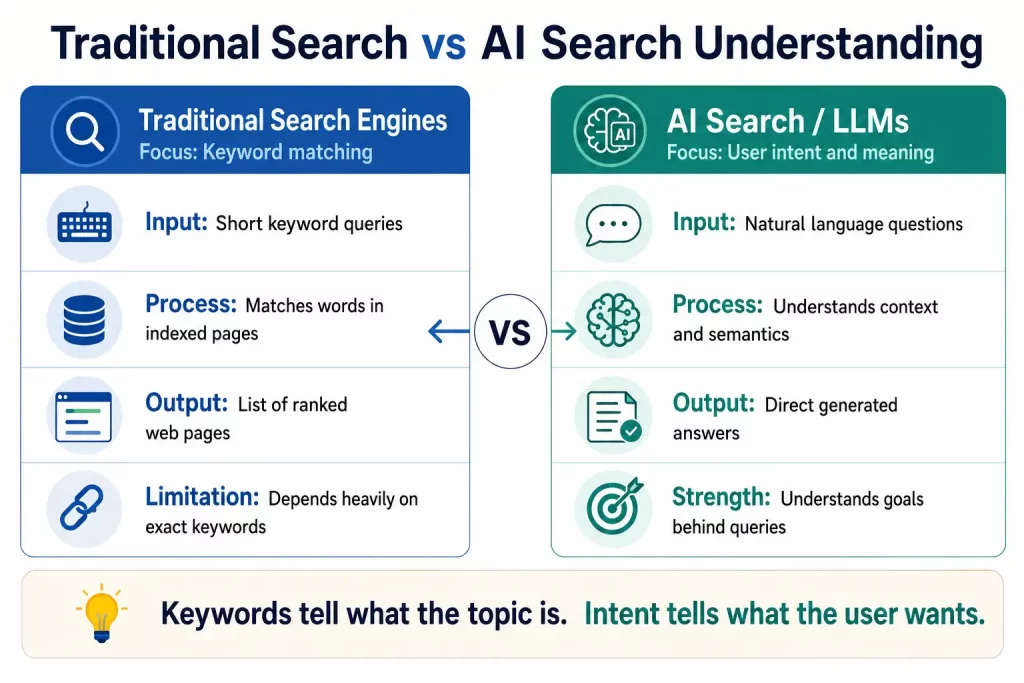
For years, traditional search engines relied heavily on keywords. Users had to enter specific phrases, and search engines looked for pages that closely matched those terms. Rankings were influenced by factors such as content relevance, backlinks, and domain authority. While search became better at understanding intent over time, users often still had to adapt their queries to find the right information.
Large Language Models (LLMs) do not use literal string matching. Instead, they process language through neural networks that map the conceptual and contextual relationships between words. When you submit a prompt, the model maps the semantic meaning of your text rather than just tracking individual characters.
Consider how this looks in practice. If you type “best ai seo agency” into an old-school search bar, it looks for articles with those exact words in the title or headers.
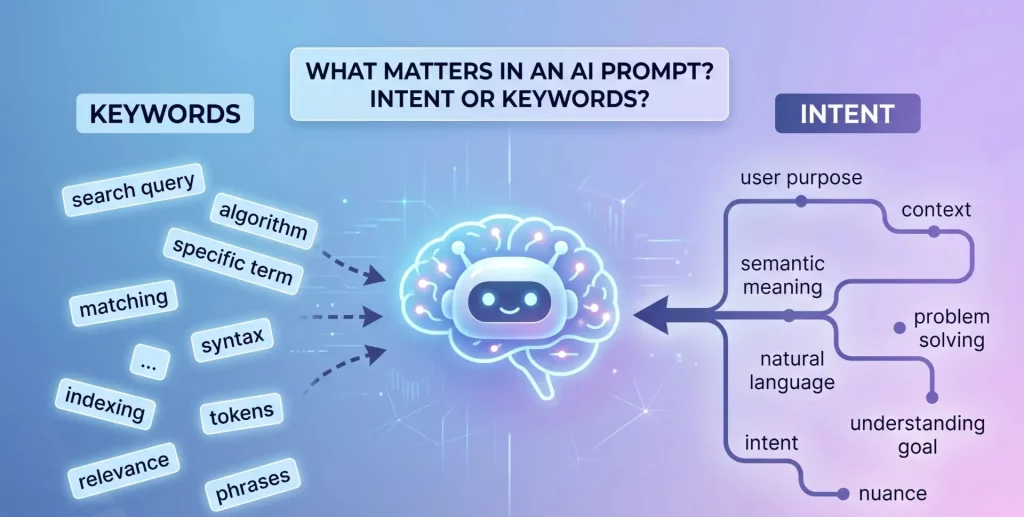
When you use the same phrase in an AI chatbot, the system goes beyond keyword matching. It tries to understand what you actually mean. Are you looking for agency recommendations, evaluation criteria, pricing information, case studies, or expert services?
Instead of focusing only on the words, the AI interprets the intent behind the query and generates a response based on the broader context. This shift from matching keywords to understanding intent is one of the biggest differences between modern AI systems and traditional search.
What Is User Intent in AI Prompts?
User intent in an AI prompt is the core objective you want the model to achieve, the specific perspective it should adopt, and the unstated rules it needs to follow. Unlike old-school search intent, which usually stops at commercial or informational categories, prompt intent is deeply layered.
When an LLM processes a prompt, it decodes the problem you are trying to solve. Intent covers the implicit context you leave out of the text. For instance, if a founder asks an LLM to critique a landing page hero copy, the literal request is text analysis. The deeper, structural intent is to fix a conversion drop-off and hold a visitor’s attention.
Forms of intent change based on very subtle shifts in how you frame a sentence. A prompt can intend to audit, expand, summarize, or restructure. If you ask an AI to read a competitor’s product documentation to extract product gaps, your intent is competitive positioning. If you ask it to read the same document to create a brief for a new developer, the intent shifts to technical utility and onboarding. The AI model is designed to recognize these operational shifts, prioritizing your structural goals over the nouns you use to describe the topic.
Do Keywords Still Matter in AI Prompts?
Because language models (LLMs) are built to interpret abstract concepts, it is easy to assume keywords no longer matter in prompt engineering. That is a mistake. Keywords are still highly relevant, but their role has completely changed. They are no longer strings used for database retrieval; they are context signals.
Keywords act as conceptual anchors that define the boundaries of your request. They tell the model which specific domain of knowledge or industry logic to pull from. If you write a prompt about improving a website’s conversion rate, using keywords like “Time to First Byte,” “hydration budget,” or “Core Web Vitals” tells the AI to look at the issue through a Technical SEO performance lens rather than a copywriting lens.
Without these anchor terms, the model has to guess the boundaries of your query, which usually results in generic responses. Keywords eliminate this ambiguity. However, using them in isolation won’t work. If you stack five industry terms together without giving the model explicit direction on what to do with them, it will simply define those terms back to you. Keywords provide the raw ingredients, but your intent provides the actual recipe.
Intent vs Keywords: Which Has More Influence on AI Responses?
When you look at what drives high-quality LLM outputs, intent consistently outperforms a keyword-heavy approach. Keywords show the AI the topic, but intent dictates its thinking process.
Look at how this plays out with two different approaches to generating a content brief:
Prompt A (Keyword Heavy): Write a content strategy brief for a B2B SaaS startup focused on AI visibility, search engine rankings, organic traffic, and generative engine optimization.
Prompt B (Intent Focused): We are a venture-backed B2B SaaS platform. Buyers frequently ask AI search tools for vendor recommendations in our space, but our product isn’t showing up in those summaries. Create a content strategy brief that identifies the exact types of technical articles and documentation we need to publish so that LLMs recognize our feature set and cite us as a top solution.
Prompt A uses all the right buzzwords. But because it lacks explicit intent, the AI will likely output a basic, textbook definition of content marketing. It will tell you to write high-quality content, update your metadata, and build links. It repeats your keywords without giving you an actual strategy.
Prompt B uses fewer buzzwords but communicates an exact business challenge. It specifies the business model, the exact technical challenge, and the concrete outcome required. The resulting AI output will be practical and tactical, focusing on structural data, entity relationships, and natural language alignment. The intent forces the model to build a real solution instead of a surface-level overview. The response of prompt B will be unique and
The Role of AI Prompt Engineering
Real prompt engineering is not about finding “magic words” to trick an LLM into working. It is the practical habit of clarifying context, constraints, goals, and audience parameters so the model can grasp your intent on the first try.
When you write a great prompt, you are building a logical box for the model to work inside. An effective prompt relies on four distinct pillars:
- Role Identification: Defining the exact viewpoint the model should take (e.g., a skeptical enterprise buyer or a veteran product manager).
- Contextual Constraints: Providing internal data, technical limitations, or market realities that narrow the scope of the answer.
- Audience Mapping: Explaining who will read the output so the model can naturally adjust its tone, density, and vocabulary.
- Output Specifications: Dictating the exact structure, format, and layout required for the final deliverable.
When you define these pillars, you define the intent. You can place relevant keywords inside this framework to keep the topic on track, but the structural box is what keeps the model from hallucinating or generating fluff.
What This Means for AI Search and Content Strategy
The shift from keywords to intent within LLMs does not just change how we write prompts. It completely changes how modern search engines function, which directly impacts your company’s content playbook. The industry is moving rapidly away from old-school search engine optimization toward an environment defined by answer engines and AI Overviews.
When prospective buyers use AI engines to find software or services, they don’t type in short keyword strings. They type out complex, multi-layered scenarios and specific organizational problems. Because AI models evaluate these inputs based on semantic meaning rather than exact word matches, legacy SEO tactics are hitting a point of diminishing returns.
For brands looking to maintain market share, survival requires a deep commitment to tracking and improving your AI Visibility. AI engines look for content that addresses the user’s core intent with genuine depth, unique perspectives, and verifiable facts. If your pages contain all the right keywords but fail to actually resolve the user’s underlying problem, an LLM will not synthesize your data or cite your brand in its answer.
Optimizing Content for LLM Understanding
To ensure your company gets cited by answer engines, your public-facing content needs to align directly with how AI models read, index, and verify information. This requires a transition to deep topical authority.
First, your content strategy must prioritize information depth over generic word counts. AI models analyze how comprehensively an article covers a topic’s entities and concepts. Instead of launching five separate, thin blog posts targeting slightly different keyword variations, you should focus on building comprehensive, structurally sound resources that address a business challenge from multiple strategic angles.
Second, formatting clean information architecture is non-negotiable for AI Overviews and standard LLM web scraping. Using clear, logical header hierarchies, answering complex technical questions directly in your introductory paragraphs, and using clean schema markup helps engines unpack and credit your points quickly.
Finally, your team needs to adopt an active Generative Engine Optimization (GEO) workflow. This means moving away from rewritten, generic content and anchoring your pages with proprietary data, direct expert quotes, and verifiable case studies. AI engines prefer content that provides distinct proof points over articles that simply rephrase old topics to hit basic keyword targets.
FAQs
1. What is prompt intent in AI?
Prompt intent is the real goal behind a user’s question or request. It tells the AI what you want to achieve, not just what words you use.
2. Do keywords still matter in AI prompts?
Yes. Keywords still help AI understand the topic, but they are not the main factor. Intent has more impact on the response.
3. How is AI search different from traditional search?
Traditional search matches keywords. AI search understands meaning and context to give more relevant answers.
4. Why is intent important for SEO and AI visibility?
Intent helps content match what users actually need. This increases the chances of being included in AI-generated answers.
Conclusion
So, what matters more in a prompt: intent or keywords?
Keywords help define the topic, but intent determines the outcome. The clearer the goal, the better the response.
The same applies to search visibility. Ranking for keywords still matters, but content that truly answers user questions has a better chance of being surfaced and recommended.
As search evolves, brands need to focus on understanding user needs, building topical authority, and creating genuinely useful content.