The rules of digital visibility just changed. Not gradually. Not theoretically. Right now.
For 25 years, website visibility meant one thing: ranking on a search engine results page. You built pages. Google indexed them. Users clicked links. That cycle drove the entire SEO industry.
That cycle is breaking.
60% of queries are now resolved entirely within an AI interface, without a single click to any website. The user asks; the AI answers. No SERP. No link. No visit. If your website cannot communicate directly with an AI agent, you are not being skipped. You simply do not exist.
The protocol that determines whether you exist or not is called Web MCP.
The Paradigm Shift: From Search Engines to Action Engines
The Search Era (roughly 2000 to 2024) had one job: index text. Google’s core innovation was treating hyperlinks as votes and text as a map. Websites published content. Crawlers read it. Rankings sorted it. Users navigated it.
The Agent Era operates on a fundamentally different premise. AI agents do not want to read your content. They want to call your functions.
Consider the difference: a user searching for “best yoga studio near me” in 2022 got a list of links. That same user in 2026 tells their AI agent: “Book me an intro class at the highest-rated yoga studio within 5 km that has an open slot this Saturday morning.” The agent needs to query availability, compare ratings, and complete a booking. No amount of well-written blog content enables that. A structured, callable interface does.
The shift is from indexing pages to indexing capabilities. Websites that offer nothing but readable text are effectively invisible to agents working on behalf of users.
What is MCP (Model Context Protocol)?
MCP, developed as an open-source standard, was built to solve the data silo problem in AI systems.
Before MCP, connecting a Large Language Model to any external data source required a custom integration: bespoke code, proprietary APIs, and fragile pipelines that broke every time either side updated. This made scalable AI tooling expensive and inconsistent.
MCP changed that by introducing a universal, standardized protocol for how AI models access external data and tools. Think of it as a common language: instead of each integration being its own dialect, every compliant system speaks the same grammar.
At its core, MCP defines how an LLM can safely request information or trigger actions from a connected resource, without that resource needing to know anything about the specific model using it. The model sends a structured request. The resource returns a structured response. Both sides remain decoupled.
This solved the developer problem. Web MCP solves the visibility problem.
What is Web MCP? The Digital Handshake
Web MCP is the implementation of MCP at the browser and website level. It is what happens when the abstract power of MCP gets deployed on a live domain, accessible to AI agents operating on behalf of real users in real time.
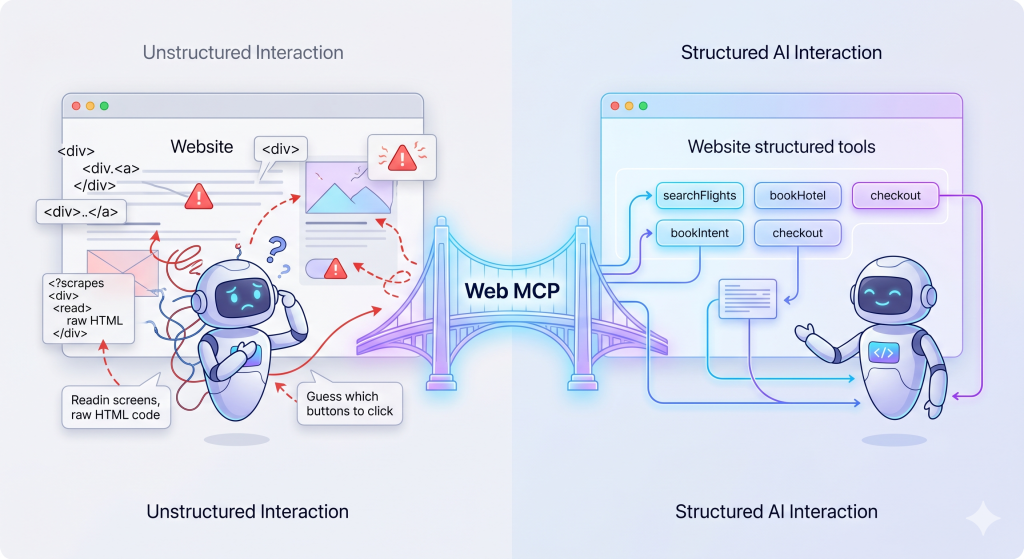
Here is the architecture, simplified:
The MCP Server is your website (or a service running on your domain). It exposes a set of defined “tools”: discrete functions that an AI can invoke. A tool might be search_products, check_availability, submit_inquiry, or get_pricing.
The MCP Client is the AI agent: a model running inside a browser, assistant application, or autonomous workflow engine. It discovers your server, reads the tool definitions, and calls the relevant function based on user intent.
The Model interprets user language and maps it to available tools. It does not guess. It reads your declared capabilities and acts on them.
{
  "tool": "check_availability",
  "description": "Returns available SEO audit slots for a given date range",
  "parameters": {
    "date_from": { "type": "string", "format": "date" },
    "date_to": { "type": "string", "format": "date" },
    "service_type": { "type": "string", "enum": ["technical", "content", "full"] }
  }
}
This is what a Web MCP tool definition looks like. It is declarative, precise, and machine-readable. When an AI agent discovers this on your domain, it knows exactly what your site can do, not what it says.
Web MCP is not a feature. It is the new baseline for AI-era discoverability.
MCP vs. Web MCP: Understanding the Distinction
| Dimension | MCP | Web MCP |
| Scope | Developer infrastructure for connecting LLMs to internal data and APIs | Client-facing protocol for exposing website capabilities to AI agents |
| Primary User | Developers building AI applications | Businesses wanting to be discoverable and actionable by AI agents |
| Connection Method | Local or remote server integration within application architecture | Hosted on a public domain, discoverable by browser-level AI clients |
| SEO Impact | Indirect: enables better AI products | Direct: determines whether your site is visible and usable by AI agents |
| Analogy | The plumbing inside a building | The front door that visitors actually use |
The key insight: MCP is infrastructure for developers building AI systems. Web MCP is the new HTML for anyone who wants to be visible in those systems. One is a construction material. The other is what the public-facing web is built with.
If your team understands traditional SEO, think of Web MCP as meta tags, sitemaps, and structured data combined into a single, callable interface. Except instead of helping a crawler understand your content, it helps an agent perform actions on behalf of your customer.
The Exact Problem Web MCP Solves: Closing the Execution Gap
Three persistent failures define the AI-website relationship today. Web MCP addresses all three.
Hallucination Prevention
AI models fill gaps. When an agent does not have direct access to your data, it infers. It guesses your pricing from cached mentions. It estimates your availability from outdated snippets. It describes your services based on what similar businesses typically offer.
Web MCP creates a live Source of Truth. The agent calls your tool. Your system returns the actual value. No inference. No guess. No reputational damage from a confidently wrong answer.
Real-Time Data Access
Traditional search crawls are periodic. A crawler visiting your site today might be working from a cache that is weeks old. For static content like brand messaging, that is acceptable. For inventory levels, appointment slots, live pricing, or active promotions, it is disqualifying.
Web MCP is synchronous. The agent calls the tool at the moment of user intent. Your server responds with current data. The gap between reality and what the AI reports collapses to near zero.
Actionability Without Redirection
Traditional SEO achieves one outcome: bringing a user to a page. Everything after that (clicking a button, filling a form, completing a purchase) depends on the user doing it manually.
Web MCP removes that dependency. The agent does not need to bring a user to your site. It can execute the intent directly. A user asking their AI to “get me a quote for a technical SEO audit” can have that form submitted, confirmation received, and calendar invite generated before they finish reading the response.
This is not automation for automation’s sake. It is meeting users where they are, which is increasingly inside AI interfaces they trust more than any single website.
How Your Business Benefits from Web MCP
Brand Authority in AI Responses
AI models are not neutral. They build preference based on what is easiest to work with accurately. A site with a well-defined Web MCP server produces clean, reliable outputs. A site without one produces guesses. Over enough interactions, agents learn to prefer reliable sources.
Being “easy to talk to” is the new domain authority. Sites that offer structured, callable interfaces get cited more often, trusted more deeply, and recommended more confidently. This is AI brand authority, and it compounds.
CRO 2.0: Conversions Without Clicks
Picture this scenario: a potential client tells their AI assistant, “Find and book the best SEO audit service in India.” The agent queries multiple providers. One has a Web MCP tool called submit_inquiry with parameters for name, email, business size, and primary concern. The agent populates those fields from conversational context and submits the lead.
Your CRM receives a qualified inquiry. The user never visited your site. The conversion happened entirely in an interface they chose and trusted.
This is CRO 2.0. The conversion funnel no longer starts at your homepage. It starts at the user’s intent and ends at your tool endpoint.
Reduced Bounce Rates Through Interface Agnosticism
Users no longer leave an AI interface to visit a site, struggle with navigation, and return frustrated. With Web MCP, your brand’s logic, your data, your forms, and your outcomes become accessible without that journey. The user stays in their preferred interface. You still get the interaction.
Bounce rate, in the traditional sense, becomes irrelevant. Engagement becomes measured by tool calls, not sessions.
Implementation: Becoming “Agent-Ready”
Implementing Web MCP is not a single task. It is a structured process across three interconnected pillars.
Pillar 1: Tool Definition
Identify which website capabilities are worth exposing. Not every feature needs to be a tool. Start with high-intent, high-value functions: search, booking, quoting, checking availability, submitting contact forms. Each tool needs a clear name, a precise description, and well-typed parameters. Vague definitions produce unreliable agent behavior.
Pillar 2: The MCP Server
The tools need to be hosted and discoverable. This means running a compliant MCP server on your domain that responds to agent discovery requests and handles tool invocations. The server manages authentication, rate limiting, and response formatting. It must be performant and reliable; agents that encounter failures will deprioritize your site in future interactions.
Pillar 3: Schema Alignment
Your existing structured data (JSON-LD, schema.org markup) should connect to your MCP tools. If you have a LocalBusiness schema with defined services, those services should map to callable tools. This alignment ensures that the information you already publish for crawlers reinforces and contextualizes the capabilities you expose to agents.
This is where most businesses encounter the gap: they have the data, but not the infrastructure to surface it in agent-readable form. An AI-SEO agency bridges that gap by connecting existing technical SEO work to agentic protocols, ensuring neither is built in isolation.
The New Frontier of Authority
Web MCP is the next logical step after llms.txt file. That file told AI models what your site contains. Web MCP tells them what your site can do. The progression from passive declaration to active capability is not optional. It is the direction the web is moving.
The metrics that define visibility are changing. Impressions, rankings, and click-through rates describe a world where users came to websites. In the world taking shape, users stay in their AI interfaces and send agents to complete tasks on their behalf.
Visibility in 2026 is measured by Integration, not Impressions.
Businesses that define their capabilities, host a compliant server, and align their existing schema with agentic tools will be the ones that AI agents reach for. The rest will exist on a web that agents rarely visit.
The question is not whether Web MCP will become standard. It is whether your domain is part of it when it does.
FAQs:
Q1. What is Web MCP?
Web MCP is the implementation of Model Context Protocol at the website level. It allows AI agents to directly call functions on your website, like checking availability or submitting a form, instead of just reading your content.
Q2. How is Web MCP different from regular SEO?
Traditional SEO helps search engines find and rank your content. Web MCP goes further by letting AI agents interact with your website’s capabilities directly, without the user ever visiting a page.
Q3. Do I need Web MCP if I already have structured data (Schema)?
Schema markup tells crawlers what your content means. Web MCP tells AI agents what your website can do. Both work together; your existing JSON-LD schema should ideally map to your MCP tool definitions for maximum AI visibility.
Q4. Is Web MCP relevant for small businesses in India?
Yes. As AI assistants become the primary way users discover and engage with services, any business, regardless of size, that exposes callable tools via Web MCP becomes actionable to agents. Early adoption is a direct competitive advantage, especially in markets where most competitors have not yet implemented it.