The era of chasing blue links is over. While traditional search engines still drive a significant portion of traffic, we are witnessing a tectonic shift toward AI Engine Optimization (AEO). AI models like GPT-4, Claude, and Gemini are no longer just tools we use to write, they are the new gatekeepers of information. They don’t just “rank” your content. They ingest it, synthesize it, and present it as their own knowledge.
If your technical foundation is shaky, these AI agents won’t just rank you lower. They will ignore you entirely. It creates a “zero-traffic” risk where your brand is erased from the synthesized answers users receive. To stay relevant, you must bridge the gap between being “searchable” and being “comprehensible.
What is Technical SEO in the Age of AI?
In the old world, technical SEO was about making sure Googlebot could find your URL and index the text. In the age of AI, technical SEO is about deep comprehension and data accessibility. It is the process of structuring your site so that large language models (LLMs) can parse your information without friction, map your brand to the global knowledge graph, and trust your data as an authoritative source.
AI crawlers are more expensive to run than traditional crawlers. They are looking for the path of least resistance to high-quality data. If your site requires too much “compute” to understand, you become invisible.
Problem #1: The JavaScript Wall
Many modern websites use frameworks like React, Vue, or Angular to create content dynamically. Instead of loading a complete webpage from the server, the browser first gets a basic HTML shell, and JavaScript generates the actual content after the page loads.
Humans eventually see the content.
AI crawlers often do not.
While Google has improved JavaScript rendering capabilities, many AI crawlers and secondary indexing systems still struggle with delayed rendering, hydration issues, blocked scripts, or rendering timeouts.
This becomes especially dangerous for:
- Ecommerce category pages
- Product descriptions
- Blog content
- Navigation menus
- Internal links
- Structured data injected via JavaScript
If the crawler receives incomplete HTML, your site becomes partially invisible.
Impact
AI systems prioritize efficiency. They crawl massive amounts of data under strict resource limits. A slow or rendering dependent site costs more compute to process.
When crawlers encounter rendering friction, they may:
- Skip content entirely
- Miss internal linking signals
- Ignore structured data
- Fail to identify entities
- Reduce crawl frequency
- Downgrade trust signals
This creates a silent visibility collapse.
Your content exists for users but not for machines.
Fix
Move critical content to server side rendering (SSR) or static site generation (SSG) whenever possible.
Your goal is simple:
Deliver meaningful HTML before JavaScript executes.
Immediate action steps:
- View your site source, not the rendered DOM. Verify critical content exists in raw HTML.
- Use SSR frameworks like Next.js or Nuxt for content heavy pages.
- Pre render important landing pages.
- Ensure internal links exist in HTML anchors.
- Inject structured data server side.
- Test rendering using crawler simulation tools.
For AI visibility, raw HTML clarity beats fancy frontend architecture every time.
Problem #2: Broken Schema and Entity Relationships
AI does not just read words. It identifies entities.
An entity is a clearly defined thing like your company, CEO, or product. AI systems use entities to understand and connect brands with topics.
If your Schema Markup is missing or broken, AI may struggle to understand who you are. For example, without proper JSON-LD structured data, AI could confuse “Apple” the tech company with “apple” the fruit.
Impact
This lack of clarity can prevent your brand from appearing in the Knowledge Graphs that power AI-generated search results and summaries.
If the AI cannot verify the relationship between your content and a known entity, it will default to a more “structured” competitor.
Fix
Relevant Schema Used on Our Website: Relevant Schema Implemented on our services page.
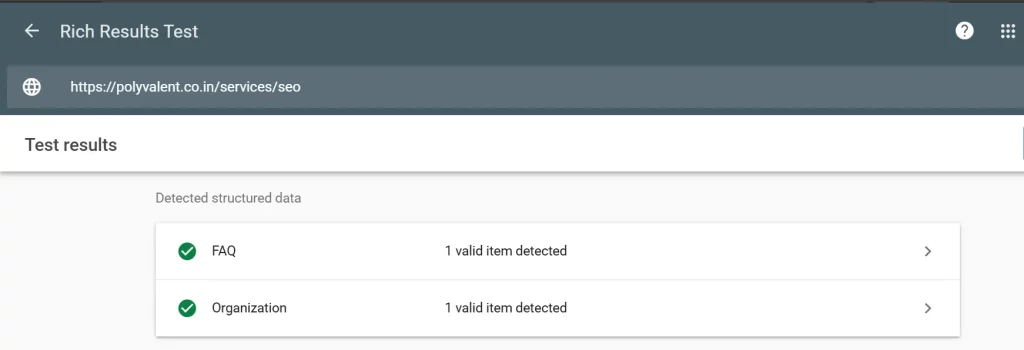
Solution : You need to go beyond basic Breadcrumb or Article schema. You must implement Organization, Person, and Product schemas that use the “sameAs” attribute to link to verified third-party profiles like Wikipedia, LinkedIn, or official social channels.
Action Plan:
- Audit your site using the Schema.org validator or rich result snippets.
- Map out your entity relationships. Ensure your “About” page clearly defines who you are and what you do using Organization schema.
- Use Nested Schema to show how different pieces of content relate to one another.
- Must add only required Schema to your Website.
Problem #3: Poor Semantic HTML
For years, developers have used “div” tags for everything. This “div soup” makes it hard for AI models to understand what matters most on a page. Unlike humans, AI cannot visually interpret layouts the same way. It relies on the website’s code structure to tell the difference between main content, navigation, ads, and footers.
Impact
When an AI bot parses a page with poor semantics, it wastes “tokens“ (the units of data AI uses to process text) on irrelevant sections like sidebar widgets or legal disclaimers.
This dilutes the signal of your main content. If the AI cannot easily identify the <article> or the <main> content, it might misattribute a random customer testimonial as your core service offering.
Fix
Return to the fundamentals of semantic HTML5. Use landmark tags to tell the AI exactly where the value lies. This creates a clear hierarchy that the AI can digest efficiently.
Action Plan:
- Replace generic containers with <header>, <nav>, <main>, <article>, <section>, and <footer>.
- Use a logical heading structure (H1 through H6) without skipping levels.
- Ensure that every page has exactly one H1 that matches the core entity of the page.
Problem #4: Robots.txt and Firewall Blocking
The first thing an AI crawler does is check your permissions. Many site owners, fearing data scraping, have implemented aggressive firewall rules or “Disallow” commands in their robots.txt files specifically targeting user agents like GPTBot or CCBot.
Impact
While protecting your intellectual property is important, a total block is a suicide mission for discovery. If you block GPTBot, ChatGPT cannot access your site to verify facts or provide links back to your store. You are opting out of the new internet. Furthermore, aggressive firewalls often trigger 403 errors for these bots, which flags your site as “unreliable” in the AI’s internal database.
Fix
Adopt a nuanced approach to bot management. Instead of a blanket ban, allow AI crawlers access to your public-facing, high-value content while keeping your proprietary data behind login screens or stricter robots.txt rules.
Here is how the Polyvalent Robots.txt file looks like.
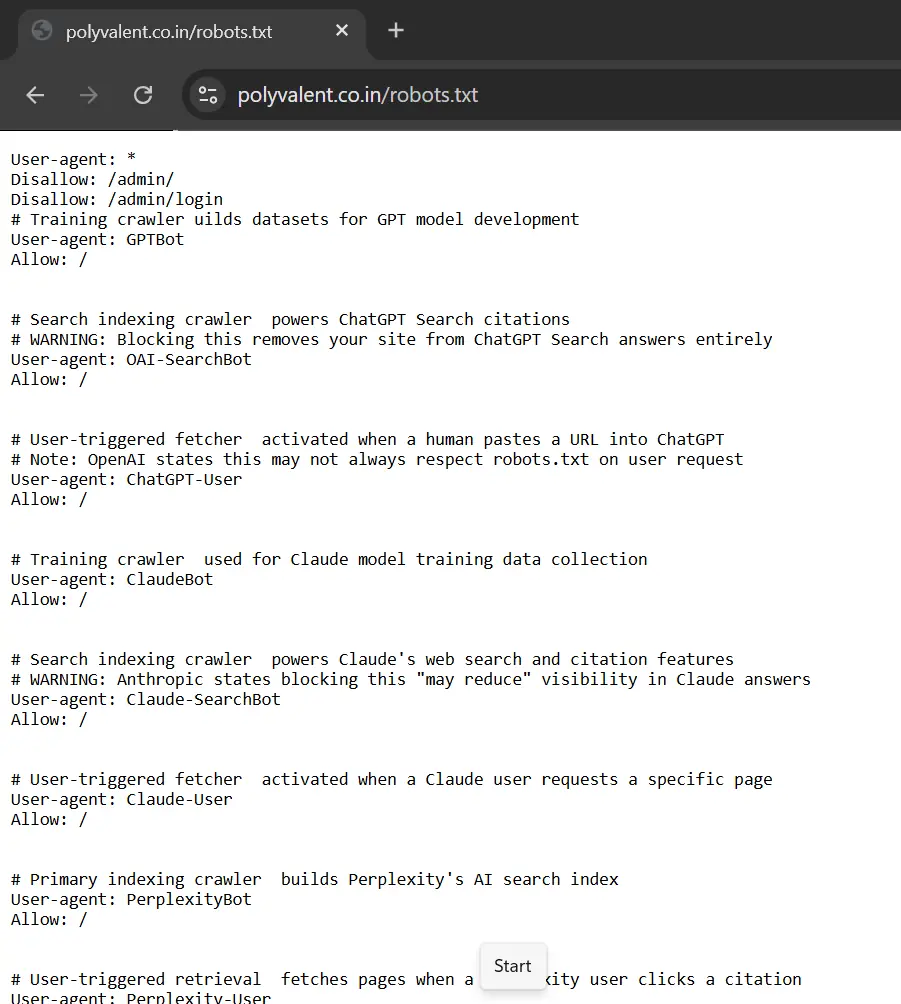
Action Plan:
- Review your robots.txt file for User-agent: GPTBot or User-agent: *.
- Ensure your Content Delivery Network (CDN) like Cloudflare isn’t accidentally flagging AI agents as malicious “DDoS” threats.
- Create a “Search-Friendly” directory and ensure it is wide open to legitimate AI crawlers.
Problem #5: Failing Core Web Vitals (The TTFB Bottleneck)
Speed is often discussed in terms of user experience, but for AI bots, Time to First Byte (TTFB) is a hard technical limit. AI crawlers operate on a massive scale and have “timeout” thresholds. If your server takes too long to respond with the first byte of data, the crawler will drop the connection and move on.
Impact
Slow response times signal to an AI that your infrastructure is fragile. This leads to infrequent crawling. If your content is updated frequently but your server is slow, the AI will continue to provide outdated or incorrect information about your brand because it simply couldn’t wait for your page to load. High latency is a signal of low quality in the eyes of an automated agent.
Fix
Optimize your server response times. This often requires moving away from cheap shared hosting and implementing robust edge caching. You want your TTFB to be under 200ms for a “Green” rating.
Action Plan:
- Use a Global CDN to serve content from the location closest to the crawler.
- Optimize your database queries and implement object caching (like Redis).
- Minimize the use of heavy third-party plugins that delay server processing.
Problem #6: High Data-to-Clutter Ratio
AI models have a limited “context window.” They can only process a certain number of tokens at one time. If your webpage is 100KB of code but only contains 500 words of actual content, your data-to-clutter ratio is abysmal. The AI has to “read” through mountains of inline CSS, bloated DOM nodes, and tracking scripts to find the value.
Impact
When the DOM (Document Object Model) is too large, the AI bot may truncate the page. This means it only reads the top half of your code. If your most important insights or product details are buried at the bottom of a bloated page, they are effectively invisible. Excessive code also increases the cost for the AI to process your site, making it less likely to be prioritized for deep indexing.
Fix
Clean up your code. Move all CSS and JavaScript to external files. Minimize your HTML by removing unnecessary nested “divs.” Focus on delivering the “signal” (your content) with as little “noise” (your code) as possible.
Action Plan:
- Audit your DOM size; aim for fewer than 1,500 nodes per page.
- Eliminate inline styles and scripts.
- Use “Content-Visibility: auto” in your CSS to help browsers and bots focus on visible content first.
Problem #7: Lack of Topical Hubs
AI understands information through context. It looks for “Topic Clusters” to determine if you are a true authority or just a generalist. If your internal linking is a mess, or if your content is scattered across unrelated categories, the AI cannot build a cohesive map of your expertise.
Impact
A “flat” site architecture without clear internal linking patterns prevents the AI from understanding the hierarchy of your knowledge. If an AI cannot determine which page is your “pillar” content and which are the supporting “spokes,” it won’t know which URL to cite in a response. You end up with fragmented authority that isn’t strong enough to trigger an AI recommendation.
Fix
Build “Authority Silos.” Use internal linking to create a clear path from broad topics to specific sub-topics. Ensure that your most important pages have the most internal “votes” from related content.
Action Plan:
- Create Pillar Pages that summarize a broad topic and link out to detailed sub-articles.
- Use descriptive anchor text that tells the AI exactly what the linked page is about.
- Eliminate “Orphan Pages” (pages with no internal links pointing to them).
Problem #8: Non-Standard Content Formats
AI has come a long way with vision and file parsing, but it still prefers clean HTML. If your most valuable data is locked inside flat images without alt-text, or buried in massive, non-tagged PDFs, you are creating a barrier to entry. While an AI can OCR an image, it is an extra step that it would rather avoid.
Impact
Content trapped in non-standard formats is often ignored during the “quick pass” of an AI crawler. If your pricing table is an image, the AI can’t compare your rates to a competitor’s. If your whitepaper is a 50MB PDF without a web-based summary, the AI may never ingest the insights within. This makes your most valuable intellectual property useless in the AI search landscape.
Fix
Adopt an “HTML-First” mentality. Any data that is vital to your business should be rendered as text in the HTML. Use SVG for graphics where text needs to remain readable, and always provide a web-version of any downloadable document.
Action Plan:
- Convert key data from PDFs into interactive, searchable HTML pages.
- Write descriptive, context-heavy Alt-text for every image.
- Use <figure> and <figcaption> tags to provide context to visual data.
Why Your Competitors are Winning the AI Search Battle
The transition from search engines to AI engines is not something to fear; it is an opportunity to outpace competitors who are still playing by 2018’s rules. By fixing these eight technical hurdles, you aren’t just “optimizing.” You are making your website the most legible, trustworthy, and accessible source of information in your niche.
An AI-ready website is fast, structured, and semantically clear. When you provide an AI with a friction-less path to your data, you become the preferred source for the answers it generates. This is the new technical SEO. It’s no longer about tricking an algorithm; it’s about feeding an intelligence. Clear the path, and the traffic will follow.
Frequently Asked Questions
Does AI use social media signals for website ranking?
Yes. AI models use social signals to verify the public consensus of a brand. While not a direct ranking factor, active social profiles provide additional training data to validate your entity authority and current relevance.
How often do AI crawlers visit my site compared to Googlebot?
AI bots like GPTBot or ClaudeBot generally crawl less frequently than Googlebot. They prioritize high authority hubs and sites with clean technical structures. If your site has a high Data to Clutter ratio, AI agents may only visit once every few months.
Can I use a “Disallow” tag for specific AI models only?
You can. You can target specific user agents in your robots.txt to block or allow them individually. This allows you to stay visible in ChatGPT while potentially blocking lower tier scrapers.
Does AI prioritize video content over text?
Not currently. While multimodal AI can process video, text remains the primary and most efficient data source for LLMs. High quality transcripts and semantic HTML text are significantly more likely to be used in an AI generated answer than raw video files.
Will AI generated content on my site hurt my AI visibility?
Only if it provides zero new information. AI engines look for Information Gain. If your site simply mirrors what the AI already knows, it has no reason to cite you. Original data and primary research are the best ways to ensure inclusion.
Conclusion
The shift from traditional search to AI discovery is a fundamental change in how the internet functions. It is no longer enough to be visible to humans. You must be legible to machines.
By eliminating technical friction, from JavaScript execution hurdles to fragmented entity data, you position your website as a primary source of truth. A clean technical foundation is your most powerful competitive advantage. In an era where being understood by AI is the only way to remain seen by your audience, a clear architecture is your greatest asset.