Search has changed. A growing number of users no longer scroll through ten blue links. They type a question into ChatGPT, Perplexity, or Gemini and read a synthesized answer. If your brand is not showing up in those answers, you are losing ground you may not even know you are losing.
The problem is measurement. Traditional SEO tools track rankings. They tell you where you appear on page one of Google. But they were never built to tell you whether an LLM mentions your brand when someone asks for the best project management tool, the most trusted accounting software, or the top digital agencies in London. That gap in visibility tracking is real, and most brands are flying blind.
This guide gives you a free, step-by-step method to check your Brand AI visibility, in free , understand where you stand relative to competitors, and begin tracking it consistently.
What AI Visibility Means Today
AI visibility refers to how often and how prominently your brand appears in AI-generated answers. If you are still exploring what is AI Visibility, it includes direct mentions, citations as a source, and recommendations in response to comparison or buying queries.
Unlike a traditional ranking, AI visibility is not a position number. It is a pattern. Your brand either gets recalled by the model when a relevant query is asked, or it does not. The goal is to be consistently present across the queries that matter to your audience and ultimately drive more revenue to your business.
Why Traditional SEO Tools Are Not Enough
Rank trackers, site auditors, and backlink tools are valuable. But they measure performance in indexed search, not in large language models. When ChatGPT answers a question, it is not pulling from a live Google index. It is drawing on patterns in its training data, often augmented by retrieval systems that pull from trusted web content in real time.
This is a fundamentally different process, and existing tools do not capture it. The debate around SEO vs GEO has surfaced for exactly this reason. Generative Engine Optimization requires different inputs, different metrics, and different measurement approaches than traditional search optimization.
If you are relying only on keyword rankings to assess your discoverability, you are missing a growing portion of the search landscape entirely.
Step-by-Step Guide to Check AI Visibility for Free
Step 1: Identify the Prompts That Matter
Start by building a list of queries your audience is likely to type into an AI tool. These fall into three categories:
Informational queries ask for knowledge or explanation. Examples:
- “What is the best way to manage remote teams?”
- “How does programmatic advertising work?”
Comparison queries put options side by side. Examples:
- “ChatGPT vs Perplexity for research”
- “Best email marketing tools for small businesses”
Commercial queries signal buying intent. Examples:
- “Top SEO agencies for SaaS companies”
- “Which CRM is best for a 10-person sales team?”
Aim for 20 to 30 prompts that genuinely reflect how your customers search. Include your category, your use cases, and the problems you solve. This becomes your testing set.
Step 2: Run Manual Checks in AI Tools
Now take your prompt list and run each query through the three main AI surfaces:
- ChatGPT (GPT-4o)
- Perplexity AI
- Google AI Overviews (search with AI mode enabled)
For each result, record three things:
- Is your brand mentioned? Yes or no.
- What position? First mention, secondary mention, or buried in a list.
- What context? Are you described accurately, positively, as a leader, as an alternative, or not at all?
This manual pass gives you a baseline. It is slow, but it is free and surprisingly revealing. Most brands discover they are absent from a large portion of relevant queries, or that competitors dominate the AI answers in their space.
Step 3: Track Mentions Systematically
Running queries once is not enough. AI answers shift. Model updates change what gets recalled. You need a tracking system, even a simple one.
Set up a spreadsheet with these columns:
| Query | AI Tool | Date | Brand Mentioned | Position | Sentiment | Competitor Mentioned |
| “Best project mgmt tools” | ChatGPT | 2026-04-21 | Yes | 2nd | Neutral | Asana, Monday |
Run your full prompt list once a week or once a fortnight. Over time, you will see patterns: which queries your brand is strong on, where you are slipping, and where a competitor is consistently beating you. Consistency in tracking is more valuable than any single snapshot.
Step 4: Analyze Competitor Visibility
Once you have a few rounds of data, shift to competitive analysis. For each query, note which brands appear most frequently, in what position, and with what framing.
You are looking for:
- Share of mentions: Out of 30 queries, how many times does your brand appear versus a competitor?
- Positioning quality: Are you recommended first, or are you an afterthought?
- Description accuracy: Does the AI describe you correctly and favorably?
This comparison often reveals specific query clusters where a competitor dominates. Those gaps are your opportunity. If a rival is consistently cited on comparison queries and you are not, the problem usually traces back to content authority, entity recognition, or citation patterns in trusted sources.
Step 5: Use Free Tools to Scale Your Tracking
Manual checks have limits. A few free tools can extend your reach without cost:
Google search operators: Use site:perplexity.ai “your brand name” or check Google’s AI Overviews for your key categories directly in search.
Reddit search: Many AI tools, especially Perplexity, pull heavily from Reddit discussions. Search Reddit for your category queries and see which brands dominate organic community mentions. This is a proxy for what the models are seeing.
Google Alerts: Set alerts for your brand name combined with category terms. This surfaces new content that may feed into AI training or retrieval.
For a more structured approach, tools like AI Visibility Checker (by Polyvalent) are designed specifically to automate prompt-based tracking across multiple LLMs, giving you consistent data without manual effort. It is a natural next step once you have outgrown the spreadsheet method.
How to Benchmark Your Brand in AI Search
Once you have a few weeks of tracking data, you can build a simple benchmark using three measures:
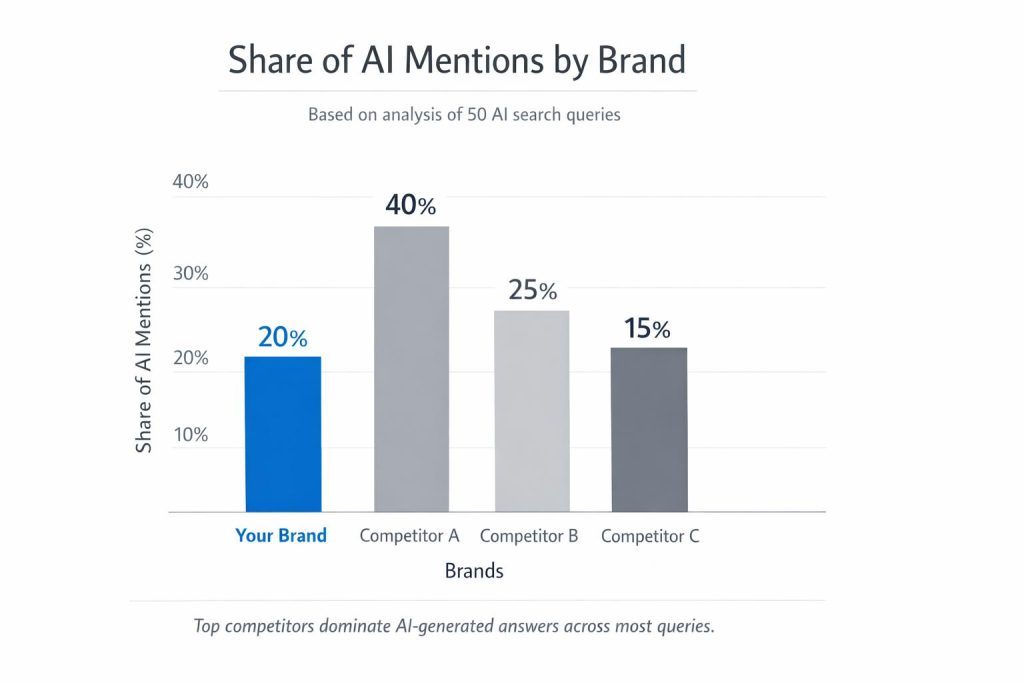
Share of mentions: The percentage of your tracked queries on which your brand appears. A brand with 40% share of mentions across 30 queries is considerably more visible than one at 10%.
Query coverage: How many distinct query types surface your brand? A brand that only appears on branded queries but never on comparison or category queries has shallow coverage.
Competitive positioning: Where do you rank in AI answers relative to direct competitors? Understanding these patterns is the foundation of actionable AI visibility metrics.
Key Metrics to Track Without Paid Tools
Even without enterprise software, you can track these five metrics manually:
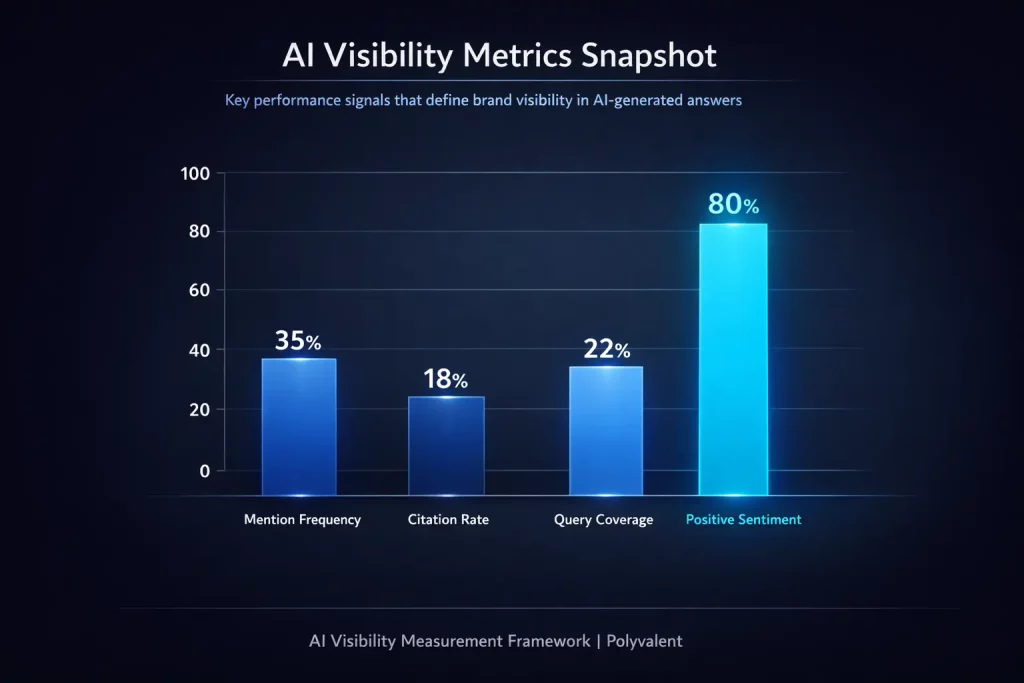
- Mention frequency: How often your brand appears across your tracked query set
- Citation rate: How often you appear as a named source or reference, not just a mention
- Query coverage: The breadth of topics and intents on which you appear
- Sentiment: Whether mentions describe you positively, neutrally, or inaccurately
- Authority sources: Whether your brand appears when the AI references industry-leading content or only in generic lists
These give you a picture of both presence and quality, which matters more than raw mention count.
Common Mistakes to Avoid
Testing too few prompts. Twenty prompts is a starting point. Brands that test only five or six get misleading results. The more diverse your query set, the more accurate your visibility picture.
Ignoring competitors. Your raw mention count means little without context. A brand with 15 mentions out of 30 queries sounds strong until you realize a competitor appears on 28.
Confusing rankings with mentions. AI mentions are not the same as search rankings. A brand can rank well on Google and be almost invisible in LLM answers, and vice versa. These are separate signals.
Tracking inconsistently. AI answers evolve. A one-time audit tells you where you stood that week. Regular tracking tells you whether your visibility is growing, shrinking, or shifting.
How to Improve AI Visibility After Measurement
Once you know where you stand, improvement comes from a few reliable levers:
Entity clarity: Make sure your brand is defined clearly across your website, Wikipedia, Wikidata, and industry databases. LLMs and vector search systems rely heavily on entity recognition. If your brand’s identity is ambiguous, it will be underrepresented.
Content authority: Publish content that directly addresses the queries in your tracking set. Long-form, well-structured, factually specific content is what Retrieval-Augmented Generation systems tend to surface.
Consistent mentions in trusted sources: Being cited in respected publications, forums, and review platforms increases the probability that AI models associate your brand with relevant queries.
Structured data: Schema markup helps search engines and AI crawlers understand what your content is about. This matters particularly for product, organization, and FAQ schema. If you want to go deeper, read our guide on how to optimize for AI overviews.
FAQ
What are the best free AI visibility tools available?
Google AI Overviews, Perplexity, and ChatGPT can all be used manually for free visibility checks. For structured tracking, Google Alerts and Reddit search help extend your coverage. AI Visibility Checker by Polyvalent offers a dedicated, automated option for brands that need consistent multi-LLM tracking.
How do I measure LLM mentions for my brand?
Build a set of 20 to 30 relevant prompts, run them through major AI tools, and record whether your brand is mentioned, in what position, and with what sentiment. Repeat this consistently over time to build a meaningful dataset.
Is there a tool to track ChatGPT citations?
Not natively. ChatGPT does not expose a citation index. The most practical approach is prompt-based testing: run queries manually or through a tool like AI Visibility Checker and log results in a structured format
How are AI SEO tools different from traditional SEO tools?
Traditional SEO tools measure performance in indexed search, tracking rankings, backlinks, and crawlability. AI SEO tools measure brand presence in LLM-generated answers, which requires different inputs like prompt testing, entity analysis, and semantic relevance scoring.
Is there something like Ahrefs for AI search?
Not yet at the same scale or maturity, but tools like Profound, Brandwatch AI features, and AI Visibility Checker are moving in that direction. The space is new, and the tooling is developing quickly.
How does RAG affect brand visibility?
Retrieval-Augmented Generation means the model pulls from live or recent sources at query time. Brands that are well-represented in high-authority, crawlable web content have a better chance of being surfaced through RAG pipelines. Strong traditional content strategy feeds directly into RAG visibility.
How do LLMs retrieve and rank sources?
LLMs do not rank sources the way search engines do. They learn associations from training data and, in RAG setups, retrieve chunks of content based on semantic similarity to the query using vector search. Content that is clear, authoritative, and semantically relevant is retrieved more often.
What is entity-based optimization for AI search?
Entity-based SEO means making your brand, products, and people clearly identifiable as named entities that models can recognize and associate with relevant topics. This involves structured data, consistent naming across sources, and presence in knowledge bases like Wikidata.
How do I increase LLM recall for my brand?
Create content that directly addresses the queries you want to be recalled for. Build citations in trusted publications. Ensure your entity data is clean. Structured data and consistent brand mentions across authoritative sources all improve the probability of LLM recall.
What schema markup helps with AI visibility?
Organization schema, FAQ schema, Product schema, and HowTo schema are the most directly relevant. They help crawlers and AI systems understand what your content covers and who you are, which feeds into both traditional and AI-generated search results.
How do I optimize for vector search?
Write content that clusters around specific topics with semantic depth rather than relying on keyword repetition. Use clear headings, structured sections, and complete answers to specific questions. Vector search systems retrieve based on meaning, so content that thoroughly covers a topic performs better than content optimized for exact-match keywords.