
Keyword research helps you identify the search terms that a user can use while searching for something and the topics they want information about. Keyword research is one of the most important on page SEO activities for improving content visibility and attracting relevant traffic.
If your keyword research is accurate, the traffic will be more relevant and valuable.
Most of the websites trying to grow organic traffic make the same mistake. They focus only on keywords with high search volume and stop there. They do not think about who is searching, what they really want, or if the page can actually rank.
If proper planning of keywords is not done it can lead to Keyword Cannibalization which might affect your website seo overall.
This leads to content that may get impressions but no clicks, or clicks that do not turn into results or sales.
What Is Keyword Research in SEO?
Keyword research is the process of finding the phrases and exact words people type into search engines (Google, Yahoo, Bing etc) and chatbots like ChatGPT and Gemini, and then choosing the best fits for your business need
If you have done your keyword research correctly, it shows you what content to create, how to structure it, and what topics you are missing. When done poorly, it leads to wasted time on content that does not rank or brings in the wrong audience.
What Are the Different Types of Keywords in SEO?
Let’s understand the types of keywords. Simply keywords can be classified based on the shorter and longer and eventually based on the intent of keywords.
Short Tail or Head terms are short, high-volume phrases like “Best AI SEO Agency ” or “running shoes.” They’re competitive and broad, which means converting traffic from them is harder. They still matter, but they shouldn’t dominate your strategy.
Long-tail keywords: These are more specific phrases, usually three words or more, like “Technical SEO Issue for AI Visibility” or “best running shoes for flat feet.” Lower volume, higher intent, and far more achievable for newer or mid-authority sites.
Also keywords can be classified on the basis of intent of keyword.
Informational keywords signal that someone’s looking to learn. “How does compound interest work” or “what is content marketing” fall here. These are valuable for awareness and brand building, but they rarely convert directly.
Commercial investigation keywords are the ones buyers use when they’re comparing options. Think “best CRM for small businesses” or “Shopify vs WooCommerce.” These convert well and are worth significant investment.
Transactional keywords signal purchase intent. “Buy standing desk online” or “hire freelance copywriter” belong here. High value, high competition.
Knowing which type you’re targeting shapes the content format, the page structure, and what success even looks like.
How To Find Keywords for SEO?
Start with what you already know about your business. Think about the problems your product or service solves, the questions customers ask, and the words they use in sales calls, reviews, or support messages. This is useful information that most keyword tools cannot provide.
From there, a few practical approaches:
Seed keyword expansion. Take a broad term that’s central to your business and plug it into a tool. You’ll get dozens of related phrases, questions, and variations. The goal isn’t to target all of them. It’s to understand the full picture.
Competitor gap analysis. Find sites ranking in your space, look at what they rank for, and identify terms you’re not covering. This surfaces real opportunities, not just theoretical ones.
Search autocomplete and “People also ask.” Google itself is telling you what people search for. Type your seed term into Google, watch what populates, and scroll through the related questions. It’s low-tech and underused.
Customer language mining. Go read your brand specific industries reviews, your competitors’ reviews, Reddit threads in your niche, and Quora questions and answers. The specific words people use to describe their problems are often better keywords than anything a tool generates.
How to Do Keyword Research at Scale
Keyword research changes shape once your website has hundreds or thousands of pages. A blogger picking ten keywords for a month of content is solving a different problem than an e-commerce site with 5,000 product pages or a marketplace adding new city or category pages every week. At that scale, manual keyword-by-keyword research breaks down. You need a system, not a list.
Cluster before you target. Instead of researching keywords one at a time, pull a large batch (often 500 to 5,000+ keywords) from a tool like Ahrefs or Semrush around your core topics, then group them by shared search intent and semantic similarity. A single well-structured page can rank for dozens of keywords inside one cluster, so the goal is to find clusters, not individual terms.
Map keywords to URLs before you write anything. For large sites, the biggest risk is not missing keywords, it is assigning the same keyword intent to multiple pages without realizing it. Before content gets briefed or written, every keyword cluster should be mapped to exactly one target URL. This single step prevents most large-scale keyword cannibalization before it happens.
Use bulk export and filtering, not manual lookup. Tools built for scale matter here. Ahrefs and Semrush both allow bulk keyword export by seed list or competitor domain. Screaming Frog combined with a keyword list can help you audit which existing pages already rank for which terms, so new content only gets created where a real gap exists. For very large keyword sets, exporting to a spreadsheet and using formulas or scripts to filter by volume, difficulty, and intent is far faster than reviewing keywords individually inside a tool’s interface.
Prioritize by page-creation cost, not just opportunity. When you are dealing with thousands of keywords, the question is rarely “is this keyword worth targeting.” It usually is. The real question is which few hundred keywords give you the best return for the content and development effort required. Rank clusters by traffic potential per page, not traffic potential per keyword, since one page in a large-scale strategy is expected to carry many keywords at once.
Revisit clusters quarterly, not keyword by keyword. On a large site, keyword strategy shifts faster than any one person can track manually. Instead of reviewing individual keywords, review whole clusters every quarter: which ones are growing, which are flat, and which pages are now competing against each other for the same terms.
Can AI Help With Keyword Research?
Yes, AI can help with keyword research by generating keyword ideas, related topics, and common questions people may ask. It can also help you discover long-tail keywords and organize content into topic clusters.
That said, AI should not be the only tool you rely on. It cannot provide accurate search volume, keyword difficulty, or ranking data. Before targeting any keyword, it is always a good idea to verify the data using tools like Google Search Console, Google Keyword Planner, Ahrefs, or Semrush.
The best approach is to use AI for brainstorming and traditional SEO tools for validation.
What Are the Best Keyword Research Tools in 2026?
We have tested multiple tools for seo purpose here are top recommendations from our side if you are just starting out or looking for a great keyword research tool.
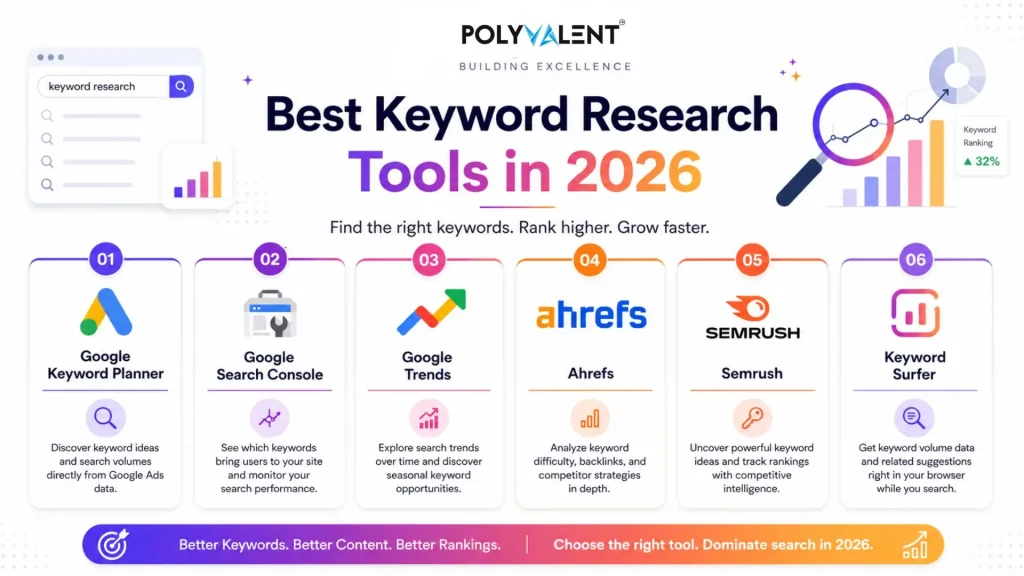
When choosing keyword research tools, it makes sense to start with the free options before investing in paid platforms. Many businesses can find valuable keyword opportunities using Google’s own tools, especially during the early stages of keyword research for content alignment.
To start keyword research, your first step is to use the google free tools like Google Keyword Planner, Google Trends, and Google Search Console. Together, these tools provide enough data to identify keyword ideas, understand search demand, and help you to find new opportunities already available within your website.
Google Keyword Planner : It helps generate keyword ideas and provides estimated search volume data. While the numbers are not always precise, it remains a useful tool for understanding how often people search for specific terms and for finding related keyword opportunities.
Google Trends: It is useful for analyzing search interest over time. It helps identify seasonal topics, rising trends, and keywords that may be losing popularity. This additional context can prevent targeting keywords that are declining in relevance. With this tool you can also find trending searches and topics in your industry.
When checking a keyword in Trends, switch to the 5-year view before deciding anything. A term that spikes every year around the same time is a genuine seasonal keyword worth planning content around in advance. A term that spiked once and never recovered is a trend that already passed, and building core content around it is a much weaker bet.
Google Search Console: It provides actual search queries that are generating impressions and clicks for your website. Reviewing these queries often reveals keywords that are already ranking on page two or three of search results, creating opportunities for quick SEO improvements.
Once enough data has been gathered from these free keyword research tools, paid keyword research platforms can be used for deeper analysis.
Note: For a new website, Google Search Console will not have sufficient data because the site is still building impressions and clicks. It usually takes some time before enough search data becomes available. In the beginning, you can use tools like Google Keyword Planner and Google Trends to find keyword opportunities while your Search Console data grows.
Ahrefs remains one of the most trusted tools for SEO professionals. Its Keyword Explorer provides search volume, keyword difficulty, traffic potential, and click metrics. The Traffic Potential metric is particularly useful because it looks beyond a single keyword and estimates the total organic traffic a page could attract from related search terms.
Semrush is also a strong option for keyword research. It helps to find the keywords competitors rank for, identify content gaps, and discover new opportunities within a niche. For businesses operating in competitive industries, this data can help shape a more effective content strategy.
Both semrush and Ahref are good for keyword research you can go with anyone as per your requirements and budget
For those looking for additional free keyword research tools, a few options are worth considering:
- Google Keyword Planner for keyword ideas and search demand
- Google Search Console for performance data and ranking opportunities
- Google Trends for seasonal and trending topics
- Keyword Surfer for quick keyword insights directly within Google search results
One important thing to remember is that no keyword research tool provides perfectly accurate search volume data. Keyword research tools use different data sources and estimation methods. Instead of treating search volume as an exact number.
The goal is not to find perfect data. The goal is to find keywords that align with search intent, match business objectives, and offer realistic ranking opportunities.
How to Analyze Keywords Before Targeting Them
Finding keywords is the easy part. Deciding which ones are worth targeting takes more judgment.
Search intent alignment. If your webpage content intent is not matched with the user’s intent it will not rank and you will waste your resources on creating the content to understand the intent. Look at the top-ranking pages for your keyword. Are they blog posts, product pages, comparison articles, or something else? If you’re planning a long-form guide and the SERPs are full of product listings, you’re fighting the wrong battle.
Keyword Research for New Websites: New websites should approach keyword research differently from established ones, because domain authority is the constraint that matters most in the first year.
Start almost entirely with long-tail, low-competition keywords. A high-volume head term might look attractive, but a brand-new site has no link history or topical authority to compete for it, and publishing content that never ranks wastes both time and budget.
Instead, look for keywords with lower search volume but clear, specific intent, the kind of phrases someone types when they already know what they want.
A realistic first 90 days often looks like this: 15 to 20 long-tail keywords, each with a clear, singular intent, each mapped to its own page, with no two pages competing for the same term.
As those pages start ranking and the site earns some authority, broader and more competitive keywords become realistic targets. Trying to skip this stage by going straight after head terms is the most common reason new sites see impressions climb in Search Console while clicks stay flat.
Keyword difficulty vs. domain authority. These metrics are not officially by google however they are present in the seo industry. High difficulty scores don’t automatically mean not to pick the keyword. They mean you need to be realistic about how long it’ll take to rank and whether your site has the authority to compete. A DR 30 site going after DR 80 territory is a slow burn at best. A new website can publish a blog on high DA or DR keywords , but it will be difficult for the website to rank at the top.
Traffic potential over search volume. A keyword with 500 monthly searches might drive far more traffic than one with 2,000 if it has a better CTR distribution. Look beyond the headline number. No tool provides the exact true search volume they estimate.
Business value. A keyword that brings 10,000 visitors who never convert is worth less than one that brings 500 who do. Always tie keyword targets back to business outcomes.
A Simple Keyword Prioritization Framework
Search volume alone is a poor way to decide what to target. A more reliable approach is to score each keyword candidate across the factors that actually predict results, then compare scores instead of comparing volume.
| Factor | What to Ask | Score (1–5) |
|---|---|---|
| Intent Match | Does this keyword’s intent match the content format you can realistically produce? | 3.5 |
| Difficulty | Is this achievable given your current domain authority and content depth? | 5 |
| Traffic Potential | Beyond the exact keyword, how much related search traffic could this page realistically capture? | 4 |
| Business Value | If this keyword ranks and converts, does it move a real business outcome? | 5 |
That is why keyword strategy should focus on all stages of the funnel. TOFU keywords can bring thousands of visits, but they rarely lead to direct conversions. However, that does not mean TOFU content should be avoided. It is not true. TOFU content still plays an important role in attracting and educating your audience.
The key is to create content for each stage of the funnel so users are guided from awareness to consideration and finally to conversion.
Best SEO Keyword Research Checklist
Free Keyword Research Tracking Template
Use this structure to track keyword opportunities as you find them. You can copy it directly into a spreadsheet.
Table 1: Keyword Discovery Tracker
| Keyword | Seed | Source | Country | Autocomplete Position | Difficulty | Hot Keyword (Y/N) | Relevancy Score |
|---|---|---|---|---|---|---|---|
| e.g. best crm for small business | crm | Ahrefs | India | 2 | 38 | Y | 8/10 |
- Seed: the broader term this keyword came from
- Source: where you found it (Ahrefs, Search Console, autocomplete, competitor gap, customer language)
- Autocomplete Position: where it appeared in Google’s suggested searches, if applicable
- Hot Keyword: mark yes if search volume is trending up or it’s tied to a current event or seasonal spike
- Relevancy Score: your own 1 to 10 rating of how closely this matches your business, not just the topic
Table 2: Keyword-to-Page Mapping
| Target URL | Primary Keyword | Secondary Keywords | Search Intent | Notes / Target Outcome |
|---|---|---|---|---|
| e.g. /blog/best-crm-software | best crm for small business | crm comparison, crm pricing | Commercial investigation | Drive demo sign-ups, update quarterly |
- Primary Keyword: the one keyword this page is built to rank for
- Secondary Keywords: supporting terms the same page should naturally cover
- Search Intent: informational, commercial investigation, or transactional
- Notes / Target Outcome: what success looks like for this page (leads, sign-ups, rank position, etc.)
Filling out Table 2 before you assign content to a writer is what prevents keyword cannibalization. If two rows have the same primary keyword, that’s your signal to merge the pages instead of publishing both.
Before finalizing any keyword to target, run it through this quick check:
- Does the search intent match what you’re planning to create?
- Is the keyword difficulty realistic for your current domain authority?
- Is the traffic potential worth the investment?
- Are there commercial or transactional modifiers you should account for?
- Does this keyword support a specific stage of the buyer journey?
- Is there an existing page on your site that already covers this (cannibalization risk)?
- Is search volume trending up, stable, or declining?
A keyword that passes most of these checks is worth pursuing. One that fails several of them deserves a harder look before you commit.
Common Keyword Research Mistakes to Avoid
Targeting only high-volume head terms. This is where most businesses start and get stuck. High-volume keywords look attractive in spreadsheets. They’re brutal in practice, especially for newer sites without strong link profiles.
Ignoring search intent entirely. Ranking for a keyword that doesn’t match your content type rarely ends well. Google is increasingly good at understanding what a searcher actually wants, and if your page doesn’t deliver that, the ranking won’t stick.
Building pages for every keyword variation. More pages don’t automatically mean more traffic. A single well-optimized page can rank for hundreds of related terms. Creating separate thin pages for every slight variation often causes cannibalization.
Chasing volume spikes without context. A sudden rise in search volume might look like an opportunity. Sometimes it is. But trends fade, and building core content around a moment rather than an enduring need is a risky bet.
Not revisiting keyword strategy. This one is more common than it sounds. A keyword strategy built 18 months ago doesn’t reflect where your competitors are now, what new terms have emerged, or which pages have already gained traction. Keyword research isn’t a one-time project.
FAQs
Q1: How often should I do keyword research?
Keyword Research depends on your requirements; there is no target rule to follow.
Q2: How many keywords should I target on one page?
In SEO, there is no specific number for a single page, but you can go with 1 primary keyword and 2 to 3 secondary keywords. Use keyword variations and avoid forcing keywords throughout the content.
Q3: Is keyword research still important with semantic search?
Yes. It helps you understand what people search for and the content they expect, even if exact-match keywords matter less.
Q4: Can AI fully replace manual keyword research?
No, AI can support keyword research, but human judgment is still needed to choose the right keywords based on business goals and audience.
Conclusion
The websites that consistently win on organic search aren’t necessarily the ones with the biggest budgets or the most content. They’re the ones that understand what their audience is searching for and build content that actually satisfies that need, better than what’s already out there.
That starts with keyword research, but it doesn’t end there. Use it as a foundation for your content decisions, not a checklist to complete and file away. The more often you revisit it, the sharper your strategy gets.
Leave a Reply